

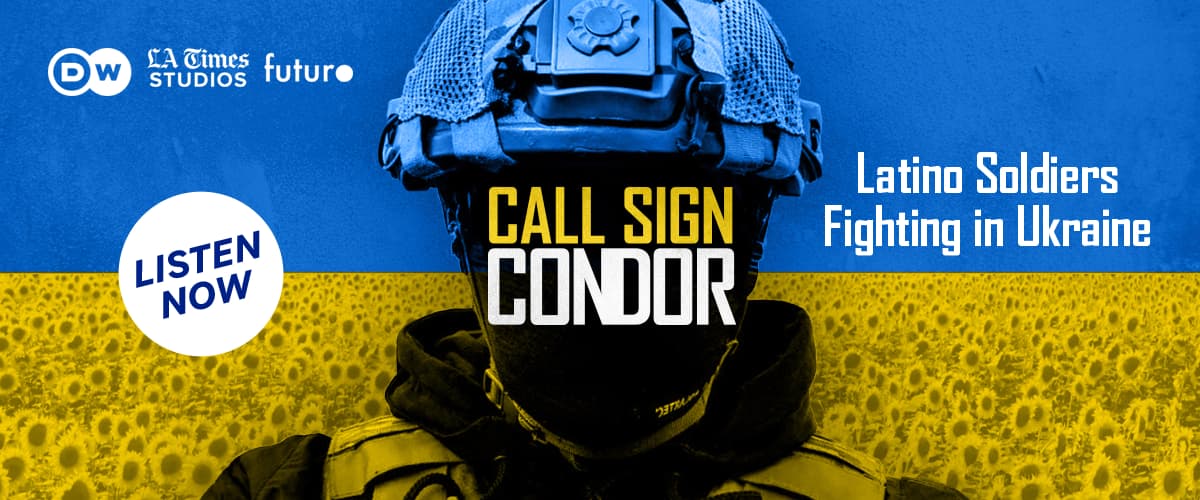
The compelling narrative of "Call Sign Condor" / "Alias Cóndor," a four-part podcast series, delves into the extraordinary lives of Latin Americans who have chosen to fight for Ukraine, a nation far from their homelands. Produced by DW, LA Times Studios, and Futuro Studios, the series offers an intimate look at the motivations, experiences, and profound human connections forged on the front lines of a conflict that has reshaped global geopolitics. Hosted by Carolina Chimoy, the podcast seeks to answer the fundamental question: why would individuals risk their lives for a country that is not their own, and what are they searching for in the crucible of war?

The podcast centers on the protagonist, known by the call sign Condor, and his fellow soldiers, providing listeners with direct access to the emotional and psychological landscape of these international combatants. For some, their involvement in the war has spanned years, a testament to their unwavering commitment. Chimoy’s investigative approach goes beyond the battlefield, exploring the complex tapestry of fear, loss, the search for belonging, and even the unexpected emergence of love amidst the chaos of war. The series aims to illuminate the personal journeys that led these men and women to the front lines, their lived experiences of the conflict, and the profound discoveries they have made.
The podcast is available in both English and Spanish, reflecting the diverse linguistic backgrounds of the individuals featured and broadening its accessibility to a global audience. This dual-language release underscores the series’ commitment to giving voice to a demographic whose participation in the Ukrainian conflict might otherwise remain largely untold. The decision by individuals from across Latin America to join the fight is a significant phenomenon, prompting a deeper examination of the factors driving such a commitment.
Background and Context: The International Legion and Motivations for Joining
The Ukrainian government established the International Legion for the Territorial Defense of Ukraine in early March 2022, shortly after Russia’s full-scale invasion. This initiative called upon foreign nationals willing to defend Ukraine’s sovereignty and territorial integrity. The response was significant, with thousands of individuals from over 50 countries expressing their willingness to enlist. Among these volunteers, a notable contingent hailed from Latin America, a region often perceived as geographically distant from the conflict.

The motivations behind these individuals’ decisions are multifaceted and deeply personal. For some, it is a matter of ideological solidarity with Ukraine, viewing the conflict as a struggle against authoritarianism and a defense of democratic values. Others are driven by a sense of duty to combat injustice, perceiving Russia’s actions as an unprovoked act of aggression that warrants international resistance. The appeal of a cause that transcends national borders, offering a chance to make a tangible difference in a significant global event, has also been cited as a powerful motivator.
Furthermore, for some Latin American volunteers, the war in Ukraine may represent an opportunity for personal growth, a chance to test their mettle, or to escape difficult circumstances in their home countries. The promise of camaraderie and a shared purpose can be a strong draw, particularly for those who feel marginalized or seeking a sense of belonging. The podcast "Call Sign Condor" / "Alias Cóndor" aims to unpack these complex drivers, moving beyond simplistic explanations to reveal the human stories behind the headlines.

The Human Element: Fear, Loss, and Unexpected Bonds
"Call Sign Condor" / "Alias Cóndor" does not shy away from the harsh realities of war. The podcast features vivid accounts of the fear and uncertainty that accompany daily life on the front lines. Listeners are exposed to the visceral experiences of combat, the constant threat of shelling and ground attacks, and the profound psychological toll these endure. The loss of comrades, the destruction of infrastructure, and the pervasive sense of danger are woven into the narrative fabric, providing a raw and unfiltered portrayal of the conflict’s human cost.

Beyond the immediate dangers, the podcast also explores the emotional landscape of displacement and the search for belonging. Many of these Latin American soldiers are far from their families, friends, and cultural roots. The podcast delves into their efforts to maintain connections with loved ones back home, the pangs of homesickness, and the challenges of adapting to a new and often hostile environment. In this context, the military unit itself can become a surrogate family, fostering deep bonds of loyalty and mutual support.
Remarkably, the podcast also touches upon the emergence of love and human connection amidst the devastation. In the face of extreme adversity, relationships can form in unexpected ways, offering moments of solace, hope, and a reminder of the shared humanity that persists even in wartime. These personal narratives add a crucial dimension to the understanding of the conflict, illustrating that even in the darkest of times, life, love, and connection continue to find a way.

Production and Reach: A Collaborative Effort in Storytelling
The collaboration between DW, LA Times Studios, and Futuro Studios for "Call Sign Condor" / "Alias Cóndor" highlights a significant trend in contemporary podcasting: the merging of journalistic expertise with compelling narrative storytelling. DW, a German public broadcaster, brings a global perspective and a commitment to in-depth reporting. The LA Times Studios, affiliated with the renowned Los Angeles Times, contributes a strong tradition of investigative journalism and human-interest storytelling. Futuro Studios, known for its focus on amplifying Latinx voices and narratives, ensures that the podcast resonates authentically with its target audience and offers a nuanced portrayal of the Latin American experience.

The availability of the podcast in both English and Spanish is a strategic decision that significantly expands its potential reach. By catering to two of the most widely spoken languages globally, the creators aim to foster a broader understanding and empathy for the experiences of these Latin American fighters. This approach acknowledges the diverse linguistic and cultural tapestry of both Latin America and the global community engaged with the conflict in Ukraine.
The release of "Call Sign Condor" / "Alias Cóndor" on platforms like Spotify and Apple Podcasts, as well as its potential distribution through new podcast apps, signifies its integration into the broader podcasting ecosystem. The inclusion of this series within the Podnews news feed, which reaches a significant segment of the podcasting industry and its enthusiasts, further amplifies its visibility.

Broader Implications and Future Narratives
The existence and narrative exploration of "Call Sign Condor" / "Alias Cóndor" have several broader implications. Firstly, it sheds light on the increasing globalization of conflicts and the willingness of individuals to transcend national boundaries in pursuit of perceived justice or duty. It challenges simplistic narratives of international relations by highlighting the personal agency and complex motivations of individuals caught in geopolitical events.

Secondly, the podcast contributes to a more nuanced understanding of the Ukrainian resistance. While the narrative often focuses on Ukrainian citizens, the inclusion of foreign fighters, particularly from regions like Latin America, adds another layer to the story of international solidarity and the diverse motivations for engaging in such a high-stakes conflict. It underscores that the fight for Ukraine has become a cause embraced by a global community, united by shared values or a common enemy.
The success and impact of "Call Sign Condor" / "Alias Cóndor" may also pave the way for future journalistic endeavors that explore similar themes. As conflicts continue to unfold and global interconnectedness deepens, the stories of individuals making extraordinary choices in extraordinary circumstances will likely continue to captivate audiences. This podcast serves as a powerful example of how audio storytelling can bring these complex human narratives to life, fostering greater awareness and understanding of the human cost and personal sacrifices involved in international conflicts. The series invites listeners to contemplate the universal human desires for purpose, belonging, and the fight for what one believes in, even across vast distances and through the darkest of adversies.
