

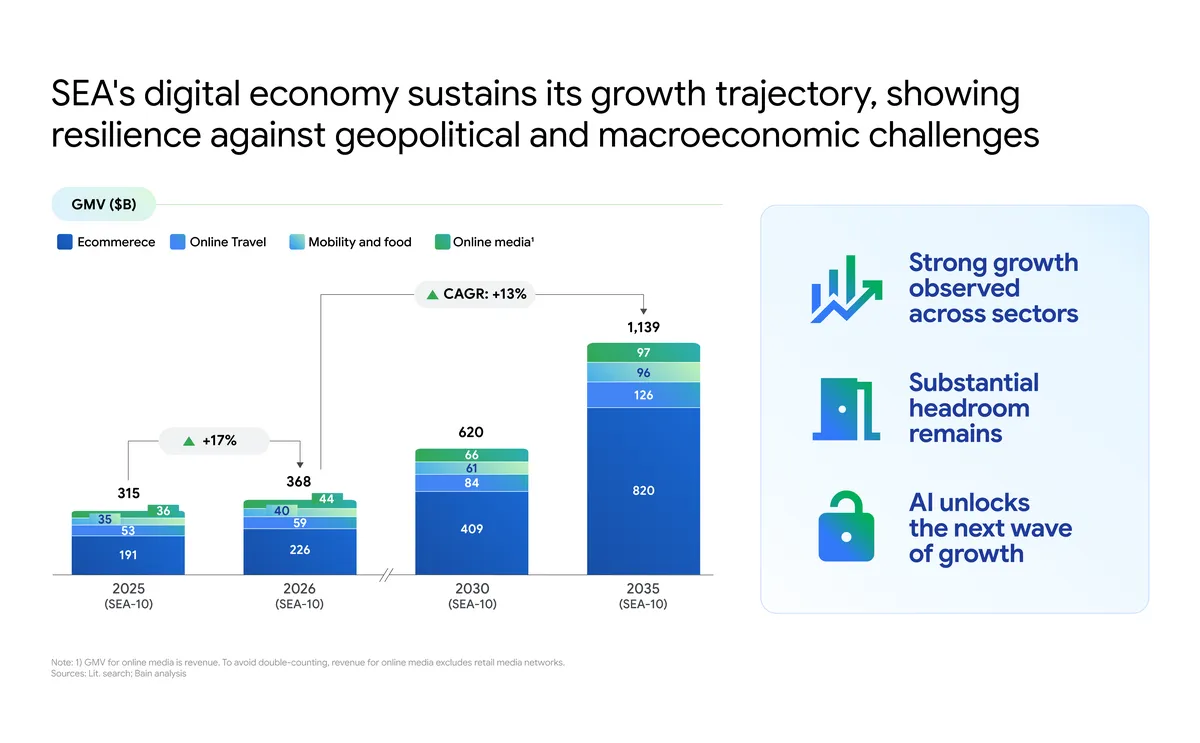
The digital economy of Southeast Asia is undergoing a profound transformation as generative artificial intelligence (AI) transitions from a speculative technology to a foundational component of daily life for hundreds of millions of people. According to the 11th edition of the e-Conomy SEA report, titled "Building the Intelligent Economy," the region’s digital Gross Merchandise Value (GMV) is projected to grow by 17% year-on-year to reach $368 billion by 2026. This trajectory, fueled by a surge in AI adoption and maturing digital ecosystems, places the region on a definitive path to exceed $1 trillion in value by 2035. The report, a collaborative research effort by Google, Temasek, and Bain & Company, highlights that generative AI is being integrated at a rate four times faster than the initial rollout of the mobile internet, with 243 million individuals—representing approximately 58% of the region’s working-age population—now actively utilizing the technology.
The Evolution of the Southeast Asian Digital Landscape
The e-Conomy SEA report has served as the primary benchmark for the region’s internet economy since its inception in 2016. In its early years, the focus was largely on the "SEA-6" nations—Indonesia, Malaysia, the Philippines, Singapore, Thailand, and Vietnam—and the rapid expansion of ride-hailing and e-commerce. However, the 2026 findings indicate a significant pivot. While previous growth was driven by increasing internet penetration and consumer subsidies, the current era is defined by "agentic commerce" and the pursuit of sustainable profitability.
The timeline of this digital evolution reveals a region that has successfully navigated the post-pandemic "funding winter." Following a period of hyper-growth in 2021 and 2022, the digital economy saw a stabilization phase in 2024 as companies shifted their focus from "growth at all costs" to unit economics. The 2026 projections suggest that this lean, more efficient infrastructure is now being supercharged by AI, which is optimizing everything from supply chain logistics in e-commerce to personalized wealth management in the financial sector.
Sectoral Analysis: AI as a Catalyst for Growth
The impact of AI is not uniform across all sectors, yet it has become a "sustaining force" that enhances value in every major vertical of the digital economy.
E-commerce and the Rise of Multimodal Discovery
E-commerce remains the largest contributor to the regional digital economy, expected to reach a GMV of $226 billion by 2026, representing an 18% annual growth rate. The sector is moving beyond simple transactional listings toward "discovery-based" shopping. AI-powered in-app assistants and multimodal search (using images and voice) are allowing consumers to navigate complex product categories with greater confidence. Data from the report suggests that these personalized experiences are driving a 10% increase in conversion rates and, in some instances, providing an uplift in order volume of up to 75%.
Online Travel and Complex Itinerary Planning
The online travel sector is projected to hit $59 billion in GMV by 2026, a 10% increase year-on-year. While traditional search engines remain the primary starting point for travel planning, generative AI has now surpassed social media as the second-most utilized tool for organizing complex, multi-city itineraries. AI’s ability to synthesize vast amounts of data regarding flight schedules, hotel reviews, and local attractions has made it an indispensable tool for the modern traveler.
Online Media and Commerce Integration
With a projected revenue of $44 billion and a 22% growth rate, online media is leveraging AI to hyper-personalize content feeds. This has created a fertile ground for "commerce media"—a $4 billion market where advertisements are integrated directly into the shopping or entertainment experience. AI-driven algorithms have resulted in a 10% to 20% improvement in quality engagement, ensuring that ads are more relevant to the specific needs and interests of the audience.

Digital Financial Services (DFS)
Digital Financial Services continue to show the most significant growth in terms of Gross Transaction Value (GTV), projected to reach $1,650 billion by 2026. This 16% growth is underpinned by AI’s role in real-time fraud detection and credit scoring. In a region where a large portion of the population remains "underbanked," AI-driven credit assessments allow platforms to offer loans and insurance to individuals without traditional credit histories. Furthermore, Singapore continues to lead the region in digital wealth platforms, utilizing AI to provide personalized financial recommendations that were previously only available to high-net-worth individuals.
The Psychology of Trust and Agentic Commerce
A pivotal finding of the 2026 report is the high level of consumer trust in AI within Southeast Asia compared to global averages. Approximately 62% of users report having more confidence in AI tools today than they did a year ago. This trust is built on three pillars: a proven track record of task accuracy (56%), rising familiarity through daily use (55%), and the perceived quality of AI outputs (53%).
This reservoir of trust is clearing the path for "agentic commerce," a state where AI agents do more than just recommend products—they execute transactions autonomously. The report indicates that 75% of Southeast Asian consumers are willing to let AI agents compare prices and complete purchases on their behalf. However, this transition is contingent on platforms providing robust privacy safeguards and the ability to reverse automated transactions. Consumers have expressed that transparency regarding what AI can and cannot do is essential for long-term adoption.
Critical Infrastructure and Regulatory Adaptation
For the region to realize the projected 60-fold increase in AI usage by 2030, four critical areas must adapt to support the burgeoning "intelligent economy."
- Data Center Capacity and Energy: The demand for AI processing requires a massive expansion of data center infrastructure. Countries like Malaysia and Thailand have already seen significant investment from global tech giants like Google and Microsoft. However, the energy-intensive nature of these facilities necessitates a shift toward sustainable power sources to prevent environmental strain.
- Digital Talent and Workforce Reskilling: As AI automates routine tasks, the demand for high-level technical skills is skyrocketing. The report emphasizes the need for public-private partnerships to reskill the workforce, ensuring that the 58% of the population currently using AI can transition into roles that manage and oversee these intelligent systems.
- Regulatory Frameworks: ASEAN has taken proactive steps with the "ASEAN Guide on AI Ethics and Governance," but national-level regulations must remain agile. Policymakers are tasked with balancing the need for innovation with the necessity of protecting consumer data and preventing algorithmic bias.
- Investment and Funding: While the era of "easy capital" has ended, investors are showing renewed interest in AI-centric startups. The report notes that venture capital is increasingly being directed toward companies that can demonstrate a clear path to profitability through AI-driven efficiency.
Statements and Economic Implications
Nitin Gajria, Managing Director for Google Southeast Asia and South Asia Frontier Markets, noted that the region is at a "tipping point" where AI is no longer a luxury but a necessity for economic competitiveness. "Generative AI is scaling at a pace we haven’t seen before in this region," Gajria stated during the report’s release. "The rapid adoption by over 240 million people is not just a statistic; it represents a fundamental shift in how the digital economy functions."
Economic analysts suggest that the implications for the region’s Gross Domestic Product (GDP) are significant. By optimizing sectors like logistics and finance, AI could add trillions of dollars in value over the next decade. However, the "digital divide" remains a concern. While urban centers in Singapore and Vietnam are rapidly digitizing, rural areas may lag if infrastructure investment is not distributed equitably.
Looking Toward 2035: The Path to $1 Trillion
The journey toward a $1 trillion digital economy by 2035 is not without its hurdles. The region must navigate geopolitical tensions that could affect hardware supply chains, particularly semiconductors required for AI processing. Furthermore, as AI agents become more autonomous, the legal frameworks surrounding "algorithmic accountability" will need to be established.
Despite these challenges, the e-Conomy SEA 2026 report paints a picture of a region that is uniquely positioned to lead the global AI revolution. With a young, tech-savvy population and a business environment that is increasingly focused on sustainable growth, Southeast Asia’s digital economy is set to become one of the most dynamic and influential markets in the world. The transition from a "mobile-first" to an "AI-first" economy is well underway, promising a future of unprecedented efficiency, personalization, and economic opportunity.
