


The roar of the crowd, the hushed anticipation, and the agonizingly slow roll of the ball – golf’s major championships are more than just athletic contests; they are intricate psychological battles. This past Sunday, the final round of the BMW Championship provided a compelling arena for such a battle, culminating in a dramatic victory for Wyndham Clark. While casual observers might have marveled at the swings and misses, a deeper examination of the sport, informed by groundbreaking behavioral economics research, reveals a subtle yet powerful force at play: loss aversion. This phenomenon, where the pain of losing outweighs the pleasure of an equivalent gain, profoundly influences even the most elite athletes on the planet, impacting their performance on the green.
Clark’s Triumph and a Familiar Psychological Echo
Wyndham Clark’s victory at the BMW Championship was a masterclass in resilience. Beginning the final round with a commanding five-shot lead, the pressure mounted as his competitors began to chip away at his advantage. By the turn, that comfortable cushion had evaporated, and the leaderboard tightened considerably. However, a combination of strategic play, crucial putts, and perhaps a touch of fortune saw Clark navigate the back nine with renewed focus. A spectacular three-birdie finish ultimately sealed his hard-earned three-shot victory, a testament to his mental fortitude under immense pressure.
Clark’s dramatic win served as a vivid reminder of a fascinating area of research that delves into the psychological underpinnings of athletic performance, particularly in golf. For years, behavioral scientists have been dissecting the seemingly simple act of putting, revealing that its difficulty is not solely a matter of physical execution but also of cognitive framing.
The Six-Foot Putt: More Than Meets the Eye
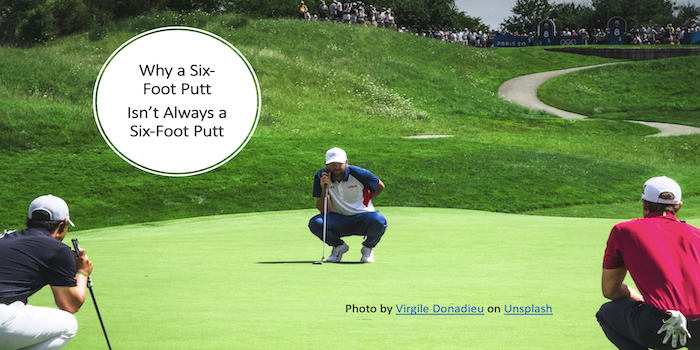
The question of whether a six-foot putt is merely a six-foot putt has been at the heart of extensive academic inquiry. While physically, the distance and the ball’s trajectory remain constant, the psychological weight associated with that putt can vary dramatically. This disparity was meticulously investigated in a seminal 2011 study by researchers Devin Pope and Maurice Schweitzer, published in the prestigious American Economic Review. Their paper, titled "Is Tiger Woods Loss Averse? Persistent Bias in the Face of Experience, Competition, and High Stakes," sought to quantify the impact of psychological biases on professional golfers.
Data-Driven Insights: Millions of Putts Analyzed
To address this question, Pope and Schweitzer leveraged the precise data captured by ShotLink, the PGA Tour’s real-time scoring and ball-tracking system. Over a five-year period, from 2004 to 2009, they meticulously analyzed more than 2.5 million putts taken by 421 professional golfers. This vast dataset allowed for a robust statistical analysis, free from anecdotal observation.
The findings were striking and counterintuitive to a purely rational economic model. The researchers discovered that professional golfers were, on average, approximately 2 to 4 percentage points more likely to make a par putt than a comparable birdie putt. This means that when faced with a putt of the same distance, under similar course conditions, and by the same golfer, the probability of success shifted depending on whether the putt was to save par or to achieve a birdie.
The Driving Force: Loss Aversion Explained
The discrepancy can be attributed to a well-documented psychological principle known as loss aversion. Pioneered by behavioral economists Daniel Kahneman and Amos Tversky, loss aversion posits that individuals experience the pain of a loss more intensely than the pleasure of an equivalent gain. In essence, losing $100 feels worse than finding $100 feels good. This principle is closely linked to Robert Cialdini’s principle of scarcity, where the perceived limited availability of something increases its desirability and the perceived cost of its absence.
In the context of golf, this psychological bias manifests in the framing of the putt. When a golfer stands over a birdie putt, they are presented with an opportunity for gain – an extra stroke relative to par. While missing the putt means not achieving the birdie, the immediate consequence is that par is still attainable with the subsequent putt.
Conversely, when facing a par putt, the psychological framing shifts dramatically. The golfer is now in a position where missing the putt results in a loss – a stroke added to their score relative to par. The prospect of dropping a stroke, of suffering a quantifiable setback, carries a greater psychological burden than the potential reward of gaining a stroke.
The Nuances of Tournament Progression
While the difference between par and birdie putting accuracy was significant, Pope and Schweitzer’s research also revealed an interesting temporal trend within tournaments. They observed that this disparity decreased as the tournament progressed. In the first round, the difference in making a par putt versus a birdie putt was around 3.8 percentage points. By the final round, this gap narrowed to 2.1 percentage points. However, crucially, the phenomenon never entirely disappeared.
The researchers attributed this reduction in the loss aversion effect in later rounds to a shift in players’ primary focus. In the early stages of a tournament, golfers are more concerned with their score relative to par for the course itself. As the tournament advances, and particularly in the final round, their focus increasingly shifts to their position relative to other competitors on the leaderboard. The pressure to outperform rivals and secure a higher finishing position can, to some extent, mitigate the individual sting of a single missed putt, as the ultimate goal becomes comparative success.
Humanity Under Pressure: Implications for Professionals and Amateurs
The findings of Pope and Schweitzer are particularly profound when considering the caliber of the athletes involved. These are professionals who have dedicated countless hours to honing their craft, practice relentlessly, compete under immense pressure, and have significant financial stakes – potentially millions of dollars – riding on their performance. Yet, even these paragmost skilled individuals are susceptible to fundamental human psychological biases.
This research extends far beyond the golf course, offering a critical lesson for everyone navigating important decisions. The concept of scarcity, often associated with overt sales tactics like "limited time offers" or "only a few left," is not always so explicit. Sometimes, scarcity is more subtly presented as the potential to lose something one already possesses. This could be a current advantage, a desired outcome, or a position of strength. In such scenarios, the fear of losing that something can exert a more powerful influence on decision-making than the prospect of achieving an equivalent gain.
Ethical Influence and Self-Awareness
The implications of understanding loss aversion are significant for ethical influence and persuasion. The goal is not to manipulate individuals by exploiting their fear of loss. Instead, it is to foster awareness of how people naturally make decisions and to communicate relevant information truthfully and transparently. By understanding that the possibility of loss can be a potent motivator, communicators can frame information in a way that resonates more deeply without resorting to deceptive tactics.
For individuals facing significant choices, this research offers a valuable prompt for self-reflection. The next time you are making an important decision, it is worth asking: Am I genuinely pursuing something I desire, or am I being driven more strongly by the fear of losing something I already have? Recognizing this distinction can lead to more considered and ultimately more beneficial choices. The impact of this psychological framing, whether on the fairway or in everyday life, may be far more significant than initially perceived.
A Golfer’s Perspective: A Call for Anecdotal Evidence
The persistent influence of loss aversion on professional golfers raises a question for those who play the game: do you personally feel a difference when standing over a six-foot putt for birdie versus a six-foot putt for par? This is an invitation for golfers at all levels to consider their own experiences and to perhaps observe this phenomenon in their own play or that of their playing partners. The interplay between physical skill and psychological framing is a constant source of fascination in golf, and the insights from behavioral economics provide a powerful lens through which to view these intricate dynamics.
The BMW Championship, like many high-stakes professional golf tournaments, serves as a living laboratory for understanding the complex interplay of skill, strategy, and human psychology. Wyndham Clark’s victory, while a triumph of athletic prowess, also underscores the enduring power of behavioral principles in shaping outcomes, reminding us that even the most experienced professionals are subject to the subtle, yet profound, influence of how we perceive gain and loss.
