

The German verb haben, translating to to have in English, serves as a cornerstone of the German language, functioning both as a primary indicator of possession and as a critical auxiliary verb for the construction of past tenses. As one of the most frequently utilized words in the German lexicon, haben is indispensable for achieving even basic proficiency. Linguistic experts and educators categorize it as a high-frequency verb that dictates the structural integrity of the Perfekt tense, which is the standard form for spoken communication regarding past events. Beyond its grammatical utility, haben facilitates a wide array of idiomatic expressions where German logic diverges significantly from English, particularly in the expression of physical states and emotional conditions. Understanding the intricacies of its conjugation and its specific role in the German tense system is therefore a mandatory milestone for any student of the Germanic languages.
The Structural Foundation and Present Tense Dynamics
At its core, haben is classified as an irregular or mixed verb, primarily due to the phonetic shifts that occur in its present tense forms. While regular German verbs maintain a consistent stem, haben undergoes a contraction in the second and third-person singular forms. In the present tense, known as Präsens, the verb follows a pattern that initially appears regular but requires specific attention to the elision of the consonant -b-.
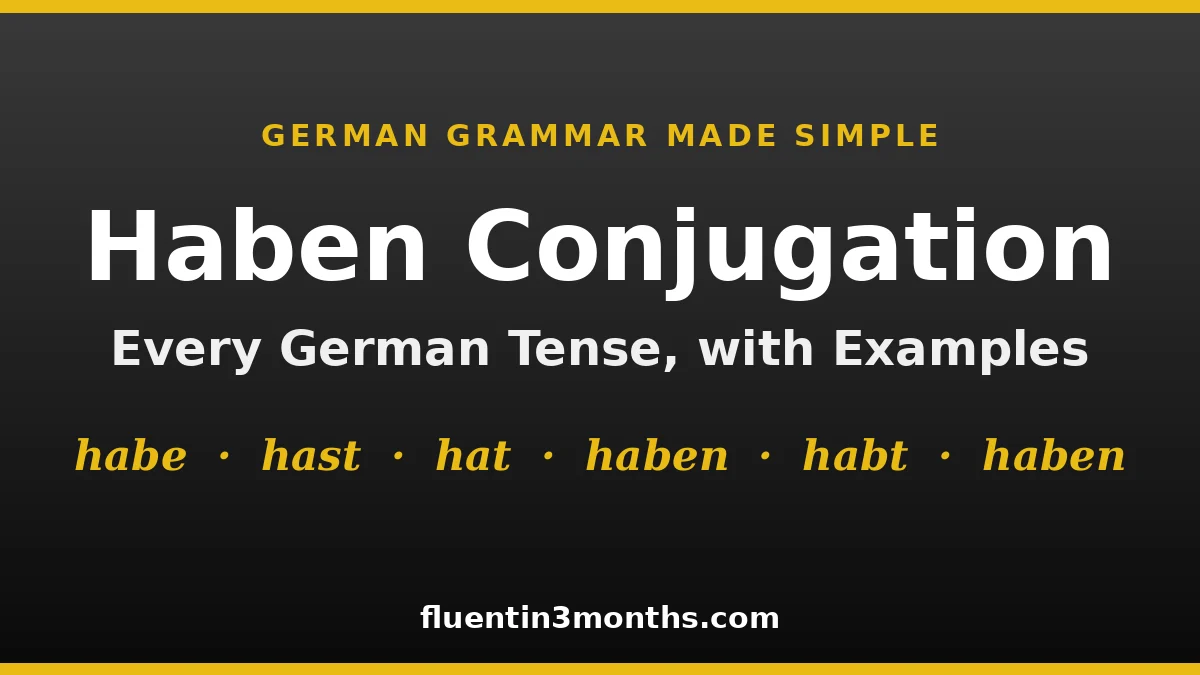
The conjugation for the present tense is as follows: ich habe (I have), du hast (you have), er/sie/es hat (he/she/it has), wir haben (we have), ihr habt (you all have), and sie/Sie haben (they/you formal have). The transition from the infinitive haben to the forms hast and hat represents a historical smoothing of the language, where high-frequency usage led to a simplified pronunciation over several centuries. This linguistic phenomenon is mirrored in the English language, where have becomes has rather than haves in the third-person singular. For learners, mastering this specific irregularity is essential, as the erroneous use of habst or habt for the singular forms is a common marker of non-native speech patterns.
Historical Context and Linguistic Evolution
The irregularity of haben is not an isolated grammatical quirk but a result of long-term linguistic evolution within the West Germanic language family. Philologists note that the verb shares a common ancestry with the English have and the Dutch hebben. The shift from the Proto-Germanic *habjanan to the modern German haben involved significant phonetic changes, including the High German consonant shift.
In the Präteritum (simple past) and Partizip II (past participle), haben displays characteristics of what grammarians call mixed verbs. These verbs utilize the endings associated with weak verbs (the -te and -t suffixes) while simultaneously undergoing a stem vowel or consonant change typical of strong verbs. For instance, the stem shifts from hab- to hatt- in the past tense (hatte). This hybrid nature places haben in a small but influential family of verbs, including bringen (brachte) and wissen (wusste), which are essential for fluid communication.
The Role of Haben as an Auxiliary Verb in the Perfekt Tense
Perhaps the most significant function of haben lies in its role as an auxiliary verb. In German, the Perfekt tense—the most common way to describe past actions in conversation—is formed by combining a conjugated auxiliary verb with the past participle of the main verb. Statistical analysis of the German language indicates that approximately 80% of all verbs utilize haben as their auxiliary.
The choice between haben and its counterpart sein (to be) is governed by specific grammatical rules. Haben is the default auxiliary for all transitive verbs (verbs that take a direct object) and most intransitive verbs that do not imply a change of position or state. For example, ich habe gegessen (I have eaten) and ich habe gelesen (I have read) utilize haben. In contrast, verbs of motion such as gehen (to go) or fahren (to drive) require sein. Because the majority of German verbs fall under the haben category, proficiency in its various forms grants the speaker the ability to discuss nearly any past action or experience.
Comprehensive Conjugation Tables and Tense Variations
To achieve full competency, one must navigate the various tenses in which haben operates. While the present tense is used for current possession and states, the past and hypothetical forms are equally vital for nuanced communication.
Simple Tenses: Präsens and Präteritum
The Präteritum is primarily used in written narratives, journalism, and formal literature, though haben and sein are notable exceptions that are frequently used in the Präteritum even in spoken contexts.
| Pronoun | Präsens (Present) | Präteritum (Simple Past) |
|---|---|---|
| ich | habe | hatte |
| du | hast | hattest |
| er/sie/es | hat | hatte |
| wir | haben | hatten |
| ihr | habt | hattet |
| sie/Sie | haben | hatten |
Compound Tenses: Perfekt and Futur
Compound tenses require the auxiliary verb to be conjugated while the main verb remains in its participle or infinitive form at the end of the sentence.
| Pronoun | Perfekt (Present Perfect) | Futur I (Future) |
|---|---|---|
| ich | habe gehabt | werde haben |
| du | hast gehabt | wirst haben |
| er/sie/es | hat gehabt | wird haben |
| wir | haben gehabt | werden haben |
| ihr | habt gehabt | werdet haben |
| sie/Sie | haben gehabt | werden haben |
In the Perfekt, haben acts as its own auxiliary, resulting in the construction habe gehabt (have had). While grammatically correct, native speakers often prefer the simpler hatte in casual conversation to avoid the repetitive phonetics of the compound form.
The Konjunktiv II: Politeness and Hypotheticals
The subjunctive mood, specifically Konjunktiv II, is a critical component of German social etiquette. The form hätte (would have) is derived from the Präteritum stem with the addition of an umlaut. This form is used to express wishes, hypothetical situations, and polite requests.
One of the most culturally significant phrases in the German language is "Ich hätte gern…" (I would like…). Using this construction in restaurants, shops, or professional settings is considered the standard for polite interaction. Unlike the direct "Ich will" (I want), which can be perceived as demanding or rude, "Ich hätte gern" demonstrates a sophisticated grasp of German social dynamics.
Idiomatic Usage and Cross-Linguistic Divergence
A common challenge for English speakers learning German is the categorical difference in how certain physical and emotional states are expressed. In English, one "is" hungry or "is" afraid, using the verb "to be." In German, these states are viewed as something one "possesses," requiring the use of haben.
Key idiomatic expressions include:
- Hunger haben: To be hungry (literally: to have hunger).
- Durst haben: To be thirsty (literally: to have thirst).
- Angst haben: To be afraid (literally: to have fear).
- Recht haben: To be right (literally: to have right).
- Glück haben: To be lucky (literally: to have luck).
- Zeit haben: To have time.
Conversely, German uses sein for age (Ich bin zwanzig Jahre alt), which contrasts with Romance languages like French (J’ai vingt ans) or Spanish (Tengo veinte años) that use their equivalents of haben. This distinction is a frequent source of error for multilingual learners and highlights the unique logical framework of the German language.
Comparative Data and Educational Implications
Educational data from the Common European Framework of Reference for Languages (CEFR) suggests that the mastery of haben is a primary indicator of progress from the A1 (Beginner) to A2 (Elementary) levels. At the A1 level, learners are expected to use haben for simple possession and basic idioms. By the A2 and B1 levels, the expectation shifts toward the correct application of haben as an auxiliary in the Perfekt and the use of the Konjunktiv II for social navigation.
Linguistic studies on verb frequency consistently rank haben within the top three most used verbs in the German language, alongside sein and werden (to become). Its ubiquity means that errors in its conjugation are highly visible and can significantly impede a speaker’s perceived fluency. Consequently, modern pedagogical approaches emphasize "drilling" the present tense irregularities and the Präteritum forms early in the curriculum.
Analytical Perspective: The Impact of Haben on Fluency
The strategic importance of haben cannot be overstated. Because it serves as the engine for the majority of past-tense constructions, a speaker who has mastered haben effectively unlocks the ability to describe the vast majority of human activity in the past. This creates a "multiplier effect" in language acquisition; rather than learning the past tense for every individual verb, the learner only needs to memorize the past participle and apply the already-mastered conjugation of haben.
Furthermore, the transition from literal possession to auxiliary function represents a cognitive shift for the learner. It marks the transition from seeing language as a collection of nouns and simple actions to seeing it as a structured system of time and modality. The dual nature of haben as both a content verb (possession) and a function verb (grammar) makes it a microcosm of the German language’s overall complexity and precision.
Conclusion and Future Outlook
As the German language continues to evolve, particularly in the context of digital communication and the influence of English (Denglisch), the core structural elements of haben remain remarkably stable. While some irregular verbs in various languages show a tendency toward regularization over centuries, the high frequency of haben protects its irregular forms from being phased out. For the foreseeable future, the "dropped -b-" in hast and hat and the umlaut of hätte will remain essential markers of correct German speech.
For the student of German, the path to fluency is paved with the conjugation tables of this singular verb. By understanding its historical roots, its role in the Perfekt tense, and its idiomatic versatility, learners can communicate with greater accuracy and cultural sensitivity. Whether ordering a coffee with a polite "hätte gern" or recounting a weekend’s events using the Perfekt, the verb haben remains the most powerful tool in the German speaker’s arsenal.
