

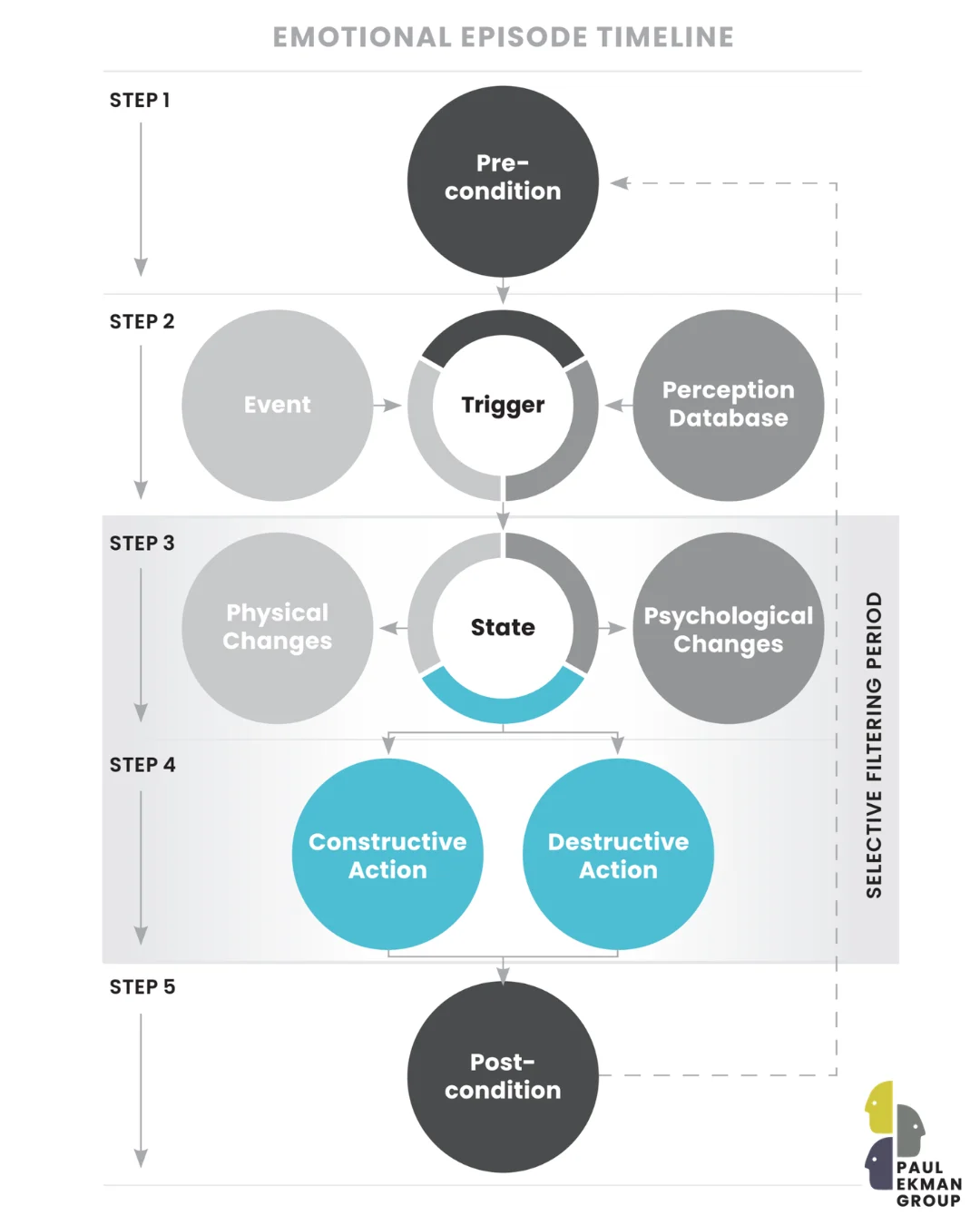
Our emotional lives, often perceived as a whirlwind of spontaneous reactions, can be understood through a structured, five-stage process known as the Emotional Episode Timeline. This framework, developed by emotion scientists, offers a detailed look at how feelings arise, manifest, and influence our behavior, moving beyond the simplistic notion of a sudden trigger leading to an immediate response. Understanding this timeline is crucial for recognizing emotions earlier, responding more effectively, and ultimately, cultivating more adaptive emotional patterns.
The core of emotional experience can be distilled into a three-step sequence: Trigger, Experience, and Response. However, the Emotional Episode Timeline expands this into a more nuanced, five-step progression, providing deeper insights into the underlying mechanisms. This detailed breakdown illuminates the subtle yet significant factors that shape our emotional landscape daily, from minor frustrations to profound emotional shifts.
The Five Stages of an Emotional Episode
The Emotional Episode Timeline outlines a sequence of events that unfold chronologically, each stage influencing the next.
Step 1: Pre-condition – The Emotional Starting Point
Before any external event occurs, we arrive at each moment with a pre-condition. This refers to our internal state – a complex interplay of our physical and psychological status. Factors such as fatigue from insufficient sleep, hunger, stress from work or personal life, or conversely, a state of contentment and rest, all contribute to our pre-condition. This initial state acts as a sort of "emotional baseline," significantly influencing our susceptibility to experiencing certain emotions. For instance, an individual who is already experiencing high levels of stress may find themselves more easily triggered by minor inconveniences compared to someone who is feeling relaxed and well-rested. Research in psychoneuroimmunology highlights the significant impact of chronic stress on the body’s physiological systems, which can directly affect our emotional reactivity. Studies have shown that elevated cortisol levels, a marker of stress, can impair prefrontal cortex function, which is involved in emotional regulation. Conversely, adequate sleep and nutrition are known to enhance mood and cognitive function, thereby improving our capacity to manage emotional challenges.
Step 2: Trigger – The Spark and its Interpretation
The trigger is the catalyst that initiates an emotional episode. It is not merely an external event but a dynamic interaction between the event itself, our interpretation of it, and our internal "perception database," all filtered through our current pre-condition.
The Event: External Stimuli and Internal Narratives
An event can be anything that impinges upon our senses or our internal world. This includes external stimuli like encountering a person, a place, or a specific situation. It can also originate internally, such as a thought, a memory, or even a fleeting fantasy. Our sensory portals – sight, sound, smell, taste, and touch – are constantly feeding information to our brain, which is perpetually engaged in a process known as automatic appraisal. This unconscious evaluation mechanism quickly assesses incoming information for potential threats or opportunities, preparing us for action. For example, a sudden swerve to avoid an animal in the road is a rapid, automatic response to a perceived threat. Similarly, not receiving a timely text response from a new acquaintance can be automatically appraised as rejection. This automatic appraisal system is a survival mechanism, honed by evolution, to ensure rapid responses to potentially dangerous situations. Neuroscientific studies using fMRI have demonstrated that the amygdala, a key brain region for processing emotions, becomes active within milliseconds of perceiving a threat, often before the conscious awareness of the event.
The Perception Database: Our Internal Emotional Library
Every individual possesses a unique perception database. This internal library is a repository of past emotional experiences, learned responses, and deeply ingrained beliefs that shape how we interpret the world. It functions as an "emotional alert system," helping our minds rapidly determine the significance of an event. This database is constructed from two primary sources:
- Universal Emotional Signals: These are the innate, evolutionary-driven expressions and physiological responses associated with core emotions that are recognized across cultures, such as facial expressions for happiness, sadness, anger, fear, surprise, and disgust. Research by Paul Ekman has identified these universal signals, suggesting a biological foundation for basic emotional experiences.
- Personal Learning and Experience: This encompasses everything we have learned throughout our lives, including cultural norms, family upbringing, past traumas, successes, and social interactions. For instance, a childhood experience of being bitten by a dog might lead to a heightened fear response to all dogs, regardless of their individual temperament. Conversely, positive social reinforcement for assertiveness might lead to a more confident response to challenging interpersonal situations. The concept of "implicit memory" plays a significant role here, where past experiences, even those not consciously recalled, can unconsciously influence our present emotional reactions.
Step 3: State – The Embodiment of Emotion
The state is the emotional experience itself, representing the "Experience" phase in the simplified model. This is a comprehensive mind-body phenomenon, characterized by both physical and psychological changes.
Physical Changes: The Body’s Emotional Orchestra
When we experience an emotion, our bodies undergo a cascade of physiological changes designed to prepare us for action. These can range from subtle sensations to pronounced physical manifestations. Examples include an accelerated heart rate, a flushing of the face, tension in the jaw, the "butterflies" sensation in the stomach, the onset of tears, muscle tightening, or alterations in breathing patterns. Research has consistently shown that each universal emotion is associated with a distinct pattern of physiological changes. For instance, fear is often linked to increased heart rate, rapid breathing, and muscle tension, preparing the body for fight or flight. Anger, on the other hand, may involve increased blood pressure and a surge of adrenaline, facilitating aggressive action. These physiological responses are not random; they are evolutionarily adapted to serve specific functions related to survival and social interaction. The autonomic nervous system, particularly the sympathetic and parasympathetic branches, plays a central role in orchestrating these bodily changes.
Psychological Changes: The Subjective Felt Sense
This refers to the internal, subjective experience of an emotion – its unique "felt sense." Each emotion possesses a distinct "flavor" that colors our psychological landscape. Sadness, for example, might feel heavy and slow, while anger can manifest as hot and sharp. These subjective feelings are crucial components of our emotional lives, shaping our perceptions, thoughts, and motivations. The cognitive appraisal theory of emotion, pioneered by theorists like Lazarus and Arnold, emphasizes the role of our interpretations and evaluations in shaping these subjective experiences. The meaning we assign to physiological changes and external events profoundly influences the quality of the emotion we experience.
Step 4: Action – The Manifestation of Emotion
Emotions are inherently action-oriented. The action stage involves how we choose to express or manage our emotional state. These actions can be external, such as speaking in anger, embracing someone in joy, or withdrawing in sadness. They can also be internal, such as suppressing an emotion, consciously softening one’s stance, or engaging in self-soothing behaviors.
Rather than categorizing emotions as inherently "positive" or "negative," a more useful approach is to assess the constructiveness or destructiveness of the resulting actions. Constructive actions tend to be beneficial for ourselves and others, promoting well-being and healthy relationships. Destructive actions, conversely, can lead to harm, regret, and strained relationships. For example, while anger is often perceived as a negative emotion due to its potential for destructive outbursts, "constructive anger" can be a powerful motivator for addressing injustice or asserting boundaries effectively. The ability to choose constructive actions, even when experiencing intense emotions, is a hallmark of emotional intelligence. Research on emotional regulation strategies, such as cognitive reappraisal and expressive suppression, indicates that while suppression can offer short-term relief, it is often associated with negative long-term consequences for mental and physical health. Constructive responses, on the other hand, are linked to greater well-being and more effective problem-solving.
Step 5: Post Condition – The Lingering Impact and Learning Opportunity
Every emotional episode leaves a post-condition, an imprint on our internal state and often on our environment. If an outburst of anger led to a reciprocal outburst from another person, that interaction becomes part of the post-condition. If anger was suppressed, residual irritation might linger, potentially fueling future emotional episodes.
These post-conditions can initiate a new cycle of emotions, creating a continuous loop. For example, the lingering irritation from a suppressed emotion might lead to increased irritability, making one more prone to anger in subsequent situations. However, these post-conditions also present a crucial opportunity for reflection and learning. By pausing to consider what happened, why it happened, and how we responded, we can gain valuable insights into our emotional patterns. This self-awareness is the foundation for making conscious choices to modify patterns that no longer serve us. The concept of neuroplasticity, the brain’s ability to reorganize itself by forming new neural connections, suggests that consistent reflection and conscious effort can indeed lead to lasting changes in emotional reactivity and behavior.
The Selective Filtering Period: An Overlay on Emotion
It is important to note that a selective filtering period is not a distinct step but rather an overlay that occurs during Steps 3 (State) and 4 (Action). When an emotion is active, our perception tends to narrow, and we selectively filter information to align with the prevailing emotional state. In a state of fear, for instance, our attention becomes hyper-focused on potential threats, both real and imagined, while positive or neutral information may be overlooked. Similarly, during anger, we might disproportionately notice frustrating aspects of a situation and tune out positive elements. This filtering mechanism, while adaptive for survival in immediate danger, can distort our perception of reality if we are not aware of its influence. Understanding this selective filtering is crucial for maintaining objectivity and making balanced decisions, especially during emotionally charged situations. Research on attentional biases in emotional states provides empirical support for this phenomenon, demonstrating how fear can enhance the detection of threat-related stimuli, while sadness can lead to a focus on negative information.
Implications and Future Exploration
The Emotional Episode Timeline provides a powerful framework for understanding the complexity of our emotional lives. By dissecting emotions into these five stages, individuals can gain greater insight into their own reactions, identify triggers, and develop more skillful responses. This understanding is not merely academic; it has profound practical implications for mental health, interpersonal relationships, and overall well-being.
The implications extend to various fields, including psychology, neuroscience, and education. For educators, understanding the Emotional Episode Timeline can inform pedagogical approaches to foster emotional literacy in students. In therapeutic settings, it offers a roadmap for clients to explore and manage their emotions more effectively. For organizations, it can contribute to developing more supportive and emotionally intelligent work environments.
The work of emotion scientists like Dr. Paul Ekman and Dr. Eve Ekman, who have contributed significantly to the development of the Emotional Episode Timeline and resources like the Atlas of Emotions, underscores the scientific rigor behind this framework. The Atlas of Emotions, a free interactive tool, further democratizes this knowledge, offering practical applications for the public. The ongoing development of resources, such as the forthcoming Atlas of Emotions book, signals a continued commitment to making these scientific insights accessible and actionable.
By acknowledging the intricate, step-by-step nature of emotional experience, we move beyond the mystique of sudden emotional outbursts and towards a more empowered understanding of our inner lives. This knowledge equips us not only to navigate our own emotions with greater skill but also to foster empathy and understanding in our interactions with others, ultimately contributing to a more emotionally resilient and compassionate society.
