

The Italian verb avere serves as one of the primary pillars of the Italian language, functioning not only as a descriptor of possession but also as a critical auxiliary component for the construction of compound tenses. Often referred to by linguists as a "workhorse" verb, its mastery is considered a mandatory milestone for any student of Romance languages. Beyond its literal translation of "to have," avere facilitates a complex network of idiomatic expressions and grammatical structures that define the daily communication of over 60 million native speakers worldwide. Understanding its irregular forms, its orthographic nuances, and its divergent usage from English counterparts is essential for achieving even a basic level of proficiency in Italian.
The Orthographic Significance of the Silent H
One of the most immediate challenges for learners is the orthographic presence of the letter "h" in the present indicative forms of avere. In the Italian language, the letter "h" is phonetically silent; however, its written presence is a vital tool for semantic disambiguation. The forms ho (I have), hai (you have), ha (he/she has), and hanno (they have) utilize the silent "h" to distinguish them from other high-frequency homophones.
Without the "h," these words transform into entirely different parts of speech: "o" functions as the conjunction "or," "ai" is a prearticulated preposition meaning "to the," "a" is the preposition "to" or "at," and "anno" translates to the noun "year." Linguistic data suggests that orthographic errors involving the silent "h" are among the most common mistakes made by both primary-level native students and foreign learners. This specific spelling convention is a vestige of the verb’s Latin roots, maintained throughout centuries of linguistic evolution to ensure clarity in written correspondence.
Historical Context and Etymological Evolution
The verb avere traces its lineage directly to the Latin infinitive habere. Throughout the transition from Vulgar Latin to the various regional dialects of the Italian peninsula, the verb underwent significant phonetic erosion and morphological shifting. While many Italian verbs follow predictable patterns based on their infinitive endings (-are, -ere, -ire), avere is classified as an irregular verb due to these deep historical transformations.
In the medieval period, as the Tuscan dialect began to emerge as the literary standard—largely due to the influence of Dante Alighieri, Petrarch, and Boccaccio—the forms of avere were stabilized. However, the irregularity remained. For instance, the future tense and conditional stems (avr-) represent a contraction of the original Latin-based forms, a phenomenon common in the development of Western Romance languages. This historical context explains why the verb does not always follow the rhythmic expectations of the second conjugation (-ere) to which it belongs.
The Present Indicative: A Foundational Chronology for Learners
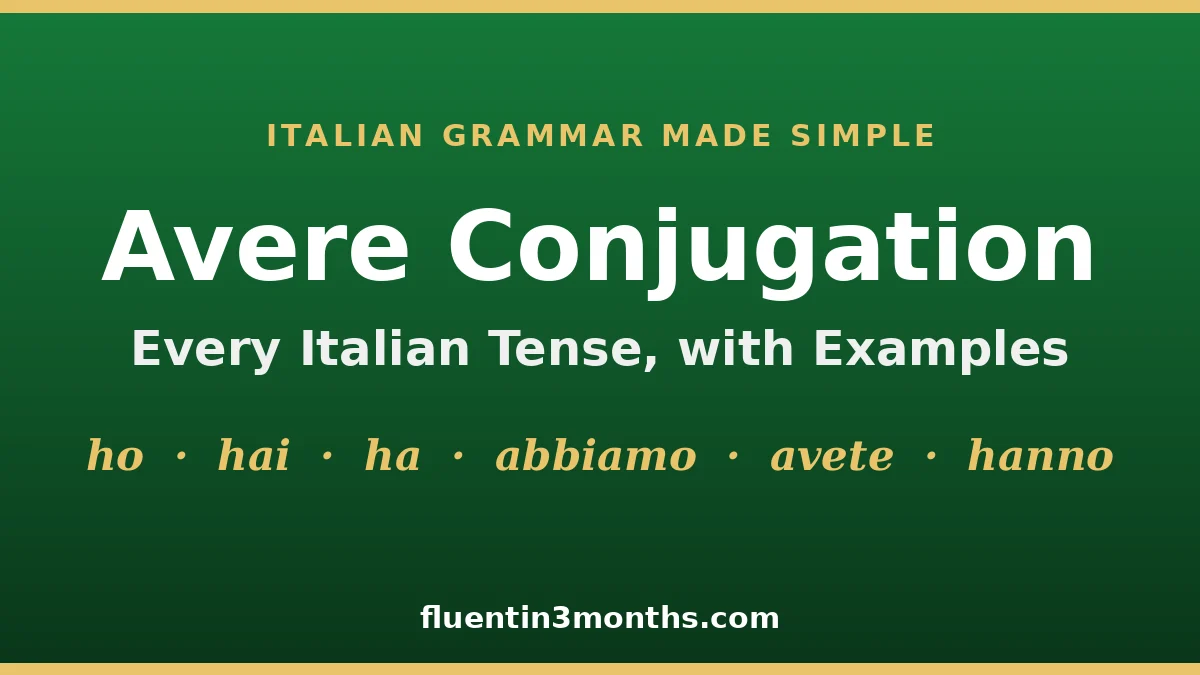
In the pedagogical timeline of language acquisition, the present indicative of avere is typically introduced within the first few hours of study. This is due to its immediate utility in establishing identity and physical state. The six forms of the presente are as follows:
- Io ho (I have)
- Tu hai (You have – informal)
- Lui/Lei/Lei ha (He/She/You – formal have)
- Noi abbiamo (We have)
- Voi avete (You all have)
- Loro hanno (They have)
These forms allow speakers to communicate essential data such as age (e.g., "Ho vent’anni"), physical sensations, and family relationships. Furthermore, these six forms act as the "engine" for the passato prossimo, the most commonly used past tense in conversational Italian. By combining the present tense of avere with a past participle (such as avuto), a speaker can describe completed actions.
The Auxiliary Function and Compound Tense Construction
The role of avere extends far beyond simple possession. In the hierarchy of Italian grammar, it serves as one of the two primary auxiliary verbs, the other being essere (to be). Most transitive verbs—those that take a direct object—require avere to form their compound tenses.
For example, to say "I have eaten," one uses the auxiliary "ho" plus the past participle "mangiato." Statistical analysis of Italian corpora indicates that avere is used as an auxiliary in approximately 70% of compound tense constructions. While the rules for choosing between avere and essere can be complex, particularly with intransitive verbs, the general rule remains that transitive actions are the domain of avere.
An important technical note for advanced learners involves the agreement of the past participle. While the past participle usually remains in its default masculine singular form when paired with avere, it must agree in gender and number with a preceding third-person direct object pronoun. For instance, "Le ho viste" (I saw them, referring to a feminine group) demonstrates the structural flexibility required when using this auxiliary.
Regional Variations: The Passato Remoto Divide
The usage of avere in the past tense also reveals significant sociolinguistic and regional data. The passato remoto (remote past), which includes forms like ebbi, avesti, and ebbe, is used to describe actions completed in the distant past with no remaining connection to the present.
In contemporary Italy, there is a distinct geographical divide in how these forms are utilized. In Northern Italy, the passato remoto has largely disappeared from spoken language, replaced almost entirely by the passato prossimo. Conversely, in Central and Southern Italy, the passato remoto remains a vibrant part of daily speech. In literary contexts and formal historiography, the use of the passato remoto remains the standard across the entire country. This regional variation highlights the ongoing evolution of the language and the importance of context when choosing the correct form of avere.
Hypothetical Frameworks: Conditional and Subjunctive Moods
As a student progresses into intermediate and advanced levels, the role of avere in expressing doubt, desire, and hypothetical scenarios becomes paramount. The congiuntivo (subjunctive) and condizionale (conditional) moods are essential for sophisticated communication.
The present conditional forms (avrei, avresti, avrebbe, etc.) are frequently used for polite requests or to express what "would" happen under certain conditions. The subjunctive forms (abbia, avessi, etc.) are triggered by expressions of emotion, uncertainty, or necessity. For example, the phrase "Spero che tu abbia ragione" (I hope that you are right) utilizes the subjunctive to convey a subjective wish rather than an objective fact. Mastering these moods is often the "tipping point" that separates basic communication from true fluency.
Bridging the Idiomatic Gap: "To Have" vs. "To Be"
Perhaps the most distinctive feature of avere for English speakers is its use in describing physical and mental states that English typically reserves for the verb "to be." This "idiomatic gap" is a frequent source of interference for learners. In Italian, one does not "be" hungry; one "has" hunger.
Key expressions include:
- Avere fame (To be hungry)
- Avere sete (To be thirsty)
- Avere freddo/caldo (To be cold/hot)
- Avere paura (To be afraid)
- Avere ragione/torto (To be right/wrong)
- Avere sonno (To be sleepy)
Linguistic experts point out that these constructions treat sensations as "possessions" or internal states that the subject "has," rather than adjectives that define the subject’s identity. This conceptual difference is fundamental to thinking like a native speaker.
Pedagogical Implications and Learning Strategies
Polyglots and language educators, including Benny Lewis, founder of Fluent in 3 Months, emphasize that the most effective way to internalize the complexities of avere is through immediate, practical application. Rather than rote memorization of conjugation tables in isolation, learners are encouraged to build "personal sentences" that relate to their own lives.
Educational data suggests that "spaced repetition systems" (SRS), such as Anki, are highly effective for mastering the irregular stems of avere. By encountering the forms in context—such as the future "avrò" or the imperfect "avevo"—the brain creates stronger neural pathways than it would through passive reading. Furthermore, the use of audio-visual materials, such as Italian-language podcasts and cinema, helps learners acclimate to the silent "h" and the rhythmic patterns of the verb in natural speech.
Broader Impact on Language Acquisition
The mastery of avere acts as a gateway to the broader world of Italian culture, literature, and professional engagement. As Italy remains a global leader in fashion, automotive engineering, and culinary arts, the ability to navigate its language with precision is a valuable asset. The verb avere, in its many forms, is the thread that weaves together the past, present, and future of Italian discourse.
From the simple "Ho un’idea" (I have an idea) to the complex "Se avessi avuto più tempo…" (If I had had more time…), the verb provides the structural integrity necessary for nuanced expression. Its study is not merely a grammatical exercise but an exploration of the Italian mindset—a mindset that views the world through a lens of possession, experience, and historical depth. By understanding the "workhorse" of the Italian language, the learner gains the tools to not only speak but to truly communicate.
