


The Paul Ekman Group has announced a significant expansion of its online micro expression training tools, now offering comprehensive instruction in Italian, French, and German. This strategic move aims to enhance the accessibility of its science-based emotional awareness programs to a wider international audience, furthering its mission to empower individuals and professionals worldwide with a deeper understanding of human emotions and nonverbal communication.
The new language translations encompass all seven core online micro expression training tools, which are integrated within the organization’s established training packages. Previously available in English, Spanish, and Portuguese, the addition of these three prominent European languages marks a substantial step in making sophisticated psychological training accessible to non-English speakers. This initiative directly addresses a growing global demand for enhanced emotional intelligence and deception detection skills across various sectors, including law enforcement, education, mental health, and corporate leadership.
A Growing Need for Emotional Literacy
Micro expressions, defined as fleeting, involuntary facial movements that betray a person’s true emotional state, have been a focal point of Dr. Paul Ekman’s groundbreaking research for decades. These brief flashes of emotion, often occurring in fractions of a second, can reveal concealed feelings and intentions, making their recognition a crucial skill in many interpersonal and professional contexts. The ability to accurately interpret these subtle cues can lead to improved empathy, more effective communication, and a greater capacity for insightful decision-making.
The demand for such skills has been steadily increasing. Reports from organizations like the World Economic Forum consistently highlight emotional intelligence as a critical competency for future workforces. In its "Future of Jobs Report," the WEW emphasizes the growing importance of skills such as active learning, resilience, flexibility, and analytical thinking, all of which are intrinsically linked to understanding and managing emotions. Micro expression training directly contributes to developing these foundational aspects of emotional literacy.
Furthermore, the rise of digital communication, while offering convenience, has also created a potential disconnect in understanding nuanced emotional signals. Online training platforms that provide structured, scientific methods for deciphering these subtle cues are thus becoming invaluable tools for bridging this gap. The Paul Ekman Group’s expansion into new languages directly responds to this evolving landscape, acknowledging that effective emotional communication transcends linguistic barriers.
Chronology of Expansion and Development
Dr. Paul Ekman’s initial research into facial expressions and their universality began in the 1960s, challenging prevailing cultural relativist theories. His seminal work, often conducted in collaboration with Wallace Friesen, involved extensive cross-cultural studies that identified a set of universal facial expressions corresponding to basic human emotions. This foundational research laid the groundwork for the development of the Facial Action Coding System (FACS), a comprehensive system for describing all observable muscle movements in the face.
The transition from academic research to practical application led to the development of training programs designed to teach individuals how to recognize these subtle emotional cues. Early iterations of training often involved in-person workshops and extensive photographic and video material. The advent of the internet and advancements in digital learning technologies paved the way for the creation of online micro expression training tools.
The Paul Ekman Group, established to disseminate Dr. Ekman’s work, has progressively expanded its offerings. The development of online training packages marked a significant milestone, democratizing access to this specialized knowledge. Initial translations into Spanish and Portuguese were strategic choices, reflecting the significant number of speakers of these languages in global markets. The recent addition of Italian, French, and German represents a deliberate expansion into key European economies and cultural spheres, further solidifying the organization’s global footprint.
The process of translating complex psychological training material is not merely a linguistic exercise. It requires careful consideration of cultural nuances, idiomatic expressions, and pedagogical approaches that resonate with diverse learners. The Paul Ekman Group’s commitment to providing fully translated content suggests a rigorous translation and localization process, ensuring that the scientific integrity and effectiveness of the training are maintained across all languages.
What the Enhanced Training Offers
The fully translated online micro expression training tools provide users with a comprehensive curriculum designed to enhance their ability to recognize and interpret facial expressions associated with fundamental human emotions. Each of the seven core training modules, integrated within three distinct training packages, has undergone thorough localization. This means that all instructional text, video content, and interactive exercises are now available in Italian, French, and German, alongside the existing Spanish and Portuguese options.
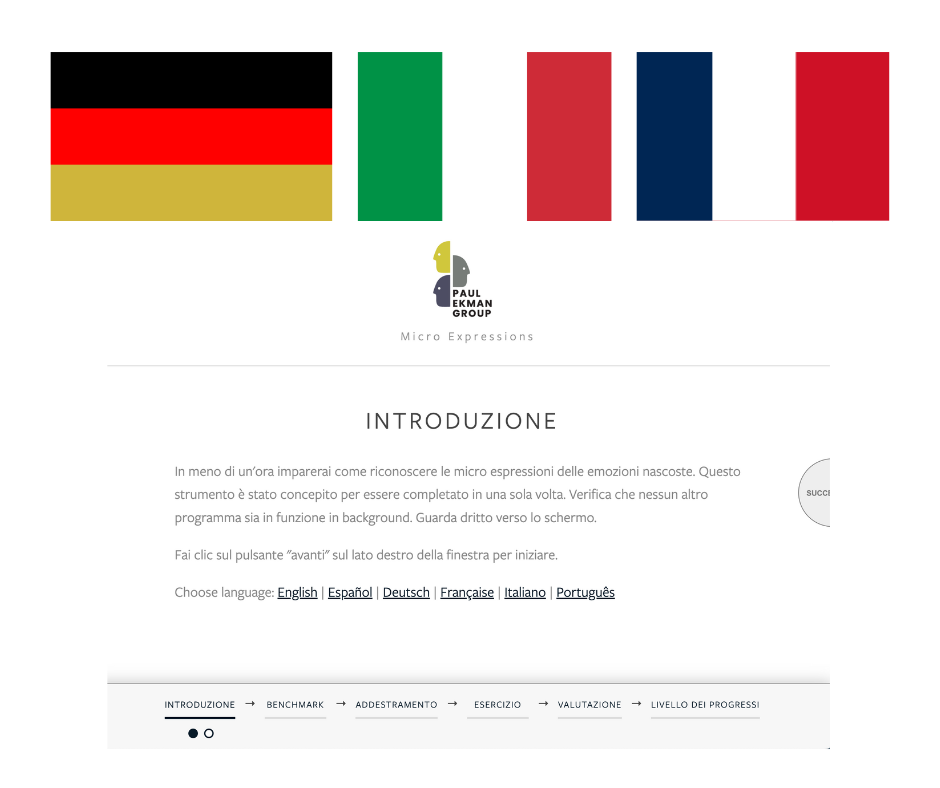
Upon commencing any micro expression course, users will be prompted to select their preferred language from a readily accessible menu. This user-friendly interface ensures a seamless transition into the learning environment, allowing individuals to engage with the material in a way that is most comfortable and effective for them. The training packages are designed to cater to a broad spectrum of learners, from individuals seeking personal development to professionals in specialized fields.
Broader Impact and Implications
The expansion of Paul Ekman Group’s micro expression training into Italian, French, and German carries significant implications for both individuals and organizations.
-
Enhanced Cross-Cultural Communication: In an increasingly globalized world, the ability to understand and respond appropriately to emotions across cultural divides is paramount. While basic emotions and their associated facial expressions are universal, the cultural display rules governing their expression can vary. Training in micro expressions can equip individuals with a more nuanced understanding of emotional communication, reducing misunderstandings and fostering stronger interpersonal connections in international business, diplomacy, and personal relationships.
-
Improved Professional Efficacy: For professionals in fields such as law enforcement, where detecting deception and understanding witness or suspect emotions is critical, this training offers a tangible advantage. In mental health, therapists can gain deeper insights into their patients’ emotional states, leading to more targeted and effective interventions. Educators can better understand student engagement and emotional well-being, fostering a more supportive learning environment. Corporate leaders can enhance their negotiation skills, team management, and customer relations by developing a keener sense of emotional awareness.
-
Personal Growth and Emotional Intelligence: Beyond professional applications, the training empowers individuals with greater self-awareness. Understanding one’s own emotional triggers and expressions can lead to improved emotional regulation and healthier relationships. Developing a more sophisticated understanding of others’ emotions contributes to higher overall emotional intelligence, a trait increasingly recognized as vital for personal fulfillment and success.
-
Democratization of Advanced Psychological Tools: By offering these sophisticated training tools in multiple languages, the Paul Ekman Group is actively working to democratize access to advanced psychological knowledge. This is particularly important for individuals and organizations in regions where English may not be the primary language of instruction or business. This inclusivity fosters a more equitable landscape for skill development.
Statements and Reactions (Inferred)
While specific official statements from individuals or organizations in Italy, France, and Germany were not provided in the initial announcement, the expansion itself can be seen as a proactive response to anticipated demand. It is highly probable that the Paul Ekman Group has conducted market research and engaged with potential partners or educational institutions in these regions to gauge interest and identify the most impactful language additions.
From a linguistic and cultural perspective, the choice of Italian, French, and German suggests a strategic alignment with significant economic and cultural hubs in Europe. These languages are spoken by millions and are central to international commerce, academia, and cultural exchange. The expansion is likely to be met with enthusiasm from professionals and students in these countries who are seeking to acquire specialized skills in emotional intelligence and nonverbal communication.
Looking Ahead: Continued Global Expansion
The Paul Ekman Group has indicated that this expansion is part of an ongoing commitment to making its resources available to a global audience. The announcement explicitly states that the organization is "actively working on expanding our offerings to additional languages." This forward-looking approach suggests a continuous effort to identify new linguistic markets and to further enhance the accessibility of its science-based training.
The organization also invites feedback from its community, encouraging users to suggest languages they would like to see added to the training platform. This open channel for communication underscores a user-centric approach to development, ensuring that future expansion efforts are aligned with the needs and preferences of its diverse global user base.
In conclusion, the availability of Paul Ekman Group’s micro expression training tools in Italian, French, and German represents a significant advancement in the dissemination of crucial emotional intelligence skills. By breaking down language barriers, the organization is empowering a broader spectrum of individuals and professionals worldwide to better understand themselves and others, fostering more insightful, empathetic, and effective communication in all facets of life. This initiative not only expands the reach of a respected scientific legacy but also contributes to the growing global emphasis on emotional literacy as a fundamental component of human development and societal progress.
