

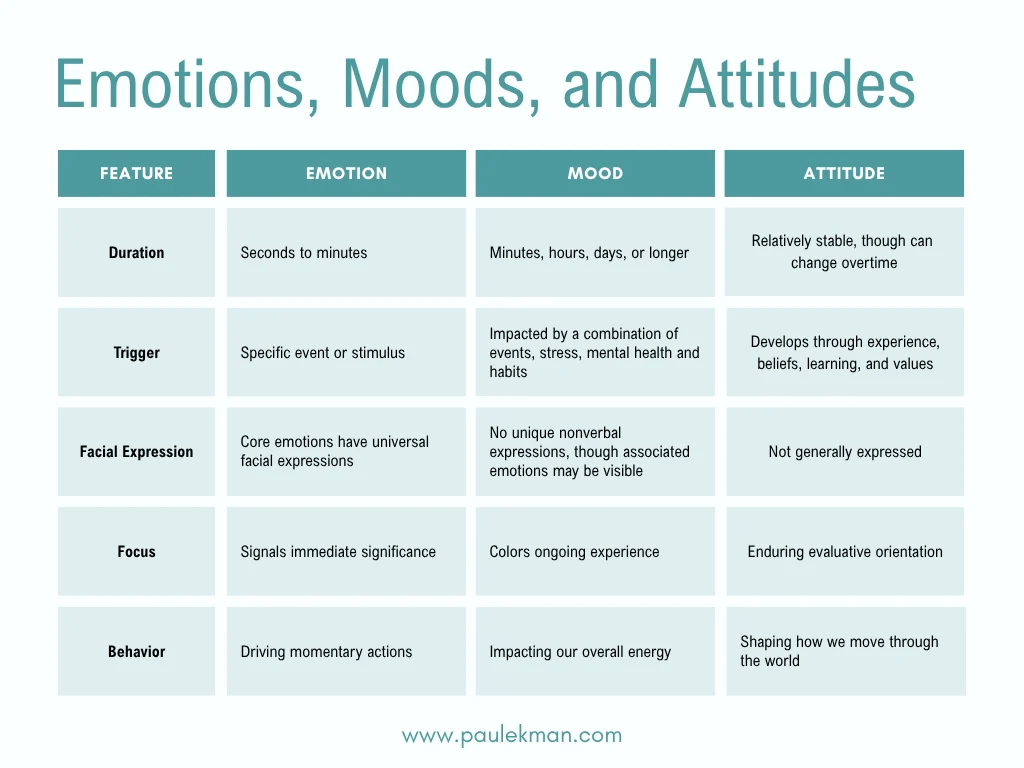
Building upon prior discussions that delineated the distinctions between moods and emotions, this comprehensive analysis expands to encompass a third critical psychological construct: attitudes. These three interconnected elements—emotions, moods, and attitudes—collectively orchestrate our subjective experience of ourselves and the world around us. While they are distinct in their temporal duration and psychological functions, their intricate interplay profoundly influences our cognitive processes, behavioral responses, and overall well-being. A deeper comprehension of their dynamics is paramount for enhancing emotional intelligence, refining emotional regulation, and gaining a more insightful perspective on our ingrained patterns of thought and action.
The Nature of Emotions: Fleeting Signals of Significance
Emotions are characterized as automatic appraisal processes, deeply influenced by both our evolutionary heritage and the accumulation of personal life experiences. They are triggered when an event or stimulus holds significant relevance to our goals, needs, or perceived well-being, initiating a cascade of coordinated psychological and physiological changes. By their very nature, emotions are transient, typically lasting from fractions of a second to a few minutes. This rapid onset and brief duration are adaptive, designed to prepare us for immediate action or response to critical environmental cues.
These intense, short-lived experiences manifest as palpable physiological alterations. Research has consistently demonstrated distinct patterns of autonomic nervous system activity associated with various emotions, influencing heart rate, respiration, and hormonal release. Furthermore, emotions are often outwardly expressed through universal facial expressions, a testament to their evolutionary role in communication and social signaling. For instance, the expression of fear, characterized by widened eyes and an open mouth, serves as a clear signal of danger, prompting appropriate responses from others. Similarly, the furrowed brow and tightened lips associated with anger convey a state of displeasure or threat, influencing social dynamics. The intensity and specific manifestation of an emotion are contingent upon the perceived significance of the triggering event and an individual’s unique appraisal of the situation.
Moods: The Enduring Emotional Atmosphere
In stark contrast to the ephemerality of emotions, moods represent more diffuse and protracted affective states. They can persist for hours, days, or even longer, creating a pervasive emotional backdrop that colors our perception of reality. A defining characteristic of moods is their often-unclear origin; they frequently lack a readily identifiable trigger or are not directed towards a specific object or event. It is not uncommon to awaken in a particular mood, or to find oneself gradually slipping into one without a discernible cause.
While emotions typically elicit distinct facial expressions, moods tend to manifest more subtly. Observable signs may include shifts in posture, variations in muscle tension, or noticeable changes in energy levels. A person in a low mood might exhibit slumped shoulders and slower movements, whereas someone in an elevated mood may appear more animated and energetic.
The primary function of moods appears to be less about immediate response and more about influencing our overall disposition and cognitive processing. They can act as amplifiers or dampeners for incoming emotional stimuli, shaping how easily certain emotions are triggered and the intensity with which they are experienced. For example, an individual in a generally optimistic mood may be more resilient to minor frustrations, whereas someone in a pessimistic mood might find everyday challenges disproportionately distressing. Moods also play a significant role in interpreting events, social interactions, and even one’s own internal thoughts, lending a particular hue to our daily experiences. Scientific studies have explored the correlation between prolonged periods of negative mood states and increased susceptibility to depressive disorders, highlighting the profound impact of mood on mental health.
Attitudes: Enduring Evaluations Shaping Perception
Distinct from the dynamic nature of emotions and moods, attitudes are defined as relatively stable and enduring evaluations of people, ideas, objects, behaviors, or experiences. Rather than being immediate affective states, attitudes are typically understood as encompassing a tripartite structure, often referred to as the ABC model: Affective (emotional associations), Behavioral (tendencies to act in certain ways), and Cognitive (beliefs and thoughts).
For instance, consider an attitude towards environmental conservation. The affective component might involve feelings of concern or appreciation for nature. The behavioral component could manifest as a tendency to recycle, reduce energy consumption, or support environmental initiatives. The cognitive component would comprise beliefs such as "Pollution is harmful to the planet" or "Protecting natural resources is essential for future generations."
Attitudes are further categorized as explicit, which are consciously held and readily accessible, and implicit, which operate unconsciously but still exert a significant influence on our thoughts and behaviors. Implicit attitudes, for example, can contribute to unconscious biases that affect interpersonal interactions and decision-making processes, even when individuals consciously endorse egalitarian values.
The development of attitudes is a continuous process, shaped by a confluence of factors. Repeated emotional experiences, observational learning (including classical and operant conditioning), societal and cultural norms, interpersonal relationships, and personal introspection all contribute to their formation and evolution. While generally more stable than emotions or moods, attitudes are not immutable. New experiences, learning, and significant life events can gradually strengthen, weaken, or fundamentally reshape them. Unlike moods, attitudes are invariably directed towards a specific target. We hold attitudes about individuals, policies, abstract concepts, or even our own emotional responses. Because attitudes act as an evaluative lens, they significantly influence how we interpret new information and predict our likely responses, thereby shaping our interaction with the world. Research in social psychology has demonstrated that individuals with strong positive attitudes towards a particular brand are more likely to purchase its products, illustrating the direct link between attitude and behavior.
The Interplay of Emotions, Moods, and Attitudes
While these three psychological constructs are conceptually distinct, they are in constant and dynamic interaction, each influencing and being influenced by the others. This intricate web of influence shapes our overall psychological landscape.
Mood as a Catalyst and Modulator for Emotions
The prevailing mood significantly impacts the likelihood and intensity of emotional experiences. An individual in an upbeat or positive mood is likely to approach challenges with greater optimism and may recover more quickly from minor setbacks or frustrations. Conversely, someone experiencing an irritable or negative mood may find themselves reacting with heightened sensitivity and disproportionate distress to even minor annoyances. For example, a series of brief, intense emotions such as worry or frustration can coalesce over time to contribute to a more prolonged state of an anxious or irritable mood. This phenomenon highlights how acute emotional episodes can contribute to the development and maintenance of chronic mood states. Scientific literature in affective neuroscience has explored the neural pathways that link mood states to emotional reactivity, suggesting that sustained mood influences the amygdala’s sensitivity to emotional stimuli.
Attitudes as a Framework for Emotional Experience
Attitudes serve as a foundational framework that shapes how we interpret events and, consequently, the emotions we experience. Consider two individuals receiving identical constructive criticism. One individual, holding a positive attitude towards feedback as a valuable opportunity for growth, might feel motivated and engaged, experiencing emotions like enthusiasm or determination. The other individual, who views feedback as a personal threat or an indictment of their capabilities, might experience anxiety, defensiveness, or annoyance. The external situation remains constant, but their pre-existing attitudes dictate their subjective appraisal and subsequent emotional response. This underscores the power of attitudes in mediating our reactions to the world. Studies in cognitive psychology have demonstrated that individuals can be trained to modify their attitudes, leading to corresponding changes in their emotional responses to specific situations.
Attitudes Toward Emotions: The Meta-Emotional Dimension
A particularly significant category of attitudes involves our evaluations of emotions themselves. We may develop attitudes that classify certain emotions as desirable or undesirable, strong or weak, acceptable or unacceptable. For instance, one might hold the belief that anger is inherently destructive, sadness signifies weakness, fear should always be suppressed, or joy is meant to be universally shared. These meta-attitudes are often deeply ingrained, formed through years of family dynamics, cultural conditioning, educational experiences, and personal history.
Our attitudes toward emotions profoundly influence our willingness to acknowledge, accept, express, and learn from them. If we believe that expressing sadness is a sign of weakness, we may actively suppress our sorrow, potentially hindering emotional processing and well-being. These attitudes are also closely linked to the concept of "display rules," which are culturally learned norms dictating how, when, and to whom emotional expressions are considered appropriate. While certain facial expressions of emotion are considered universal, the specific display rules governing their outward manifestation vary significantly across cultures. This variation contributes to observable differences in emotional expression worldwide, impacting how emotions are perceived and managed in diverse social contexts. For example, research on cross-cultural communication has identified significant differences in the expression of grief, with some cultures encouraging open displays of sorrow while others emphasize stoicism.
Cultivating Emotional Awareness: A Pathway to Enhanced Well-being
At the Paul Ekman Group, we advocate for the principle that emotional awareness is a foundational skill, cultivated through the practice of observing our internal experiences with clarity and curiosity. By diligently identifying our emotions, understanding the pervasive influence of our moods, and becoming cognizant of the attitudes that color our interpretations, we equip ourselves to respond to ourselves and others with greater wisdom, compassion, and effectiveness.
The development of these essential skills is an ongoing journey that requires consistent practice and dedication. They are not innate but can be significantly strengthened over time through deliberate effort and exposure to evidence-based learning. For individuals seeking to deepen their understanding of the science of emotion and enhance their emotional intelligence, the Paul Ekman Group offers a range of scientifically validated resources designed to facilitate this growth. These resources are grounded in decades of research and are intended to provide practical tools and insights for navigating the complexities of human emotion.
The ability to accurately identify and label one’s emotions is a crucial first step. This involves paying attention to both internal physiological sensations and outward behavioral cues. For example, recognizing the tightening in one’s chest and the rapid heartbeat as indicators of anxiety allows for a more targeted response. Similarly, understanding how a lingering low mood might be contributing to a generally negative outlook can prompt efforts to shift that mood through activities known to elevate spirits, such as exercise or social connection. Finally, becoming aware of the underlying attitudes that shape our perceptions—such as an attitude that success is solely defined by external validation—can reveal the roots of persistent self-criticism and open the door to adopting more self-compassionate perspectives. By integrating these insights, individuals can foster greater emotional resilience, improve interpersonal relationships, and lead more fulfilling lives. The ongoing exploration of these fundamental psychological concepts is not merely an academic pursuit but a vital component of personal development and societal well-being.
