


In an era where effective communication is paramount, a new framework known as Adaptive Listening is emerging as a critical competency, moving beyond traditional notions of passive attention and even established active listening techniques. Developed and championed by communication experts at Duarte, this innovative model redefines workplace listening by centering on a fundamental question: "What does the person speaking need from me?" This empathetic and strategically driven approach, detailed in their new book, aims to equip professionals with the nuanced skills required to navigate the complexities of modern organizational dynamics, fostering deeper trust, accelerating progress, and improving decision-making across all levels of an enterprise.
The concept of listening, often celebrated in ancient wisdom and modern motivational rhetoric, has long been simplified. Philosophical maxims like Epictetus’s "We have two ears and one mouth so that we can listen twice as much as we speak," or Ram Dass’s observation, "The quieter you become, the more you can hear," underscore the value of silence and attentiveness. Even contemporary business magnates like Richard Branson echo this sentiment: "Listen more than you talk. Nobody learned anything by hearing themselves speak." These teachings, ingrained from early education, typically equate effective listening with merely avoiding interruption, maintaining eye contact, and nodding in affirmation. While these actions are foundational to basic human interaction, they represent only the initial layer of truly impactful communication, particularly within the multifaceted environment of the contemporary workplace.
The Evolution of Listening Theory: From Passive to Active to Adaptive
Historically, the understanding and practice of listening in professional contexts have undergone several transformations. The earliest and most rudimentary form can be categorized as passive listening, where the listener is present, physically attentive, but primarily absorbing information without significant engagement or strategic intent. This aligns with the traditional advice of "just being quiet and paying attention." While crucial for information reception, its limitations quickly become apparent when complex problem-solving, emotional support, or critical evaluation are required.
The mid-20th century saw the rise of active listening, a concept largely popularized by psychologist Carl Rogers. Active listening introduced a more robust methodology, emphasizing not just hearing words but also understanding the speaker’s message, both verbal and non-verbal, and then reflecting that understanding back to the speaker. Key components include paraphrasing what has been heard, asking clarifying questions, and demonstrating empathy through verbal and non-verbal cues. This approach significantly improved communication by ensuring mutual understanding and validating the speaker’s feelings, becoming a cornerstone of conflict resolution, counseling, and early management training. Many organizations today continue to advocate for active listening as the gold standard for internal and external communications.
However, as workplaces have grown more dynamic, interconnected, and demanding, the limitations of even active listening have begun to surface. While active listening ensures that the listener is engaged and comprehends the message, it often lacks a critical component: a clear understanding of the speaker’s underlying goal or need from the interaction. A manager might actively listen to an employee’s problem, paraphrase it perfectly, and show empathy, yet still miss the mark if the employee wasn’t seeking sympathy but rather a solution, delegation of tasks, or a critical evaluation of their approach. This gap is precisely where Adaptive Listening positions itself as the necessary next evolutionary step. It acknowledges the value of active listening but posits that true effectiveness lies in tailoring the listening response to the specific, often unstated, goals of the speaker.

The Core Principle: Empathy-Driven Strategic Engagement
At the heart of Adaptive Listening lies an empathetic yet highly strategic imperative: to shift the listener’s focus from "What’s in it for me?" or "How does this impact my job?" to the more profound and altruistic question, "What does the person speaking need from me?" This reorientation moves beyond self-interest, recognizing that every communication interaction, particularly in a professional setting, carries an implicit or explicit goal for the speaker. Failing to identify and address this goal renders even perfectly heard messages less effective.
Research consistently highlights the costs associated with poor communication. A study by the Holmes Report estimated that ineffective communication costs businesses in the U.S. and U.K. an average of $37 billion annually. Another report by Dynamic Signal found that 80% of the U.S. workforce feels stressed due to ineffective company communication. These figures underscore not only the financial drain but also the impact on employee morale, productivity, and retention. Adaptive Listening aims to mitigate these issues by transforming listening from a passive reception act into a deliberate, goal-oriented engagement.
The S.A.I.D.™ Framework: Four Strategic Listening Goals
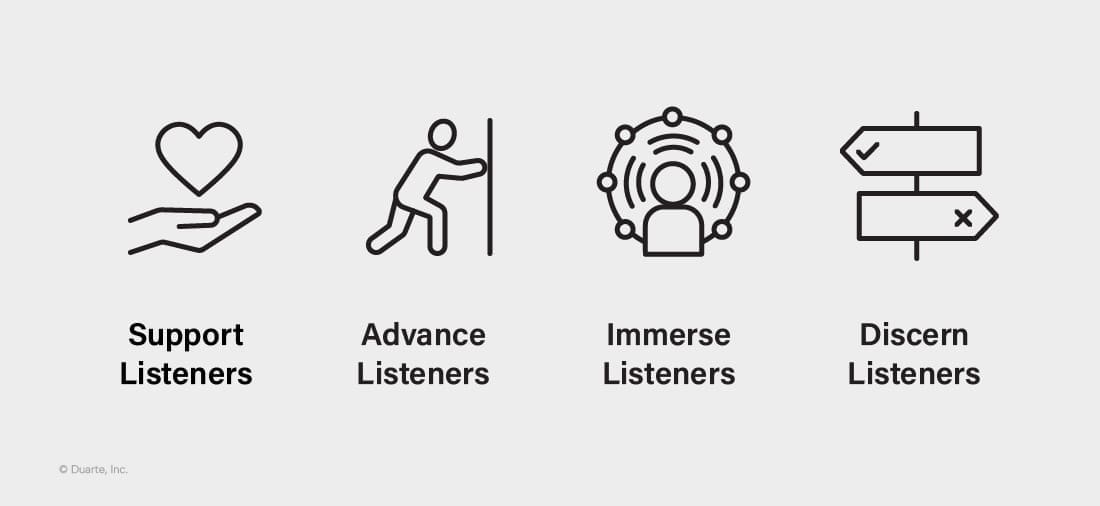
To provide a practical framework for this empathetic and strategic engagement, Duarte introduces the S.A.I.D.™ model, which categorizes the four primary goals a speaker typically seeks to achieve through communication in the workplace. This acronym, representing Support, Advance, Immerse, and Discern, serves as a mnemonic for listeners to quickly identify and respond to the speaker’s needs.
1. Support Listening™ Skills:
This type of listening is required when a speaker needs emotional validation, comfort, or shared celebration. Workplaces are not sterile environments; they are filled with human experiences, both triumphs and tribulations. An employee might be sharing the stress of a challenging project, the frustration of a setback, or the excitement of a personal achievement.
- Trigger Phrases: "I’m having a horrible day," "This project is driving me crazy," "I have the best news!"
- Listener’s Role: To act as a confidant or a cheerleader. This involves acknowledging and mirroring the speaker’s feelings, offering commiseration or congratulations without immediately jumping to problem-solving or judgment. The goal is to create a safe space for emotional expression and connection.
- Implications: Fosters psychological safety, strengthens interpersonal bonds, and enhances team cohesion, leading to higher employee engagement and loyalty. A manager who consistently offers Support Listening builds trust and a reputation for empathy.
2. Advance Listening™ Skills:
Advance Listening comes into play when the speaker is overwhelmed, facing a roadblock, or needs assistance in moving a project or process forward. Their primary need is for tangible progress or burden reduction.
- Trigger Phrases: "I don’t think I’ll have time to finish all of this," "I don’t know how I’m going to keep this project moving," "I’m stuck on this task."
- Listener’s Role: To be a problem-solver or an enabler of progress. This might involve offering to take on tasks, delegating responsibilities, providing resources, or brainstorming solutions together. The key is to actively contribute to alleviating the speaker’s burden and facilitating forward momentum.
- Implications: Increases productivity, accelerates project completion, reduces stress, and demonstrates leadership and initiative. This type of listening directly impacts operational efficiency and goal attainment.
3. Immerse Listening™ Skills:
In many workplace scenarios, the speaker’s objective is simply to convey information or provide updates, with no expectation of immediate feedback, critique, or emotional response. This could be a project update, a training session, a company announcement, or even an entertaining anecdote.
- Trigger Phrases: "I’m here to give you an update today," "Sit back and enjoy!" "Here’s what you need to know."
- Listener’s Role: To be a "content sponge." The primary goal is to absorb, understand, and mentally catalogue the information without interruption or premature judgment. While clarifying questions for understanding are appropriate, the listener avoids offering unsolicited opinions, solutions, or emotional responses. Taking notes is often a key component.
- Implications: Ensures accurate information dissemination, reduces misunderstandings, and supports effective knowledge transfer. This is crucial for onboarding, compliance, and maintaining informed teams.
4. Discern Listening™ Skills:
This critical listening skill is engaged when the speaker requires evaluation, critique, or assistance in identifying strengths, weaknesses, risks, or opportunities. It demands analytical thought and constructive feedback.
- Trigger Phrases: "I need some feedback on this," "I’m not sure if this makes sense," "What are your thoughts on this proposal?" "Can you spot any red flags?"
- Listener’s Role: To act as a critical analyst or a strategic consultant. This involves carefully considering the information, evaluating its merits, identifying potential issues or advantages, and providing objective, actionable feedback. The listener helps the speaker refine their ideas, mitigate risks, and optimize outcomes.
- Implications: Drives innovation, improves decision-making, identifies potential pitfalls before they escalate, and fosters a culture of continuous improvement and accountability. This is particularly vital in leadership, project management, and strategic planning roles.
Broader Impact and Implications for Modern Organizations
The adoption of Adaptive Listening carries profound implications for organizations across various dimensions:
- Enhanced Leadership Effectiveness: Leaders who master Adaptive Listening can more accurately gauge the needs of their teams, stakeholders, and clients. This allows for more targeted support, strategic guidance, and effective delegation, leading to increased trust and followership.
- Improved Team Dynamics and Collaboration: When team members consistently practice Adaptive Listening, it cultivates an environment of mutual understanding and respect. Miscommunications decrease, conflicts are resolved more efficiently, and collaboration becomes more productive as individuals feel truly heard and supported in their specific needs.
- Strategic Decision-Making: By discerning the true intent behind communications, decision-makers can gather more accurate information, anticipate challenges, and identify opportunities that might be overlooked with less sophisticated listening approaches. This leads to more robust strategies and better organizational outcomes.
- Customer and Client Relations: Extending Adaptive Listening beyond internal teams to external stakeholders can revolutionize customer service and client management. Understanding whether a client needs support, advancement on a project, information immersion, or critical discernment about a proposal allows businesses to tailor their responses precisely, enhancing satisfaction and loyalty.
- Fostering a Culture of Empathy and Trust: At its core, Adaptive Listening is an empathetic practice. By consistently asking, "What does the person speaking need from me?", individuals demonstrate genuine care and respect. This builds a foundation of trust that is invaluable in navigating organizational change, fostering innovation, and retaining talent.
- Reducing Communication Friction and Costs: As previously noted, poor communication is costly. By proactively addressing the specific needs of speakers, Adaptive Listening reduces the likelihood of misunderstandings, rework, and wasted effort, contributing directly to operational efficiency and cost savings.
Duarte’s Contribution and The Future of Workplace Communication
Duarte, a renowned communication firm, has researched and tested Adaptive Listening extensively within professional settings, culminating in their new publication, "Adaptive Listening: How to Cultivate Trust and Traction at Work." This resource offers practical, easy-to-remember techniques designed to reduce ambiguity and tension in the fast-paced realities of the modern workday. It provides a roadmap for individuals and teams to enhance their listening skills, whether they are engaging with direct reports, senior leadership, peers, clients, or external partners.
The dynamic nature of professional life dictates that speakers will have varied needs at different times, and the ability to accurately discern these needs is no longer a soft skill but a critical strategic advantage. By making the conscious shift to ask, "What does the person speaking need from me?", professionals can dramatically improve their communication effectiveness, fostering stronger relationships, driving greater impact, and contributing to a more empathetic and productive workplace culture. The era of merely "paying attention" is yielding to a more sophisticated, adaptable, and profoundly human approach to listening.
