

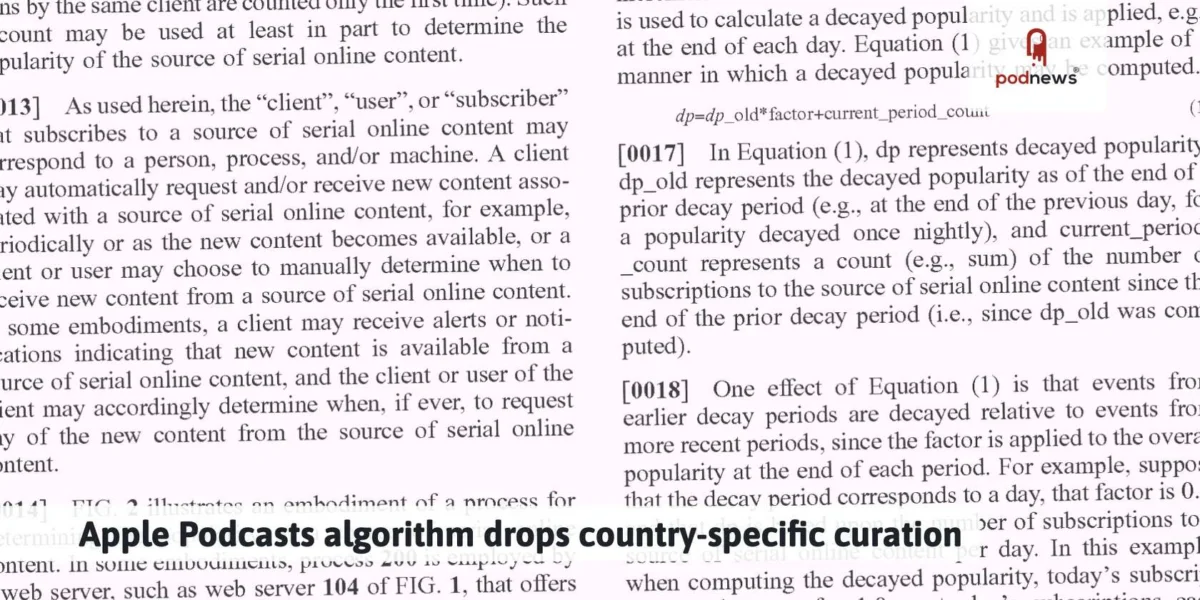
An examination of Apple’s patent filings has brought to light a previously utilized patent for a trending chart mechanism, a feature that was integral to the early user experience of Apple Podcasts. This discovery, highlighted by a visual representation of the patent, has prompted a deeper look into the technological underpinnings and evolving strategies of one of the world’s largest podcast platforms. The patent, officially filed and subsequently described, details a system for identifying and displaying trending content, a functionality that directly impacted podcast discoverability and audience engagement within the Apple ecosystem.

The patent in question, illustrated by a visual graphic that once graced the Apple Podcasts interface, outlines a sophisticated method for dynamically ranking and showcasing popular podcasts. This system was designed to analyze user consumption patterns, download statistics, and potentially other engagement metrics to determine which podcasts were experiencing a surge in popularity. The intention was to provide users with an intuitive and real-time overview of what was resonating with the broader podcasting community, thereby facilitating discovery and encouraging deeper exploration of the platform’s vast content library.
While the specific patent number and filing date are not explicitly provided in the accompanying visual, its depiction suggests a period when Apple Podcasts was actively refining its user interface and discoverability features. Early iterations of podcast platforms often relied on static charts or editorially curated lists. However, the technological approach described in this patent points towards a more data-driven and automated system, capable of adapting to the rapidly changing landscape of podcast consumption.

The Evolution of Podcast Discoverability
The introduction of trending charts represented a significant step forward in podcast discoverability. Before the widespread adoption of sophisticated algorithms and personalized recommendations, users often struggled to find new and relevant content amidst a growing sea of available podcasts. Trending charts offered a crowd-sourced validation, signaling to listeners that a particular podcast was capturing the attention of many. This could lead to a positive feedback loop, where increased visibility on the trending list further boosted a podcast’s popularity.
Apple’s approach to podcast discoverability has evolved considerably since the likely implementation of the patent’s concepts. Initially, platforms like Apple Podcasts relied heavily on editorial curation and simple popularity metrics. As the podcasting industry matured and the volume of content exploded, a more nuanced approach became necessary. This led to the development of more sophisticated recommendation engines, often powered by machine learning, which aim to personalize the listening experience for each individual user.

The underlying principle of identifying and surfacing popular content, however, remains a cornerstone of platform strategy. Even with advanced personalization, users often seek out what is currently generating buzz within the wider community. This can be seen in the continued prominence of trending sections on various media platforms, from social media to streaming services.
Implications for Podcast Creators and Platforms
The existence and prior utilization of such a patent have several implications for both podcast creators and the platforms themselves. For creators, understanding how these trending mechanisms operate can be crucial for developing effective growth strategies. Visibility on a trending chart, even if temporary, can lead to significant spikes in downloads and listener acquisition. This underscores the importance of producing high-quality, engaging content that has the potential to resonate with a broad audience.

For platforms like Apple Podcasts, the patent signifies a proactive approach to technological development and user experience enhancement. Investing in patented technologies demonstrates a commitment to innovation and a desire to maintain a competitive edge in the increasingly crowded audio landscape. The ability to patent such a system also highlights the intellectual property considerations inherent in developing proprietary algorithms and user interface features.
The shift away from a solely trending-chart-driven discoverability model to more personalized recommendations can be viewed as a natural progression in platform sophistication. While trending charts offer a broad overview, personalized recommendations aim to cater to individual tastes and listening habits, potentially leading to a more engaged and loyal audience. This dual approach, combining broad appeal with individual tailoring, is often seen as the most effective strategy for content platforms.

A Look at Historical Context
While the exact timeframe of the patent’s active implementation within Apple Podcasts is not detailed, it likely corresponds with a period of significant growth and development for the platform. Apple Podcasts, launched in 2012, quickly became a dominant force in the podcasting market. In its early years, the focus was on making podcasts accessible and discoverable to a wider audience, a task that trending charts were instrumental in achieving.
The podcasting industry has undergone a dramatic transformation since the early days. From a niche medium, it has evolved into a mainstream form of entertainment and information consumption. This growth has been fueled by increased accessibility, the rise of dedicated podcasting hardware and software, and the significant investment from major technology companies. Apple’s role in this evolution cannot be overstated; its platform provided a crucial gateway for many listeners and creators.

The visual representation of the patent suggests a user interface that was designed for clarity and ease of use. The integration of such features into the core product demonstrates Apple’s commitment to providing a seamless user experience. The decision to eventually move beyond or supplement this specific trending chart functionality with more advanced recommendation algorithms likely reflects a strategic adaptation to the changing dynamics of content consumption and technological capabilities.
Broader Industry Trends and Future Outlook
The discussion around Apple’s patent also touches upon broader trends in the digital media landscape. The constant innovation in how content is discovered, recommended, and consumed is a defining characteristic of the modern digital age. Platforms are continuously experimenting with new algorithms, user interfaces, and monetization strategies to attract and retain users.

The success of podcasting has not gone unnoticed by other major technology players. Spotify, for instance, has made significant investments in podcasting, acquiring content and developing its own recommendation and discovery tools. Google Podcasts and Amazon Music also compete in this space, each with its own approach to surfacing relevant audio content.
The future of podcast discoverability will likely involve an even greater emphasis on artificial intelligence and machine learning. As platforms gather more data on listener behavior, they will be able to create increasingly sophisticated and personalized experiences. However, the fundamental human desire to discover what is popular and what others are talking about is unlikely to disappear. Therefore, some form of trending or curated content may continue to play a role, albeit perhaps in a more integrated and subtle manner.

Conclusion: A Testament to Platform Evolution
The rediscovery of Apple’s patent for a trending chart mechanism serves as a compelling reminder of the dynamic and ever-evolving nature of digital content platforms. It highlights the technological innovations that have shaped the podcasting industry and underscores the continuous effort by companies like Apple to enhance user experience and facilitate content discovery. While the specific implementation of this patent may have been superseded by more advanced technologies, its existence is a testament to Apple’s foundational role in the growth and popularization of podcasting. The journey from simple trending charts to sophisticated AI-driven recommendations reflects a broader narrative of technological advancement and a relentless pursuit of optimizing how audiences connect with the content they love. The ongoing development in this space promises even more innovative approaches to content discovery in the years to come.
