

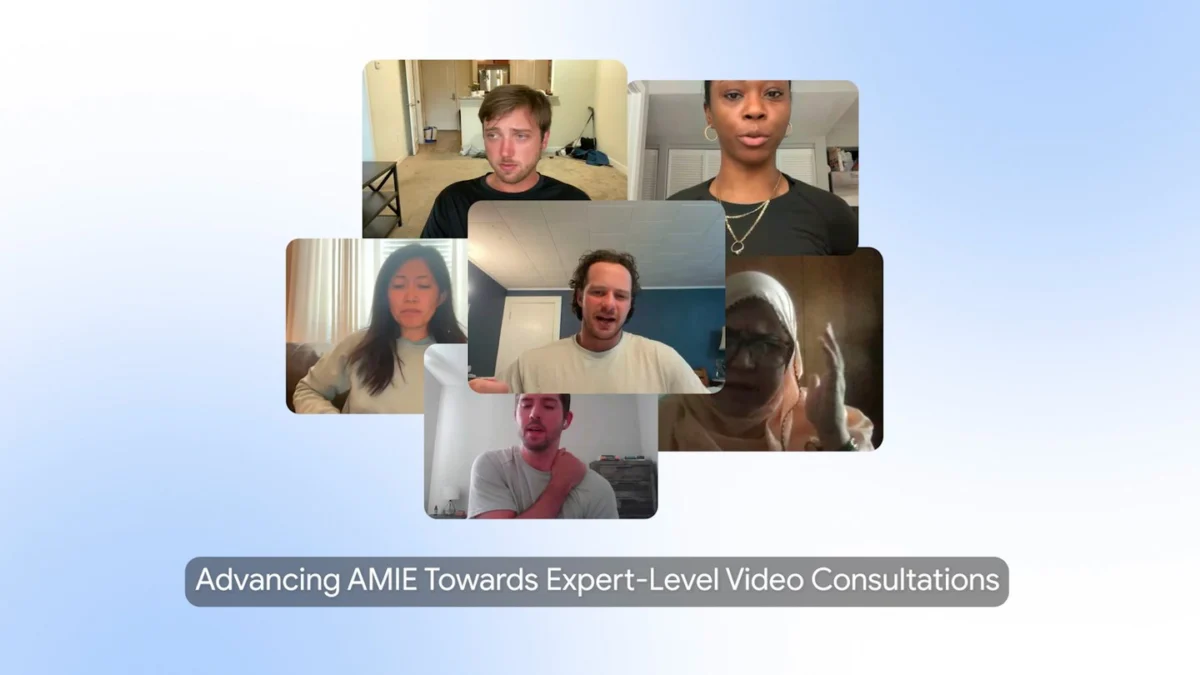
Google Research and Google DeepMind have announced a transformative advancement in the capabilities of AMIE (Articulate Medical Intelligence Explorer), a research-based medical artificial intelligence system. In a significant evolution from its original text-based interface, AMIE has now demonstrated the ability to conduct real-time clinical video consultations. This development, facilitated by a first-of-its-kind study, showcases the system’s capacity to interpret visual and auditory cues, guide virtual physical examinations, and provide diagnostic reasoning with a level of sophistication comparable to human clinicians. By integrating the multimodal capabilities of Gemini and the real-time interaction framework of Project Astra, the researchers have moved closer to a future where AI can assist in the nuanced, observational aspects of healthcare that traditionally require a physical presence.
The transition to video-based interaction marks a shift in how artificial intelligence perceives the patient-provider relationship. In a traditional clinical setting, a physician’s assessment begins the moment a patient walks through the door, encompassing observations of gait, respiratory patterns, and visible signs of distress or discomfort. Until recently, AI systems were largely confined to processing structured data or text-based symptoms. The updated AMIE system utilizes a multi-agent architecture to process a continuous stream of audio and video data, allowing it to "see" and "hear" the patient in a manner that mimics a live telehealth encounter.
The Technological Foundation: Gemini and Project Astra
The advancement of AMIE is rooted in the integration of Google’s most sophisticated AI models. The system is built upon the Gemini family of models, which are natively multimodal, meaning they were trained from the outset to handle text, images, audio, and video simultaneously. This allows AMIE to understand the context of a patient’s verbal descriptions while simultaneously analyzing visual data, such as the appearance of a skin lesion or the range of motion in a limb.
To achieve the low latency required for real-time conversation, AMIE leverages Project Astra, Google’s initiative focused on building universal AI agents that can see and hear the world more clearly and respond more quickly. The multi-agent architecture of AMIE allows different components of the system to handle specialized tasks—one agent may focus on maintaining the flow of conversation and rapport, while another analyzes the clinical validity of the patient’s history, and a third observes visual symptoms. This collaborative framework ensures that the AI can maintain a natural dialogue while performing complex diagnostic reasoning in the background.
Methodology of the Randomized Clinical Study
To evaluate the efficacy of the updated AMIE system, Google conducted a randomized study involving simulated consultations. The study utilized professional patient actors—individuals trained to portray specific medical conditions consistently—to interact with both the AMIE system and a control group of human primary care physicians (PCPs). This methodology is a standard in medical education, often used in Objective Structured Clinical Examinations (OSCEs) to assess the competency of medical students and residents.
The consultations were evaluated by a panel of independent clinical experts and the patient actors themselves. The evaluators used a comprehensive rubric to grade the interactions across several core clinical competencies:
- History-Taking Thoroughness: The ability of the system to ask the right questions to uncover the patient’s medical history and current symptoms.
- Diagnostic Accuracy: The correctness of the differential diagnosis provided by the system based on the information gathered.
- Management Appropriateness: The quality of the suggested next steps, including further testing or treatment plans.
- Communication Quality: The clarity, empathy, and professional tone maintained throughout the consultation.
The results of the study indicated that clinical evaluators assessed AMIE favorably against the human physicians across these metrics. Notably, the patient actors expressed a preference for the video-based AI experience over previous text-based iterations, citing a higher degree of engagement and a more "human-like" interaction.
A Chronology of Google’s Medical AI Development
The evolution of AMIE is part of a decade-long trajectory in Google’s health-focused AI research. This timeline reflects a steady progression from specialized diagnostic tools to generalized clinical assistants:
- 2016: Google researchers published a landmark study in the Journal of the American Medical Association (JAMA) showing that deep learning could detect diabetic retinopathy from retinal fundus photographs with accuracy on par with board-certified ophthalmologists.
- 2019-2021: Research expanded into oncology, with models developed to assist in the detection of breast cancer and lung cancer through medical imaging.
- Late 2022: Google introduced Med-PaLM, a large language model (LLM) designed specifically for the medical domain, which was the first to achieve a "passing" score on the U.S. Medical Licensing Examination (USMLE) style questions.
- 2023: Med-PaLM 2 was released, achieving "expert" level scores on medical licensing questions and demonstrating improved reasoning in complex clinical scenarios.
- Early 2024: The first iteration of AMIE was introduced in a research paper, focusing on the system’s ability to conduct diagnostic dialogues via text.
- Late 2024: The current advancement integrates audio-visual capabilities, moving AMIE into the realm of real-time, multimodal clinical interaction.
Analyzing the Impact of Non-Verbal Cues
The significance of the audio-visual upgrade cannot be overstated in a clinical context. Medical education often emphasizes that up to 80% of a diagnosis can be derived from a thorough history and physical observation. By incorporating video, AMIE can now observe "clinical signs" rather than relying solely on "patient symptoms."
For example, during a virtual physical exam, AMIE can instruct a patient to move a joint or show a specific area of the body to the camera. The system can then analyze the video frames to detect subtle indicators like jaundice (yellowing of the eyes or skin), cyanosis (a bluish tint indicating low oxygen), or tremors. Furthermore, the audio analysis allows the system to detect nuances in speech, such as shortness of breath or changes in voice tone that might suggest neurological or psychological conditions. This transition from a "chatbot" to a "perceptual agent" represents a paradigm shift in the potential utility of AI in telehealth.
Industry Context and Competitive Landscape
Google is not alone in the pursuit of AI-driven healthcare solutions. The medical AI sector has seen rapid growth, with companies like Microsoft (through its acquisition of Nuance) and OpenAI also exploring clinical applications. Microsoft’s DAX (Dragon Ambient eXperience) Copilot is already being used in many hospitals to transcribe and summarize patient visits, reducing the administrative burden on doctors.
However, AMIE’s focus on the diagnostic dialogue itself sets it apart. While most current commercial AI tools act as "scribes" or "assistants," AMIE is designed as an "explorer"—a system that actively engages in the clinical reasoning process. The inclusion of real-time video puts Google at the forefront of the "multimodal" medical AI race, addressing a key limitation of previous models that were "blind" to the patient’s physical state.
Official Responses and Ethical Guardrails
Despite the promising results of the simulated study, Google Research has maintained a cautious and responsible stance regarding the deployment of AMIE. The system remains a research prototype and is not currently intended for real-world clinical use or to replace human doctors.
In official statements, Google researchers emphasized that "more research is needed before responsible real-world clinical deployment." They pointed to several critical areas that require further investigation, including the system’s performance across diverse populations to ensure equity and the mitigation of "hallucinations" (where an AI might confidently state incorrect information).
The ethical implications of such technology are also at the forefront of the discussion. Privacy is a paramount concern, as a video-based AI system would require the processing of highly sensitive personal health data and visual imagery. Google has indicated that any future deployment would require rigorous adherence to data protection standards and regulatory approvals from bodies such as the FDA.
Broader Implications for Global Healthcare
The successful demonstration of a real-time, audio-visual clinical AI has profound implications for global healthcare access. In many parts of the world, there is a critical shortage of primary care physicians. A system like AMIE could eventually serve as a triage tool, helping to identify high-priority cases and providing preliminary guidance in areas where medical expertise is scarce.
Furthermore, the technology could address the growing issue of physician burnout. By handling routine history-taking and preliminary diagnostic workups, an AI system could allow human doctors to focus more on complex decision-making and direct patient care. The preference expressed by patient actors for the video experience also suggests that AI could help bridge the gap in telehealth, making remote consultations feel more personal and thorough than traditional text-based portals.
As Google continues to refine AMIE, the focus will likely shift toward larger-scale clinical trials and the integration of even more specialized medical knowledge. While the journey from a research system to a bedside tool is long and fraught with regulatory and technical challenges, the latest demonstration of real-time clinical video capabilities provides a clear glimpse into a future where AI is an observant, listening, and reasoning partner in the delivery of healthcare.
