

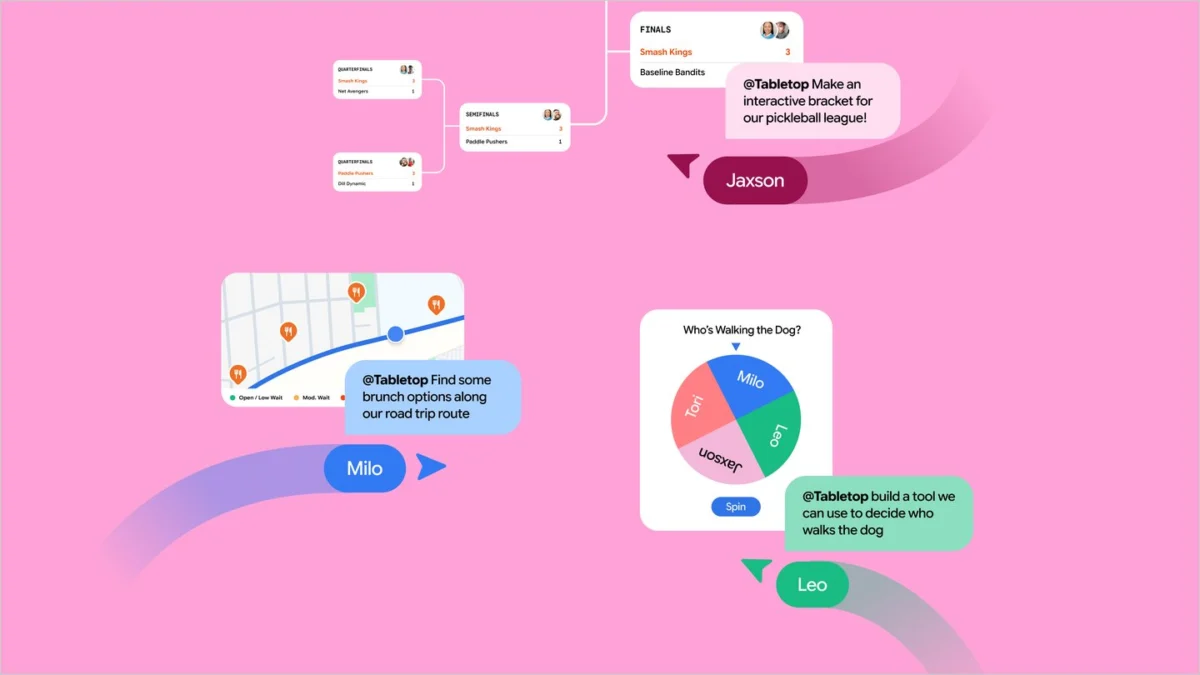
In a significant move to streamline the often fragmented process of group coordination, Google Labs has officially unveiled Tabletop, a new experimental platform designed to serve as a centralized, interactive hub for collective planning and execution. The announcement marks a strategic expansion of Google’s artificial intelligence capabilities into the realm of personal and community logistics, moving beyond traditional document editing toward a more dynamic, AI-assisted workspace. Tabletop allows users to aggregate links, files, and ideas into a single digital environment where an integrated AI agent, accessible via the "@tabletop" command, can instantly generate functional tools such as trip itineraries, expense splitters, and tournament brackets.
A New Paradigm for Real-Time Group Collaboration
Tabletop is built on the foundation of real-time collaboration, a technology Google pioneered with Google Docs nearly two decades ago. However, Tabletop shifts the focus from text-based content creation to operational logistics. The platform is designed to solve the "fragmentation problem"—the common scenario where a group planning a vacation or an event must juggle communication across messaging apps, spreadsheets for budgeting, maps for navigation, and dedicated polling apps for decision-making.
By consolidating these disparate functions into a single "space," Tabletop enables participants to interact with data simultaneously. When a user drops an invite link into a group chat, all members gain access to the shared workspace. The interface is designed to be highly customizable, allowing users to build a digital environment that reflects the specific needs of their project, whether it is a family reunion, a local sports league, or a neighborhood potluck.
Technical Capabilities and the Role of Generative AI
The core innovation within Tabletop is the integration of generative AI to transform static information into interactive components. Users can prompt the system using natural language. For instance, by typing "@tabletop," a user can request a three-day itinerary for a trip to Chicago based on a list of links to museums and restaurants already present in the space. The AI does not merely provide a text summary; it generates an interactive module that can be edited, reorganized, and voted upon by the group.
The platform offers several starter templates to lower the barrier to entry, including:
- Interactive Trip Itineraries: Automatically mapping out schedules based on shared interests and geographical locations.
- Dinner and Event Polls: Streamlining the decision-making process for dates, venues, and menus.
- Expense Splitters: Managing group finances by tracking contributions and calculating debts, similar to specialized apps like Splitwise.
- Tournament Brackets: Providing structure for recreational sports leagues or gaming competitions.
This functionality suggests that Tabletop is leveraging Google’s advanced Large Language Models (LLMs), likely from the Gemini family, to interpret user intent and structure data into specific UI components.
Historical Context: The Evolution of Google Labs
Tabletop is the latest product to emerge from Google Labs, the company’s dedicated incubator for experimental projects. Historically, Google Labs has served as a testing ground for features that eventually become staples of the Google ecosystem, such as Gmail and Google Maps. In the current era of rapid AI development, Google Labs has been revitalized to deploy "bold and responsible" AI experiments.
The launch follows other recent AI-centric initiatives like NotebookLM, which uses AI to help users synthesize information from complex documents, and Search Generative Experience (SGE). Tabletop represents a shift toward "applied AI," where the technology is used to solve mundane but complex logistical hurdles in everyday life. By releasing Tabletop as an experiment, Google can gather user feedback on how AI-driven collaboration tools are used in real-world scenarios before potentially integrating these features into the broader Google Workspace suite.
The Problem Tabletop Aims to Solve: Data and Market Context
The "coordination tax"—the time and mental energy spent on organizing groups—is a well-documented phenomenon in productivity research. According to industry data, the average consumer uses between three and five different applications to plan a single group event. This results in "information silos," where critical details are buried in long chat threads or lost across different platforms.
Market research into digital collaboration trends indicates a growing demand for "all-in-one" workspaces. Platforms like Notion, Miro, and Microsoft Loop have seen significant growth by offering flexible canvases that combine notes, databases, and project management tools. However, these platforms are often tailored for professional or enterprise environments. Tabletop appears to be Google’s attempt to bring this "canvas" philosophy to the consumer and social market, emphasizing ease of use and immediate utility for non-professional tasks.
Official Rollout and Accessibility
As of its launch, Tabletop is being rolled out exclusively in the United States. To manage the experimental phase and ensure platform stability, Google has implemented a waitlist system. Access is currently limited to users aged 18 and older. This age restriction is consistent with Google’s recent policies regarding generative AI experiments, which often require a higher level of user maturity due to the unpredictable nature of AI-generated content.
Prospective users are encouraged to sign up at the dedicated Google Labs portal. While Google has not provided a specific timeline for a global rollout or the transition of Tabletop from an experiment to a permanent product, the company has a history of iterating rapidly based on waitlist feedback.
Strategic Implications for the Productivity Software Market
The introduction of Tabletop carries significant implications for the competitive landscape of productivity software. By creating a space that combines the functionality of several niche apps, Google is positioning itself to capture more "user time" within its ecosystem. If a group uses Tabletop for an expense splitter, they are less likely to leave the Google environment for a third-party financial app.
Furthermore, Tabletop represents a move toward "fluid productivity," where the boundaries between different types of data (text, maps, dates, money) are blurred. For Google, this experiment is a way to test how AI can act as a glue between its existing services. For example, a Tabletop itinerary could logically sync with Google Calendar and Google Maps, creating a seamless end-to-end user experience that competitors without a broad ecosystem of services would struggle to match.
Industry Reactions and Expert Analysis
Initial reactions from tech analysts suggest that Tabletop is a response to the "Notion-ification" of the workspace—a trend where users prefer modular, building-block styles of organization over rigid document formats. "Google is recognizing that the ‘document’ is no longer the primary unit of work for many people," says one industry observer. "For a group of friends planning a trip, a blank white page is less useful than an interactive space that can ‘understand’ their goals."
However, analysts also point to potential challenges. Privacy and data security remain paramount, especially when AI is used to process personal plans and financial splits. Google will need to demonstrate that Tabletop adheres to its stringent AI principles, particularly regarding how user data is used to train future iterations of the model. Additionally, the success of Tabletop will depend on its ability to integrate with non-Google platforms, as group members often use a mix of different operating systems and services.
Conclusion: The Future of Collaborative AI
Tabletop stands as a testament to the current direction of consumer technology: the move away from tools that simply store information toward tools that actively help users process and act upon it. By leveraging AI to automate the creation of brackets, polls, and itineraries, Google is attempting to lower the friction of human collaboration.
As the experiment progresses, the data gathered from the U.S. waitlist will likely determine whether Tabletop becomes a standalone brand, a feature within Google Drive, or a fundamental reimagining of how groups interact online. For now, it offers a glimpse into a future where "planning" is no longer a chore managed across a dozen tabs, but a conversation facilitated by an intelligent, shared digital table. Google’s invitation to "pull up a chair" reflects a broader industry shift toward making AI a helpful, invisible participant in the social and organizational fabric of daily life.
