

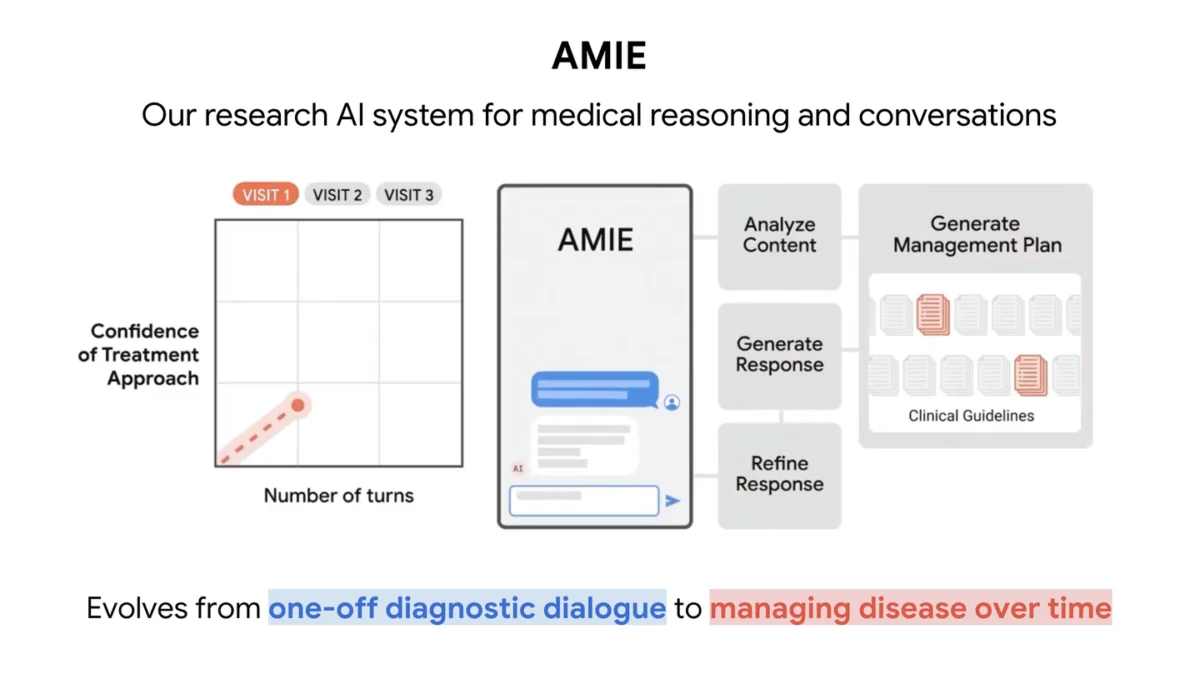
The landscape of digital health underwent a significant transformation today with the publication of new research in the journal Nature, detailing the evolution of Google’s Articulate Medical Intelligence Explorer (AMIE). While initial iterations of medical artificial intelligence focused primarily on the singular task of diagnosis, this latest research demonstrates AMIE’s capacity to transition into the complex realm of longitudinal disease management. This development signals a shift from one-off clinical interactions toward a sustained, AI-augmented approach to chronic care, medication titration, and adherence to evolving clinical guidelines. By leveraging the long-context capabilities of the Gemini model family, AMIE is now capable of processing extensive patient histories, cross-referencing them against hundreds of pages of medical literature, and maintaining an empathetic dialogue with patients over extended periods.
The challenge of modern medicine has increasingly moved beyond the identification of ailments to the management of chronic conditions, which currently account for the vast majority of healthcare expenditures and physician workloads globally. Once a diagnosis is established, the subsequent steps—tracking symptoms across multiple appointments, interpreting updated guidelines, and fine-tuning medication dosages—represent a heavy cognitive load for primary care providers. Google’s research suggests that a specialized AI system can not only match the reasoning capabilities of human clinicians in these tasks but, in certain metrics, exceed them through rigorous alignment with established medical protocols.
The Architectural Foundation of AMIE for Disease Management
At the core of the updated AMIE system is a sophisticated dual-agent architecture designed to handle the nuances of long-term care. This architecture utilizes the expansive context windows of Google’s Gemini models, which allow the system to "remember" and analyze vast amounts of data from previous patient encounters. Unlike traditional chatbots that process information in isolated bursts, AMIE’s longitudinal approach enables it to identify trends in a patient’s health over months or years.
The system is bifurcated into two specialized components. The first is an empathetic dialogue agent, optimized for real-time patient conversations. This agent is trained to handle the emotional and communicative complexities of medical consultations, ensuring that the interaction feels supportive and professional. The second component is a deep-thinking management reasoning agent. This "back-end" of the AI functions as a clinical logic engine, capable of parsing hundreds of pages of authoritative clinical knowledge, including drug formularies and specialty-specific guidelines. By separating the communicative task from the analytical task, AMIE can provide responses that are both human-centric and medically rigorous.
The integration of drug formularies is a particularly notable advancement. In the modern healthcare environment, medication management is often complicated by insurance coverage, cost-effectiveness, and contraindications. AMIE’s ability to cross-reference a patient’s specific condition with the available pharmaceutical options and the latest evidence-based recommendations allows for a level of precision in treatment planning that is difficult to maintain in a standard 15-minute physician consultation.
Methodology and Comparative Performance Data
To validate the efficacy of AMIE in a simulated clinical environment, researchers conducted a rigorous, blinded study. The study involved patient actors—individuals trained to portray specific medical scenarios consistently—who interacted with both AMIE and a cohort of 21 licensed primary care physicians (PCPs). To ensure an unbiased assessment, specialist physicians were tasked with evaluating the transcripts of these interactions without knowing whether the provider was a human or the AI.
The results, as published in Nature, indicate that AMIE matched the human clinicians in overall management reasoning. However, the AI showed a statistically significant advantage in two critical areas: plan preciseness and guideline alignment. In the context of medical care, guideline alignment refers to the degree to which a treatment plan follows the "gold standard" protocols established by medical boards and research institutions. The fact that AMIE scored higher in this area suggests that the AI is less prone to the cognitive biases or "knowledge decay" that can affect human practitioners who may struggle to keep pace with the thousands of medical papers published annually.
Furthermore, the study measured the quality of the dialogue. Despite the common perception of AI as "robotic," the patient actors and the evaluating specialists frequently rated AMIE’s communication as more empathetic and thorough than that of the human clinicians. This is often attributed to the AI’s ability to provide undivided attention and exhaustive explanations without the time pressures that typically constrain human doctors in a busy clinic setting.
Chronology of Medical AI Development at Google
The emergence of AMIE as a tool for disease management is the result of a multi-year trajectory in AI research. This journey began with the development of large language models (LLMs) generalized for text generation, which eventually led to the creation of Med-PaLM. Med-PaLM was the first AI system to reach a passing score on the U.S. Medical Licensing Examination (USMLE) style questions, proving that AI could master medical knowledge.
Following the success of Med-PaLM, Google researchers identified a gap: knowing medical facts is different from conducting a clinical consultation. This led to the first version of AMIE, which focused on diagnostic reasoning through conversational interfaces. By early 2024, AMIE had demonstrated the ability to outperform clinicians in diagnostic accuracy in simulated settings. The current milestone, published today, represents the third major phase: moving from a single point of diagnosis to the continuous, longitudinal management of a patient’s health.
The timeline for AMIE’s development is as follows:
- 2022: Introduction of Med-PaLM, establishing a baseline for medical knowledge in LLMs.
- 2023: Development of the first AMIE prototype, focusing on diagnostic dialogue.
- Early 2024: Pilot studies showing AMIE’s diagnostic capabilities exceeding baseline expectations.
- Late 2024: Publication in Nature regarding longitudinal management and the integration of Gemini’s long-context capabilities.
- 2025 and Beyond: Planned transition to real-world clinical feasibility studies and nationwide virtual care assessments.
Addressing the Global Primary Care Crisis
The implications of AMIE’s success in disease management arrive at a critical time for global healthcare systems. The World Health Organization (WHO) has long warned of a looming shortage of healthcare workers, particularly in primary care. In the United States alone, the Association of American Medical Colleges (AAMC) projects a shortage of up to 48,000 primary care physicians by 2034.
The burden of chronic disease management is a primary driver of physician burnout. Conditions such as diabetes, hypertension, and chronic obstructive pulmonary disease (COPD) require constant monitoring and frequent adjustments to treatment plans. By delegating the administrative and preparatory aspects of these tasks to an AI system like AMIE, physicians could potentially reclaim time for high-level decision-making and complex physical examinations.
Industry analysts suggest that AMIE could serve as a "clinical co-pilot." In this role, the AI would summarize a patient’s progress over the last six months, highlight deviations from clinical guidelines, and propose a range of medication adjustments for the doctor to review. This would transform the physician’s role from a data-gatherer to a final adjudicator, significantly increasing the efficiency of each patient encounter.
Perspectives from the Medical and Research Communities
While the research results are promising, the medical community remains cautiously optimistic, emphasizing the need for real-world validation. Dr. Alan Karthikesalingam, a research lead at Google Health and one of the authors of the study, has noted that the goal of AMIE is not to replace doctors but to provide them with a tool that manages the "information explosion" in modern medicine. He emphasizes that the AI’s ability to remain "guideline-perfect" serves as a safety net for busy practitioners.
Ethicists and patient advocacy groups have raised questions regarding the transparency of AI-driven care. There is a consensus that for AMIE to be integrated into actual clinical workflows, patients must be informed when they are interacting with an AI, and there must be clear accountability for the medical decisions made. The "black box" nature of some AI reasoning remains a point of discussion, though Google’s use of a "deep-thinking reasoning agent" is an attempt to make the AI’s logic more structured and traceable.
The reaction from the broader tech industry has focused on the competitive advantage of Google’s Gemini architecture. By utilizing "long-context" windows—the ability to process millions of tokens of data at once—Google has positioned AMIE as a uniquely capable tool for longitudinal care, a feat that shorter-context models struggle to replicate without losing the "thread" of a patient’s multi-year medical history.
Future Outlook: From Simulation to Clinical Reality
The transition from simulated studies with actors to real-world clinical application is the next significant hurdle for AMIE. Google has announced that it is already exploring how the system could function in actual clinical settings, where variables are far less controlled than in a laboratory. This includes a nationwide randomized study designed to assess the impact of AI in real-world virtual care environments.
These future studies will focus on several key areas:
- Patient Safety: Ensuring that the AI identifies "red flags" that require immediate human intervention.
- Integration: How well the AI connects with existing Electronic Health Records (EHR) systems.
- Equity: Ensuring the AI performs equally well across diverse demographic groups and languages.
- Health Outcomes: Measuring whether patients managed with the help of AMIE actually show better health metrics, such as lower blood pressure or improved glucose control, over time.
As AI continues to permeate the medical field, the research published today in Nature serves as a benchmark for what is possible. If AMIE can successfully navigate the transition from a research environment to the bedside, it may represent the most significant advancement in medical technology since the digitization of health records. For now, it stands as a powerful proof of concept: a future where the management of health is a continuous, data-driven, and deeply empathetic conversation facilitated by artificial intelligence.
