

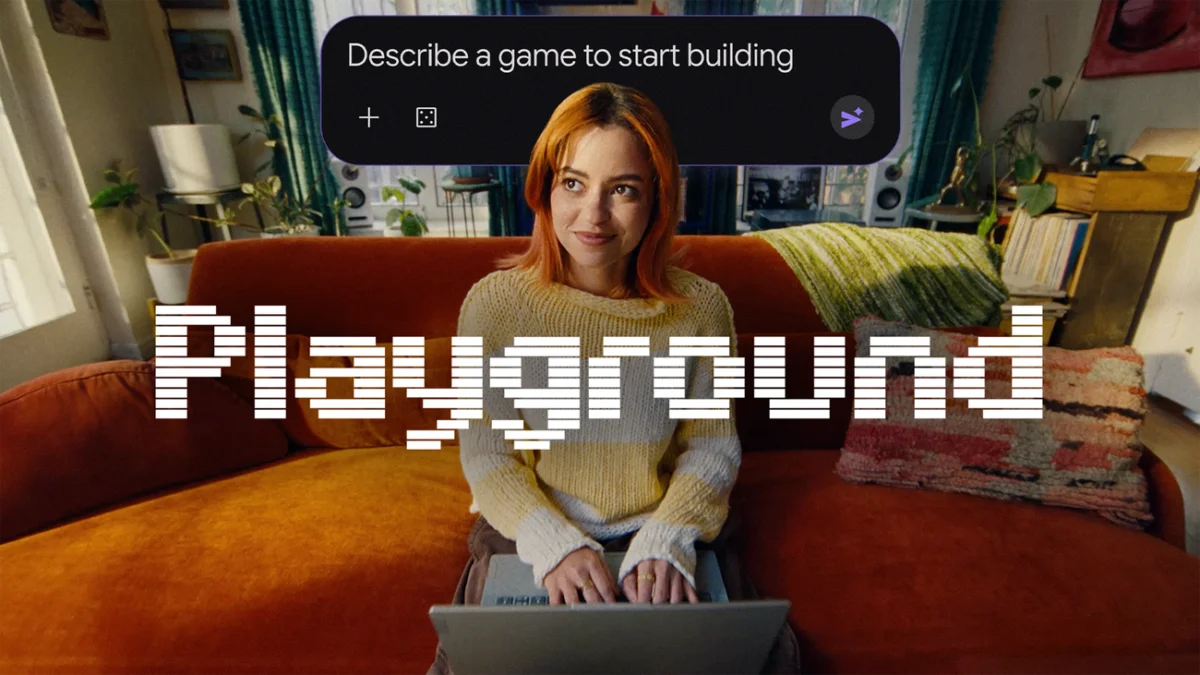
Google has officially unveiled Playground, an experimental gaming platform that leverages generative artificial intelligence to allow users to design, play, and distribute custom video games without any traditional coding knowledge. Developed by the company’s AI Innovation and Research division, the platform aims to democratize game development, a field that has historically required deep technical expertise in programming languages like C++, C#, and Python, alongside mastery of complex engines such as Unreal or Unity. By utilizing a conversational interface, Playground allows users to transform text-based prompts into interactive experiences, effectively turning natural language into functional game logic.
The initiative, led by Software Engineer Maryam Karimzadehgan, marks a significant step in Google’s broader strategy to integrate generative AI into creative workflows. As the gaming community continues to expand—with an estimated 3.2 billion gamers worldwide—the demand for user-generated content (UGC) has reached unprecedented levels. Playground positions itself as a direct response to this demand, offering a low-barrier entry point for creators who possess conceptual ideas but lack the technical training to execute them through traditional means.
The Shift Toward Generative Game Development
The launch of Playground arrives at a pivotal moment for the interactive entertainment industry. For decades, game creation was a gatekept discipline, restricted to those with the resources to hire large teams or the time to learn intricate software suites. The rise of "no-code" and "low-code" platforms like Roblox and Minecraft’s Creative Mode began to shift this dynamic, but even these environments require a fundamental understanding of spatial logic and internal scripting languages.
Playground represents a new tier of accessibility. Instead of manipulating blocks or dragging nodes in a visual script, users interact with an AI model that interprets intent. This "prompt-to-play" workflow allows for the rapid prototyping of mechanics, environments, and character behaviors. For instance, a user can describe a "cozy game where a sloth jumps across city rooftops to collect coffee," and the platform’s underlying AI generates the 2D assets, physics parameters, and win-state conditions necessary to make that vision playable.
This development follows a series of advancements in Large Language Models (LLMs) and generative media. While previous AI applications in gaming were largely limited to non-player character (NPC) dialogue or procedural terrain generation, Playground attempts to synthesize the entire game loop—mechanics, visuals, and rules—through a unified interface.
Technical Architecture and User Experience
The user experience within Playground is centered on a "conversational canvas." Creators can start from a blank slate or utilize "starter prompts" designed to guide them through the initial stages of world-building. Once a baseline is established, the platform allows for iterative refinement. A creator might ask the AI to "make the gravity lighter" or "add a leaderboard for high scores," and the system updates the game’s code in the background in real-time.
Because the platform is browser-based, it bypasses the need for high-end hardware or lengthy installation processes. This accessibility extends to the consumption side; games created on Playground are instantly playable on both mobile devices and desktop computers via a shareable URL.
To foster a social ecosystem, Google has integrated several community-centric features:
- Play Games Profiles: Users can claim custom handles, track their progress, and follow specific creators.
- Public Gallery: An "Explore" page highlights trending and high-rated games, using player activity data to surface creative content.
- Multiplayer Support: Select genres within the platform support real-time competitive or cooperative play, a feature often difficult to implement in traditional no-code tools.
- Remixing: Much like the open-source software movement, users can "remix" existing games, taking a community member’s creation and adding their own creative twists or mechanical improvements.
A Chronology of Game Creation Tools
To understand the impact of Playground, it is necessary to view it through the lens of historical game development evolution.
- The Assembly Era (1970s-1980s): Developers wrote code directly for hardware, requiring intimate knowledge of processor architecture.
- The Engine Revolution (1990s-2000s): The release of engines like id Tech and Unreal allowed developers to reuse code for physics and rendering, though professional-grade programming was still mandatory.
- The No-Code/Sandbox Era (2010s): Platforms like Roblox and Super Mario Maker introduced visual interfaces for game design, significantly lowering the age of the average creator.
- The Generative AI Era (2024-Present): Tools like Playground and the upcoming Unity Spark integration remove the need for manual asset placement and logic mapping, moving the bottleneck from "technical skill" to "creative imagination."
Google’s entry into this space follows its previous experiments with AI-assisted creativity, such as MusicLM for audio and Genie for generating interactive 2D environments from images. Playground serves as the most cohesive implementation of these technologies to date.
The Unity Spark Integration: Bridging the Gap
While Playground focuses on ease of use and 2D experiences, Google has announced a strategic partnership with Unity to expand the platform’s capabilities. "Unity Spark" is an upcoming integration that will allow Playground creators to transition their concepts into high-fidelity 3D environments.
Unity, which powers roughly 70% of the world’s mobile games, provides the professional-level runtime necessary for more complex projects. By linking Playground’s generative interface with Unity’s robust physics and rendering engines, the companies aim to create a pipeline where a user can start with a text prompt and eventually scale their project into a professional-grade release.
This partnership is particularly noteworthy for the indie development community. Many small studios struggle with the "blank page" problem or the high cost of asset creation. Unity Spark could potentially serve as an advanced prototyping tool, allowing professional developers to "sketch" game ideas in Playground before moving them into a full Unity production environment.
Safety, Moderation, and Community Guidelines
As with any platform that allows for user-generated content and generative AI, safety is a primary concern. Google has implemented a multi-layered screening process for all published games. Before a game becomes visible in the Explore gallery, it undergoes automated safety screenings designed to filter out prohibited content, including hate speech, graphic violence, and copyright-infringing materials.
These screenings are aligned with Google’s established Community Guidelines. Furthermore, the platform includes a user reporting system, allowing the community to flag content that bypasses automated filters. Given the experimental nature of the platform and the unpredictability of generative AI, these safeguards are critical to maintaining a welcoming environment, particularly as the platform is currently limited to users aged 18 and older in the United States.
Market Implications and Future Outlook
The launch of Playground has significant implications for the broader tech and gaming industries. According to market research, the global generative AI in gaming market is expected to grow at a compound annual growth rate (CAGR) of over 23% through 2032. By providing a free-to-use (with tiered premium access) platform, Google is positioning itself to capture a significant share of this emerging market.
Industry analysts suggest that Playground could serve several strategic purposes for Google:
- Data Acquisition: User interactions with the game-creation AI provide valuable data for training future models on logic, spatial reasoning, and creative intent.
- Ecosystem Lock-in: By tying creation access to Google AI subscriptions (such as Gemini Advanced), Google creates a new value proposition for its premium services.
- Cloud Dominance: As more users play and host games on the platform, the demand for Google Cloud’s infrastructure increases.
However, the platform also faces challenges. The "black box" nature of generative AI can sometimes lead to hallucinations or nonsensical game logic, which may frustrate users looking for precision. Additionally, the transition from 2D prompts to the 3D complexities of Unity Spark will be a major technical hurdle that remains to be fully demonstrated in a public setting.
Availability and Getting Started
Playground is currently in an early experimental phase. As of today, it is available to users in the United States who are 18 years of age or older. Access to the creation tools is being rolled out in tiers, with priority given to those with active Google AI subscriptions.
The company has emphasized that Playground is a living experiment. Feedback from the initial user base will be used to refine the AI’s understanding of game mechanics and to expand the library of available genres and assets. For now, the public can visit playground.google to play community-created titles such as "Sloth on the Clock" or to begin prompting their own interactive worlds.
As the line between "player" and "developer" continues to blur, Playground stands as a testament to the transformative power of generative artificial intelligence. It suggests a future where the ability to create a game is limited only by one’s ability to describe it, potentially sparking a new wave of digital expression that is as diverse and varied as the community that drives it.
