

In an era saturated with information, the ability to distil complex data and strategic imperatives into compelling narratives has emerged as a paramount skill for business leaders. Beyond mere rhetoric, effective storytelling in a professional context is a proven methodology for fostering engagement, securing buy-in, and galvanizing teams through periods of change and innovation. This approach transcends traditional presentations, transforming flat lists of facts into dynamic, memorable experiences that resonate deeply with audiences and inspire tangible outcomes. The shift towards narrative-driven communication acknowledges the inherent human propensity for stories, recognizing their power to convey meaning, build empathy, and facilitate understanding in ways that raw data often cannot.
The Foundational Power of Narrative in Business Communication
The concept of storytelling in business is not a novel trend but a re-emphasis of fundamental human psychology. Research in neuroscience has consistently demonstrated that stories activate multiple regions of the brain, including those associated with emotion and memory, far more effectively than logical arguments alone. When presented with facts, only two areas of the brain typically engage; however, a well-crafted story can light up seven regions, creating a more holistic and immersive experience for the listener. This cognitive engagement translates directly into higher retention rates, stronger emotional connections, and a greater likelihood of action. For business leaders, this means that the difference between a forgotten presentation and a transformative one often lies in the narrative arc employed.
Traditional business presentations, often characterized by dense slides and an overload of statistics, frequently fail to capture sustained attention. A study by Prezi indicated that 70% of employed Americans find presentations stressful, and a significant portion admit to mentally checking out during such sessions. Conversely, narratives provide context, create suspense, and offer a journey that the audience can follow, making information more digestible and impactful. Leaders who master this art are better positioned to close deals, gain budget approvals, navigate organizational shifts, and align diverse teams towards common objectives. It’s about framing information not as a mere report, but as a potential future, a challenge overcome, or a problem solved.
Seven Pillars of Effective Storytelling in Business Presentations
To transition from conventional reporting to compelling storytelling, presenters can leverage several established techniques. These methods move beyond anecdotal openings, embedding narrative principles into the very structure and delivery of information, ensuring audiences are not just informed but also moved to act.
1. Embracing the Hero’s Journey as a Presentation Structure
At the heart of every powerful story lies a discernible structure, and in business, none is more universally applicable than the "Hero’s Journey." Popularized by mythologist Joseph Campbell, this archetypal narrative describes a hero who embarks on an adventure, confronts a crisis, and returns transformed. Adapting this framework for business presentations provides a robust template:
- The Ordinary World (Beginning): Establish the current state, the status quo, or the prevailing challenge. This is where the audience identifies with the "hero’s" initial situation.
- The Call to Adventure (Problem Identification): Clearly articulate the problem, opportunity, or change that disrupts the ordinary world. This is the catalyst for the journey.
- Refusal of the Call/Meeting the Mentor (Hesitation and Guidance): Acknowledge the difficulties or resistance to change. This is where the presenter, as the mentor, introduces the solution, offering tools, insights, or a new perspective.
- Tests, Allies, and Enemies (The Messy Middle): Detail the challenges in implementing the solution, the obstacles to overcome, and the support available. This builds credibility by addressing potential hurdles.
- The Ordeal (Climax): Present the crucial moment of decision or action where the solution is applied, or the proposed change is enacted.
- Reward (New State): Showcase the immediate benefits or successes following the application of the solution.
- The Road Back/Resurrection (Sustained Impact): Outline how the solution creates lasting value, mitigates future risks, or transforms the "ordinary world" into something better.
- Return with the Elixir (The New Bliss): Conclude with a compelling vision of the future, the ultimate "happily ever after" for the audience, driven by the proposed solution.
Crucially, for this structure to resonate, the roles of the hero and the mentor must be clearly defined and consistently maintained throughout the narrative.

2. Positioning the Audience as the Indispensable Hero
A common misstep in business presentations is for the presenter to inadvertently cast themselves or their organization as the hero. This often manifests in lengthy recitations of company history, impressive client lists, or numerous awards. While such details might establish credibility, they fail to engage the audience on a personal level because the narrative isn’t about them.
The most impactful storytelling presentations fundamentally shift this perspective, positioning the audience as the hero. It is the audience that faces the challenge, grapples with the problem, or seeks a better future. By framing the narrative around their struggles and aspirations, the presenter immediately creates relevance and empathy. For instance, a sales presentation should not focus solely on the product’s features but on how those features empower the customer (the hero) to overcome their business challenges and achieve their goals. This audience-centric approach transforms a monologue about "us" into a dialogue about "you."
3. Embracing the Role of the Guiding Mentor
Following logically from the audience-as-hero principle, the presenter’s role naturally evolves into that of the mentor. The mentor in a story is not the protagonist who achieves glory, but the wise figure who provides the hero with the tools, knowledge, and encouragement necessary to succeed.
Consider a presentation designed to sell a new software solution. A "hero-presenter" might emphasize their company’s market dominance, technological superiority, and vast customer base. While informative, this perspective lacks immediate relevance for the audience’s specific pain points. A "mentor-presenter," however, would articulate the audience’s daily struggles – perhaps inefficient workflows, missed deadlines, or data silos – and then introduce the software as the essential tool that enables them to overcome these obstacles. For example, instead of "Our software has 10 advanced features," a mentor would say, "Imagine regaining 15 hours a week previously lost to manual data entry, allowing your team to focus on strategic initiatives. Our software provides the automation you need to achieve that." This reframing demonstrates an understanding of the audience’s reality and positions the presenter as a trusted guide towards a better future.
4. Harnessing Contrast with the Presentation Sparkline™ Framework
Monotony is the enemy of engagement. Linear presentations, which follow a predictable, step-by-step progression without shifts in emotional or intellectual intensity, often lose an audience’s attention quickly. Just as compelling stories replace "and then" with "but then," effective business narratives leverage contrast to create dynamic tension and maintain audience interest. This is encapsulated in the Presentation Sparkline™ framework.
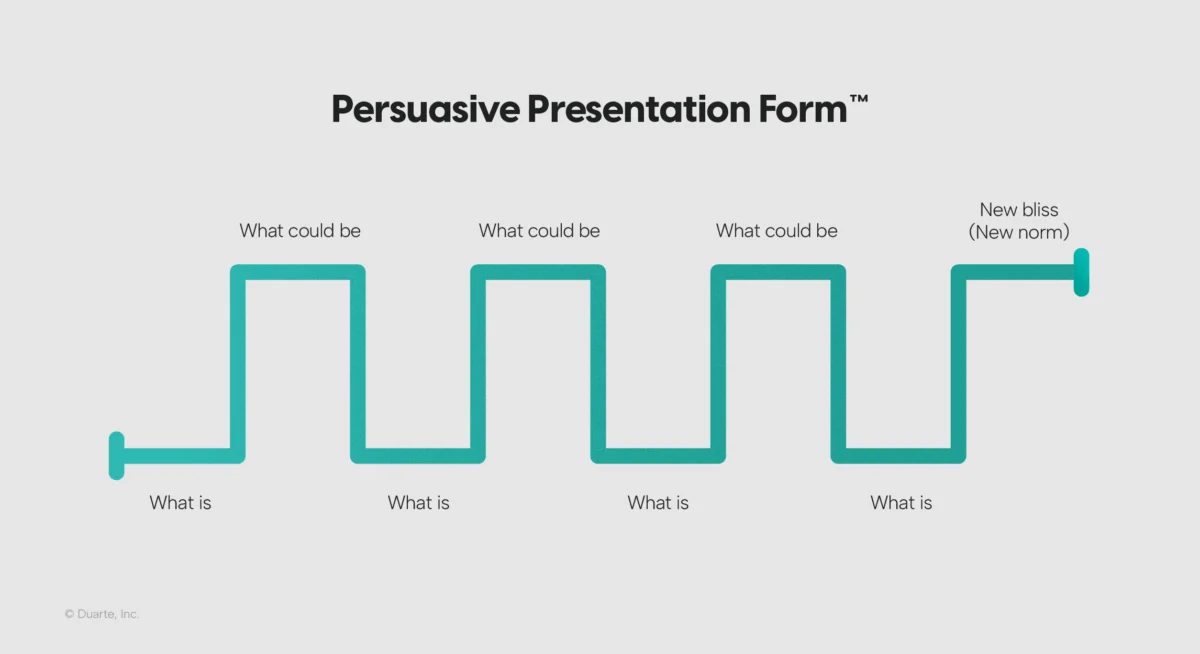
The Sparkline illustrates the interplay between "what is" (the current state, problems, challenges) and "what could be" (the proposed solution, vision, desired future). Most traditional presentations tend to dwell predominantly on one side: a "report" focuses on "what is" with a brief recommendation, while a "pitch" jumps quickly to an idealized "what could be." Both approaches can be disengaging – reports are often dry, and pitches can feel unrealistic or overwhelming.
The Persuasive Presentation Form™, a refinement of the Sparkline, demonstrates how consistently alternating between "what is" and "what could be" creates a more engaging and persuasive narrative. By highlighting the current pain points ("what is"), then offering a glimpse of a better future ("what could be"), only to return to the realities of the present before revealing further transformative possibilities, the presenter builds anticipation and demonstrates a comprehensive understanding of the journey. Iconic speeches, such as Dr. Martin Luther King Jr.’s "I Have a Dream" and Steve Jobs’ 2007 iPhone launch, masterfully employed this oscillation, keeping their audiences captivated through a powerful blend of reality and aspiration. This rhythmic contrast is not merely stylistic; it mirrors the problem-solution dynamic that underpins much of human decision-making.
5. Crafting S.T.A.R. Moments™ for Unforgettable Impact
In an age of information overload, recall is a significant challenge. Audiences rarely remember every data point or slide, but they tend to retain specific, emotionally resonant moments. These are S.T.A.R. Moments™ (Something They’ll Always Remember). A S.T.A.R. Moment is a deliberate, impactful segment designed to etch a key message into the audience’s memory through unexpected visuals, powerful demonstrations, surprising statistics, or vivid analogies.
A classic example is Al Gore’s presentation on climate change, which became the basis for An Inconvenient Truth. To convey the alarming projection of rising CO2 levels, Gore didn’t just display a graph; he physically ascended a lift alongside a projected chart, visually demonstrating the dramatic spike. This experiential moment transcended mere data, creating a visceral understanding of the scale of the crisis. Similarly, a S.T.A.R. Moment could involve a prop that symbolizes a complex idea, a concise, evocative analogy, or a personal anecdote that perfectly illustrates a critical point. The goal is to create a sensory or emotional anchor for the core message, making it stick long after the presentation concludes.

6. Integrating Data Storytelling for Clarity and Persuasion
Data is the backbone of most business decisions, but raw data is often impenetrable and uninspiring. The challenge for presenters is to transform figures and statistics into meaningful insights that drive action. Data storytelling involves contextualizing numbers, making them relevant to the audience’s experience, and using them to advance the narrative.
There are three primary strategies for effective data storytelling:
- Marvel at the Magnitude: Highlight the sheer scale or significance of a data point. Instead of stating "sales increased by 200%," articulate the implication: "This 200% surge represents unprecedented market penetration, reaching twice as many households as our closest competitor."
- Humanize the Data: Connect statistics to real-world impacts on individuals or groups. A statistic about healthcare costs becomes far more potent when framed as "This 15% increase translates to an average of $500 more per family, directly impacting their ability to afford other necessities."
- Surprise the Audience with the Unexpected: Present data in a way that defies expectations or challenges assumptions. Steve Jobs’ 2008 MacBook Air reveal is a prime example. Rather than merely stating its thickness, he dramatically slid the laptop into a standard manila envelope. This unexpected demonstration instantly conveyed the product’s revolutionary thinness in a way that numbers alone could not. Such moments make data not just informative, but also memorable and persuasive.
7. Concluding with "New Bliss": A Vision of the Transformed Future
Every compelling story requires a satisfying conclusion, and in business presentations, this comes in the form of "new bliss." This is not a fairytale ending but a realistic, tangible vision of the positive future state that the audience (the hero) can achieve by embracing the presenter’s (the mentor’s) solution. It’s the "happily ever after" that is within reach, providing a clear and motivating picture of what success looks like.
The "new bliss" synthesizes the solutions presented throughout the narrative, illustrating how they collectively lead to a significantly improved reality. It should address the initial challenges identified, demonstrating a complete transformation from the "what is" to the "what could be." This concluding vision serves as a powerful call to action, inspiring confidence and enthusiasm for the proposed path forward. For a company pitching a new sustainability initiative, the "new bliss" might be a future where the organization not only meets its environmental targets but also garners significant positive brand recognition and achieves cost savings through optimized resource use. It solidifies the value proposition and reinforces the emotional and logical reasons for adopting the proposed change.
Broader Implications for Corporate Strategy and Leadership Development
The mastery of business storytelling extends far beyond individual presentations; it is a fundamental pillar of effective corporate strategy and leadership development. Organizations that cultivate a strong storytelling culture benefit from enhanced internal alignment, more successful change management initiatives, and a more compelling brand narrative that resonates with customers, investors, and employees alike.
- Internal Alignment and Change Management: Within large organizations, storytelling can bridge departmental silos and foster a shared understanding of strategic goals. When employees grasp the "why" behind a new initiative through a clear narrative of challenge and opportunity, resistance decreases, and engagement rises. According to McKinsey & Company, effective communication is a critical success factor for 70% of change programs. Storytelling provides the framework for this effective communication.
- Brand Narrative and Market Impact: A coherent corporate story strengthens brand identity, differentiating a company in a crowded marketplace. It humanizes the brand, allowing customers to connect with its values and mission on an emotional level, leading to increased loyalty and advocacy.
- Leadership Effectiveness: Leaders who can articulate a clear vision and inspire action through narrative are often perceived as more charismatic and effective. They can motivate teams, navigate crises, and foster innovation by painting compelling pictures of future possibilities. This skill is increasingly recognized as a core competency for executive leadership.
- Return on Investment (ROI): While difficult to quantify precisely, the ROI of effective storytelling is evident in higher sales conversion rates, faster budget approvals, reduced project delays due to improved communication, and increased employee retention. A study by the American Psychological Association noted that narratives are up to 22 times more memorable than facts alone, directly impacting the long-term effectiveness of any business communication.
In conclusion, storytelling is no longer a peripheral soft skill but a critical strategic imperative for modern business success. By consciously employing structures like the Hero’s Journey, strategically positioning the audience as the hero and the presenter as the mentor, leveraging contrast through frameworks like the Sparkline, creating memorable S.T.A.R. Moments, and transforming data into compelling narratives that culminate in a vision of "new bliss," leaders can elevate their communication from merely informative to truly transformative. In an increasingly complex and competitive world, the ability to tell the right story, in the right way, at the right moment, remains the most powerful tool in a business leader’s arsenal for driving engagement, inspiring action, and shaping a desirable future.
