

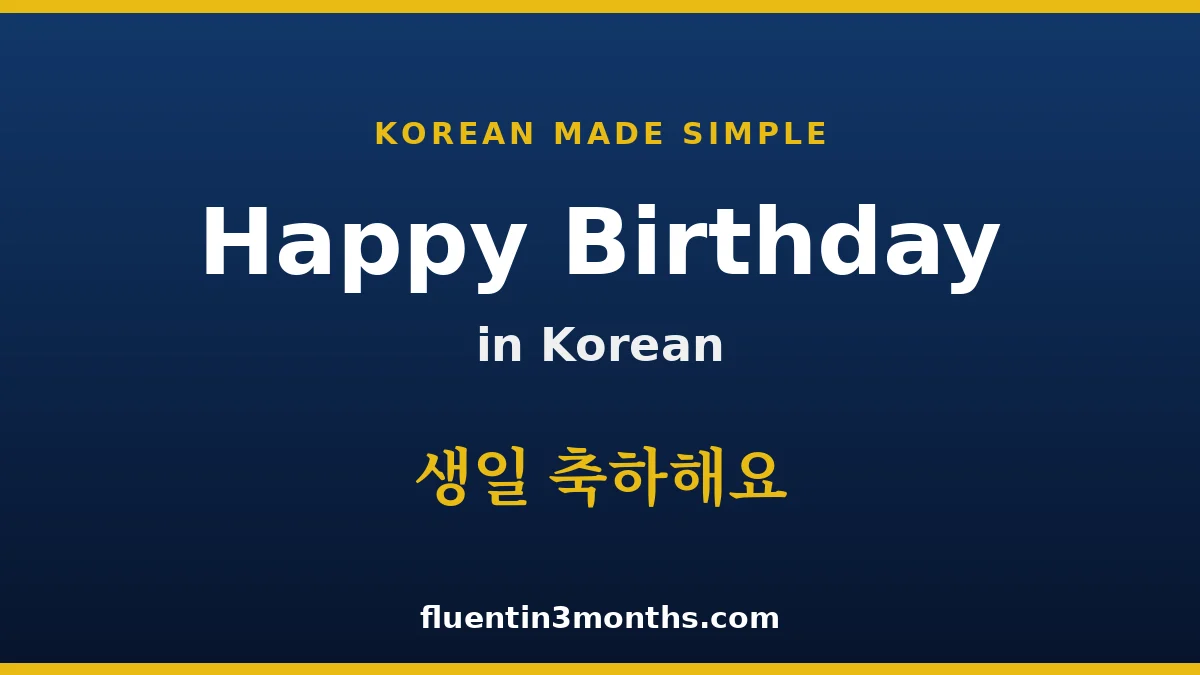
The Korean language is defined by a sophisticated system of honorifics and speech levels that reflect the nation’s deeply rooted Confucian values, making the simple act of wishing someone a "happy birthday" a nuanced exercise in social navigation. The standard, most versatile expression for birthday greetings is saengil chukhahaeyo (생일 축하해요), a phrase that balances politeness with friendliness, yet it represents only one facet of a complex linguistic hierarchy. Understanding when and how to use various forms of this greeting is essential for anyone engaging with Korean culture, particularly in light of recent legislative changes that have overhauled how age is calculated within the country.
The Linguistic Framework of Korean Birthday Greetings
In Korean, the phrase for "happy birthday" is not a direct translation of the English sentiment but is instead framed as a congratulatory remark. The root verb is chukhahada (축하하다), meaning "to congratulate," combined with saengil (생일), the word for birthday. The way these components are assembled depends entirely on the relationship between the speaker and the recipient, the social setting, and the relative age of the parties involved.
Linguists categorize Korean speech into several distinct levels, four of which are most commonly applied to birthday celebrations. The choice of suffix determines the level of deference shown.
The Four Primary Variations of Birthday Greetings
- Casual (Banmal): Saengil chukhae (생일 축하해). This version is strictly reserved for close friends, younger siblings, or children. Using this with a superior or an acquaintance is considered a significant social faux pas, implying a lack of respect for the recipient’s status.
- Polite/Standard (Haeyo-che): Saengil chukhahaeyo (생일 축하해요). This is the "gold standard" for daily interactions. It is appropriate for colleagues, acquaintances, and people of a similar social standing where a degree of professional or social distance remains.
- Formal (Hasipsio-che): Saengil chukhahamnida (생일 축하합니다). This version is used in formal settings, public announcements, or when addressing a large group. It is also the version most commonly used in the lyrics of the Korean birthday song, regardless of the individual relationship between the singers and the celebrated person.
- Honorific/Formal (Saengsin): Saengsin chukhadeurimnida (생신 축하드립니다). This is the highest level of deference. It replaces the standard word for birthday (saengil) with the honorific saengsin and uses the humble verb deurida (to give/offer) instead of the standard chukhahada. This form is used for grandparents, elderly parents, or highly respected seniors and teachers.
The 2023 Legislative Shift: Reforming the Korean Age System
One of the most significant shifts in Korean social and legal life occurred on June 28, 2023, when South Korea officially abolished its traditional age-counting system in favor of the international standard. For centuries, Korea utilized three distinct ways of calculating age, a practice that often led to administrative confusion and social friction.
The Three Systems of Age
Before the reform, Koreans navigated three simultaneous age calculations:
- The Traditional System (Seneun nai): A baby was considered one year old at birth, and everyone in the country aged by one year simultaneously on New Year’s Day.
- The "Year Age" (Yeon nai): Calculated by subtracting the birth year from the current year. This is still used in specific legal contexts, such as the legal age for drinking, smoking, and military conscription.
- The International System (Man nai): The standard system where a person turns one on their first birthday.
The Ministry of Government Legislation reported that the transition to the international system was intended to reduce "unnecessary social and economic costs." In social settings, the change has been met with a mix of relief and habitual resistance. While legal documents and medical records now strictly follow the international age, many Koreans still refer to their "Korean age" in casual conversation, as age remains the primary determinant of speech levels and social hierarchy.
Rituals of the First Year: The Doljanchi
In Korean culture, the first birthday, known as Doljanchi (돌잔치), is arguably the most significant milestone in a person’s early life. This tradition dates back to a time when infant mortality rates were high, and reaching the one-year mark was a cause for immense communal celebration.
The centerpiece of the Doljanchi is a ritual called Doljabi (돌잡이). During this ceremony, the child is placed before a variety of symbolic objects. It is traditionally believed that the first object the child picks up will predict their future career or life path.
- Thread: Symbolizes a long and healthy life.
- Money or Rice: Indicates future wealth and prosperity.
- Pencil or Book: Suggests the child will become a scholar or excel in academics.
- Stethoscope or Gavel: Modern additions representing careers in medicine or law.
While modern Doljanchi celebrations are often held in specialized banquet halls with professional catering, the core essence of the ceremony remains a vital way for families to introduce the newest member of the society to their extended social circle.
The Cultural Significance of Miyeokguk (Seaweed Soup)
Unlike the Western tradition of prioritizing birthday cake, the essential culinary component of a Korean birthday is miyeokguk (미역국), or seaweed soup. This tradition is deeply rooted in maternal health and filial piety.
Seaweed is naturally high in iodine and calcium, making it a staple for recovering mothers in Korea for centuries. By eating miyeokguk on their birthday, individuals are not just celebrating their own life but are symbolically honoring their mother’s sacrifice and the care they received at birth. This practice reinforces the Confucian value of Hyo (filial piety), reminding the individual of their debt of gratitude to their parents.
In professional environments, it is common for colleagues to ask, "Did you have your seaweed soup today?" as a way of acknowledging a person’s birthday without necessarily throwing a formal party.
The Korean Birthday Song and Modern Celebrations
The Korean birthday song utilizes the same melody as the English "Happy Birthday to You" but adapts the lyrics to fit the formal speech level. The lyrics are:
Saeng-il chuk-ha ham-ni-da (Happy birthday to you)
Saeng-il chuk-ha ham-ni-da (Happy birthday to you)
Sa-rang-ha-neun [Name] ssi (Dear beloved [Name])
Saeng-il chuk-ha ham-ni-da (Happy birthday to you)
In contemporary South Korea, birthday celebrations have evolved to include "gifticon" culture. Through mobile platforms like KakaoTalk, it has become standard practice to send digital vouchers for cakes, coffee, or physical goods that the recipient can then have delivered to their home. This has streamlined the gift-giving process in a fast-paced urban society while maintaining the social expectation of generosity.
Milestone Birthdays: Hwangap and Beyond
Beyond the first birthday, other significant milestones include the 60th birthday (Hwangap) and the 70th birthday (Chilsun). Historically, reaching the age of 60 was a rare feat, and the Hwangap was a massive celebration marking the completion of one full cycle of the 60-year lunar calendar.
As life expectancy in South Korea has surged—currently among the highest in the world—the 60th birthday is now often celebrated with a simple family dinner, while the 70th or 80th birthdays have become the new benchmarks for large-scale festivities. These events serve as public acknowledgments of an elder’s wisdom and their contribution to the family lineage.
Broader Implications for Language Learners and International Relations
The global rise of the "Korean Wave" (Hallyu) has led to an explosion of interest in the Korean language. According to data from language-learning platforms like Duolingo, Korean is consistently one of the fastest-growing languages worldwide. However, educators emphasize that learning vocabulary like "happy birthday" is insufficient without understanding the sociolinguistic context.
The use of correct honorifics is seen as a sign of cultural intelligence (CQ). For international businesses and diplomats operating in Seoul, mastering these nuances is critical for building trust. The transition to the international age system is a step toward global synchronization, yet the persistence of traditional greetings suggests that the underlying social hierarchy based on seniority remains a powerful force in Korean society.
Conclusion
Wishing someone a happy birthday in Korean is more than a simple greeting; it is a reflection of the speaker’s awareness of social standing, history, and family values. From the humble bowl of seaweed soup to the high-tech exchange of digital gifts, the Korean birthday serves as a bridge between the nation’s ancestral past and its hyper-modern present. As the country continues to refine its legal definitions of age and identity, the linguistic and ritualistic traditions surrounding the anniversary of one’s birth remain a steadfast pillar of Korean identity. Whether one says saengil chukhae to a friend or saengsin chukhadeurimnida to a grandparent, they are participating in a rich cultural tapestry that prizes respect, gratitude, and communal harmony.
