

The Spanish verb querer stands as one of the most fundamental pillars of the Romance linguistic tradition, serving as the primary vehicle for expressing desire, intent, and various shades of affection. Within the global community of over 500 million Spanish speakers, the mastery of this verb is considered a critical milestone for achieving functional fluency. Unlike regular verbs that follow a predictable pattern of suffix modification, querer is characterized by significant morphological irregularities, necessitating a disciplined approach to its study. This analysis explores the historical roots, grammatical structures, and socio-linguistic implications of the verb, providing a rigorous framework for students and philologists alike.
Historical Context and Etymological Evolution
The contemporary Spanish verb querer finds its origins in the Latin quaerere, a verb originally signifying "to seek," "to search for," or "to inquire." Over centuries of linguistic evolution on the Iberian Peninsula, the semantic scope of the word shifted from the physical act of seeking to the psychological state of desiring or wanting. This transition reflects a broader trend in Vulgar Latin where verbs of motion or inquiry often evolved into verbs of volition.
In the transition from Latin to Old Spanish, querer retained its importance but developed specific orthographic and phonetic irregularities. The most notable of these is the diphthongization of the stem vowel "e" to "ie" when stressed, a common feature in many Spanish verbs (such as pensar or sentir). Furthermore, the preterite forms underwent a radical shift, adopting a "strong" stem—quis-—which deviates entirely from the infinitive. Understanding these historical shifts is essential for comprehending why the verb behaves as it does in modern syntax.
The Paradigm of the Indicative Mood
The indicative mood represents the foundational layer of Spanish communication, used to state facts, describe reality, and convey certainty. For querer, the indicative mood is divided into simple and compound tenses, each serving a distinct temporal and aspectual function.
The Present Indicative and Stem Change Mechanics
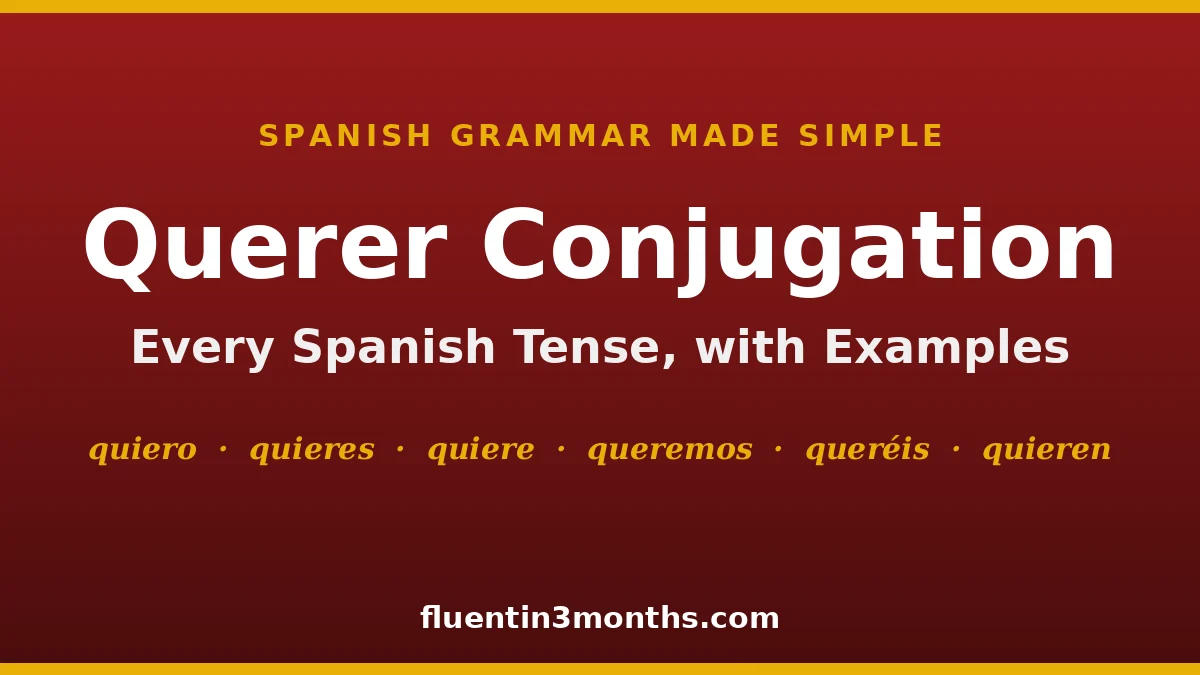
In the present tense, querer functions as an "e to ie" stem-changing verb. This change occurs in all forms except for the nosotros (we) and vosotros (you all, informal Spain) conjugations, where the stress falls on the ending rather than the stem.
- Yo quiero (I want/love)
- Tú quieres (You want/love)
- Él/Ella/Usted quiere (He/She/You want/love)
- Nosotros/as queremos (We want/love)
- Vosotros/as queréis (You all want/love)
- Ellos/Ellas/Ustedes quieren (They/You all want/love)
This tense is the primary tool for daily interactions, ranging from ordering sustenance in a commercial setting to expressing immediate emotional states.
Past Tense Dichotomy: Preterite versus Imperfect
A significant challenge for English speakers is the distinction between the preterite and the imperfect tenses. In the case of querer, the choice of tense fundamentally alters the meaning of the sentence.
The Preterite (quise, quisiste, quiso, quisimos, quisisteis, quisieron) is used for completed actions in the past. When querer is used in the preterite, it often implies an attempt or a specific instance of wanting that resulted in an action. For example, "Quise salir" can mean "I tried to leave." In the negative, "No quise," it frequently translates to "I refused."
Conversely, the Imperfect (quería, querías, quería, queríamos, queríais, querían) describes ongoing states or background conditions. It is used to express a desire that existed over an indefinite period without focusing on its beginning or end. "Yo quería un perro" translates to "I wanted a dog (as a general state of being in the past)."
Future and Conditional Developments
The future and conditional tenses of querer are irregular in their stems. Rather than using the full infinitive, the "e" is dropped, and an additional "r" is inserted, resulting in the stem querr-.
- Future: querré, querrás, querrá, querremos, querréis, querrán (I will want).
- Conditional: querría, querrías, querría, querríamos, querríais, querrían (I would want).
The future tense is often used for predictions or promises, while the conditional is used for hypothetical scenarios or to express politeness, though the latter is frequently supplanted by the imperfect subjunctive in modern speech.
The Subjunctive Mood: Desires and Hypotheticals
The subjunctive mood is a hallmark of Spanish grammar, used to express subjectivity, doubt, or unreality. Given that querer inherently deals with desires—which are by definition subjective—it frequently triggers the subjunctive in subordinate clauses.
Present Subjunctive
The present subjunctive (quiera, quieras, quiera, queramos, queráis, quieran) follows the stem-changing pattern of the present indicative but utilizes the "a" thematic vowel. It is commonly used in structures like "Espero que quieras venir" (I hope you want to come).
The Versatility of the Imperfect Subjunctive
The imperfect subjunctive of querer (quisiera) is perhaps one of the most culturally significant forms of the verb. While its primary grammatical function is to exist in past-tense subjective environments, it has evolved into a standard tool for "polite requests."
In a linguistic phenomenon known as "softening," using the form quisiera instead of the blunt quiero signals respect and social awareness. When a patron says, "Quisiera un café," they are technically saying "I would like a coffee," which is considered far more appropriate in professional or formal service environments than the direct "I want."
Compound Tenses and the Role of the Past Participle
The compound tenses are formed using the auxiliary verb haber combined with the past participle querido. These tenses allow for the expression of actions that have a relationship with another point in time.
- Present Perfect: He querido (I have wanted). Used for recent past actions with present relevance.
- Pluperfect: Había querido (I had wanted). Used for an action that occurred prior to another past action.
- Future Perfect: Habré querido (I will have wanted).
- Conditional Perfect: Habría querido (I would have wanted).
The past participle querido also doubles as an adjective meaning "dear" or "beloved," frequently used in the salutations of formal letters or to describe a cherished individual.
Socio-Linguistic Analysis: "Te Quiero" versus "Te Amo"
One of the most nuanced aspects of the verb querer lies in its use as an expression of love. In the English language, the word "love" covers a vast spectrum of affection, from a preference for a specific food to deep romantic commitment. Spanish, however, bifurcates this concept primarily through the verbs querer and amar.
Regional Variations and Intensity
Data from linguistic surveys across the Hispanosphere suggest that the usage of te quiero versus te amo varies significantly by geography. In Spain, te quiero is the standard expression for almost all forms of love, including between romantic partners, family members, and close friends. Te amo is often reserved for highly stylized, poetic, or extremely intense romantic contexts, and can sometimes sound overly dramatic or "cinematic" to the Peninsular ear.
In contrast, many Latin American dialects utilize te amo more frequently in long-term romantic relationships, while te quiero remains the staple for friends and extended family. Despite these regional preferences, te quiero remains the more versatile and commonly used phrase globally. It carries a sense of "I care for you" or "I value you," providing a level of intimacy that is profound yet grounded.
Practical Application and Pedagogical Strategies
For the language learner, the transition from theoretical knowledge to practical application requires a multi-faceted approach. Educators typically recommend a "phased acquisition" strategy:
- Immediate Utility: Prioritizing the present indicative and the polite quisiera for basic survival and social interaction.
- Narrative Capability: Mastering the preterite/imperfect distinction to tell stories and describe past desires.
- Complex Expression: Integrating the subjunctive and conditional forms to express nuanced opinions and hypothetical situations.
Statistical analysis of language acquisition indicates that learners who engage with "high-frequency" irregular verbs like querer early in their studies show a 30% faster progression toward B1 level proficiency (Common European Framework of Reference for Languages) compared to those who focus solely on regular verb patterns.
Broader Implications in Modern Communication
The importance of querer extends beyond the classroom into the realms of international diplomacy, commerce, and media. As Spanish continues to expand as a global lingua franca, particularly in the United States and within the European Union, the ability to navigate the subtle differences between "wanting" and "loving" is essential for cross-cultural competency.
In a professional context, the misuse of querer (such as using a direct imperative when a subjunctive request is required) can lead to perceived rudeness, potentially impacting negotiations or workplace harmony. Conversely, the correct application of the verb’s various moods allows for a sophisticated level of communication that honors the social hierarchies and emotional nuances inherent in Hispanic cultures.
Conclusion
The verb querer is more than a mere grammatical unit; it is a linguistic mirror reflecting the history, values, and social structures of the Spanish-speaking world. From its Latin origins as a verb of inquiry to its modern status as a dual-purpose expression of will and affection, it remains an indispensable tool for anyone seeking to understand the heart of the Spanish language. By mastering its irregular forms and subtle meanings, the speaker gains access to a richer, more empathetic mode of human connection.
