


For decades, the bedrock of effective communication has been widely understood through maxims from ancient philosophers like Epictetus to modern business magnates like Richard Branson, all emphasizing the profound importance of listening over speaking. This long-held wisdom has shaped educational approaches from early childhood, equating effective listening primarily with passive attention – remaining silent, nodding, making eye contact, and avoiding interruption. This foundational philosophy, often encapsulated in the concept of "active listening" in professional settings, has guided countless training programs centered on maintaining focus and paraphrasing spoken words. While these practices are undeniably valuable and represent a significant step beyond mere inattention, a growing consensus among communication experts suggests that the modern, dynamic workplace demands a more nuanced and strategically responsive approach to listening. This shift culminates in the introduction of Adaptive Listening™, a new framework designed to move beyond the foundational principles of active listening and equip professionals with the skills to truly meet the specific, evolving needs of their communication partners.
The Evolution of Listening Paradigms in the Workplace
Historically, the understanding and teaching of listening skills have undergone several key evolutions. In the mid-20th century, communication theory often focused on a sender-receiver model, where the listener’s primary role was to decode the message accurately. This gave rise to the emphasis on simply "paying attention" as the core of good listening. As workplaces became more complex and interdependencies grew, the concept of "active listening" gained prominence. Popularized in the 1950s by Carl Rogers and Richard Farson, active listening encouraged listeners not just to hear words but to interpret the full message, including non-verbal cues, and to demonstrate understanding through techniques like paraphrasing, summarizing, and asking open-ended questions. This model became a cornerstone of management training and conflict resolution, largely because it fostered empathy and ensured message reception.
However, the rapid pace of globalized business, the proliferation of digital communication channels, and the increasing complexity of team dynamics have exposed limitations in even robust active listening models. While ensuring understanding, active listening often presupposes a universal listener response, failing to account for the diverse, immediate goals a speaker might have in a given interaction. A recent study published by the International Journal of Business Communication indicated that approximately 60% of workplace misunderstandings stem from misaligned communication objectives, rather than mere inattention. Furthermore, internal corporate reports frequently cite poor communication as a primary driver of project delays, team friction, and employee disengagement, with estimated costs running into billions of dollars annually for large organizations. These findings underscore the critical need for a more adaptable listening strategy.
Introducing Adaptive Listening™: A Goal-Oriented Approach

Developed and rigorously tested within professional environments, Adaptive Listening™ posits that true listening effectiveness is not a one-size-fits-all skill, but rather a dynamic process of aligning the listener’s response with the speaker’s specific goals and needs during an interaction. This model challenges the conventional wisdom that silent attentiveness alone constitutes effective listening, advocating instead for a critically analytical and observant approach. The fundamental question at the heart of Adaptive Listening is: "What does the person speaking need from me right now?" This contrasts sharply with the common internal monologue of "What’s in it for me?" or "How does this impact my job?" that often preoccupies listeners.
Adaptive Listeners™ are trained to actively diagnose the speaker’s intent and then tailor their listening and response to fulfill that intent. This approach moves beyond simply absorbing information or confirming understanding; it empowers listeners to become strategic partners in the communication process. The benefits of this elevated form of listening are multifaceted and significant for organizational health and individual success. Enhanced communication can lead to improved decision-making, reduced conflict, stronger team cohesion, increased productivity, and a more positive workplace culture. It fosters trust, builds stronger relationships, and accelerates problem-solving, creating a more responsive and resilient workforce.
The S.A.I.D.™ Framework: Four Core Listening Goals
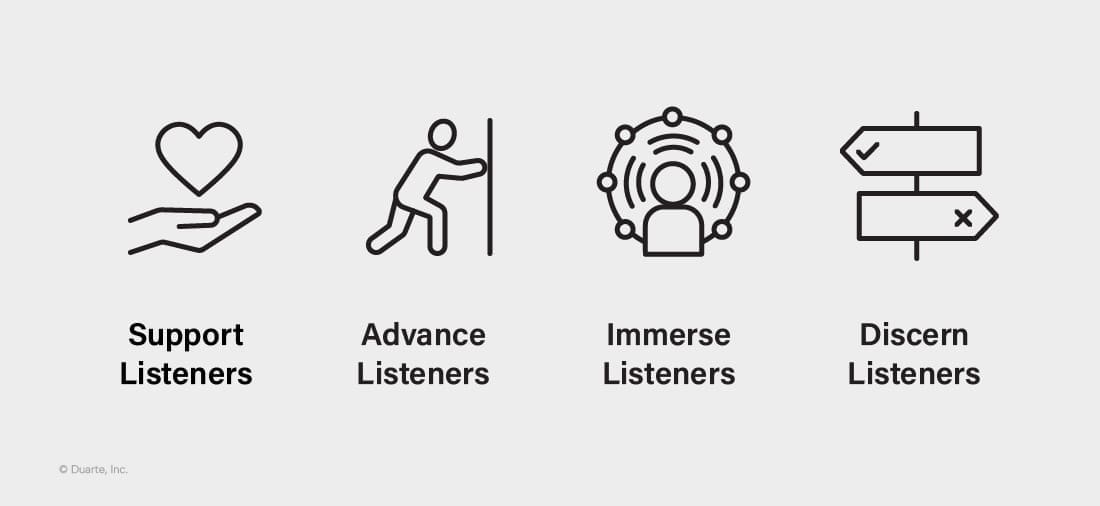
Adaptive Listening introduces a memorable and practical framework, S.A.I.D.™, which identifies four primary goals a speaker typically seeks to achieve during workplace interactions. By recognizing these goals, listeners can consciously adapt their approach to provide the most relevant and impactful response. The acronym S.A.I.D. stands for Support, Advance, Immerse, and Discern.
1. Support Listening™ Skills:
This listening mode is crucial when a speaker seeks emotional acknowledgment, validation, or shared experience. In the professional sphere, individuals frequently encounter moments of both challenge and triumph. Whether navigating a difficult project setback, grappling with personal stress impacting work, or celebrating a major achievement, the underlying human need for connection remains constant. Support Listening requires the listener to tune into the speaker’s emotional state, mirroring their feelings and offering appropriate empathetic responses.
- Contextual Cues: Phrases like "I’m having a horrible day," "I just can’t catch a break," or "I have the best news!" are clear indicators that the speaker needs emotional support.
- Adaptive Response: The listener’s role is to act as a confidant or a cheerleader. This might involve active commiseration, offering words of comfort, validating their feelings ("That sounds incredibly frustrating"), or enthusiastically celebrating their success. The key is to acknowledge and validate their emotional experience, rather than immediately jumping to solutions or analysis.
2. Advance Listening™ Skills:
When a speaker is feeling overwhelmed, pressed for time, or struggling to move a project forward, they are often seeking assistance to lighten their load or propel progress. Advance Listening is about identifying bottlenecks and actively contributing to solutions that move individuals, projects, or processes to the next logical step.
- Contextual Cues: Statements such as "I don’t think I’ll have time to finish all of this," "I’m stuck on how to proceed," or "I don’t know how I’m going to keep this project moving" signal a need for advancement.
- Adaptive Response: The listener’s objective is to facilitate progress. This could involve offering to take on specific tasks, delegating responsibilities to others, connecting the speaker with relevant resources, or jointly brainstorming next steps. The focus is on tangible actions that unburden the speaker and drive momentum.
3. Immerse Listening™ Skills:
Many workplace interactions are purely informational, where the speaker’s goal is simply to convey data, updates, or entertainment without immediate expectation of critique or action. Immerse Listening requires the listener to act as a "content sponge," absorbing information without prejudice or interruption, with the primary goal of understanding and retention.
- Contextual Cues: Phrases like "I’m here to give you an update today," "Just sit back and enjoy this presentation," or "I want to walk you through the new policy" indicate that the speaker intends to inform or entertain.
- Adaptive Response: The listener’s task is to actively receive and catalog the information. This involves taking notes, mentally organizing facts, and only asking clarifying questions for the sole purpose of ensuring accurate comprehension. Judgment, debate, or problem-solving are deferred until the informational delivery is complete.
4. Discern Listening™ Skills:
Critical evaluation is an indispensable component of organizational success. From project proposals to performance reviews, the workplace frequently demands objective assessment, identification of strengths and weaknesses, and the foresight to pinpoint potential risks and opportunities. Discern Listening is employed when a speaker explicitly seeks feedback, critique, or an objective analysis of a situation, idea, or plan.
- Contextual Cues: Statements such as "I need some feedback on this," "I’m not sure if this makes sense," "What do you think are the potential pitfalls here?" or "How can we improve this?" are clear signals for discernment.
- Adaptive Response: The listener’s role is to engage in critical thinking, providing constructive evaluation. This involves identifying both red flags and positive aspects, offering balanced perspectives, and helping the speaker refine their ideas or approach. The feedback should be objective, actionable, and aligned with the speaker’s request for evaluation.
Implications and Broader Impact of Adaptive Listening
The implementation of Adaptive Listening represents a significant step forward in fostering truly empathetic and effective communication cultures within organizations. By consciously training employees to identify and respond to the specific needs of their communication partners, companies can expect a range of profound benefits:
- Enhanced Trust and Psychological Safety: When individuals feel truly heard and understood, trust flourishes. This fosters psychological safety, encouraging open dialogue, honest feedback, and greater innovation.
- Reduced Miscommunication and Conflict: By proactively addressing the speaker’s goals, Adaptive Listening minimizes assumptions and misunderstandings, thereby reducing the frequency and intensity of workplace conflicts.
- Improved Decision-Making: When leaders and teams are adept at discerning what information is truly needed and how to provide it, decision-making processes become more efficient, informed, and robust.
- Increased Productivity and Efficiency: Time wasted on clarifying miscommunications or addressing emotional fallout from feeling unheard is significantly reduced, leading to more streamlined operations and project delivery.
- Stronger Leadership and Team Cohesion: Leaders who are Adaptive Listeners are perceived as more approachable, empathetic, and effective. This strengthens team bonds and improves overall morale and engagement.
- Agility in a Dynamic Environment: The ability to quickly adapt listening styles allows teams to navigate rapidly changing priorities and complex challenges with greater fluidity and effectiveness.
The Adaptive Listening model, as detailed in the recently released book Adaptive Listening: How to Cultivate Trust and Traction at Work, offers practical, easy-to-remember techniques designed to mitigate ambiguity and tension inherent in today’s fast-paced work environments. It moves beyond the foundational "active listening" to provide a framework that acknowledges the multifaceted nature of human interaction and the diverse needs of individuals in professional settings. This comprehensive approach is applicable across all organizational levels and relationships—whether listening to colleagues, direct reports, superiors, clients, or external stakeholders.
As workplaces continue to evolve, demanding greater collaboration, empathy, and efficiency, the strategic application of Adaptive Listening is poised to become an indispensable skill set. By shifting the focus from simply "hearing" to profoundly understanding "what the other person needs from me," organizations can unlock new levels of communication effectiveness, fostering environments where every interaction contributes meaningfully to shared success.
