

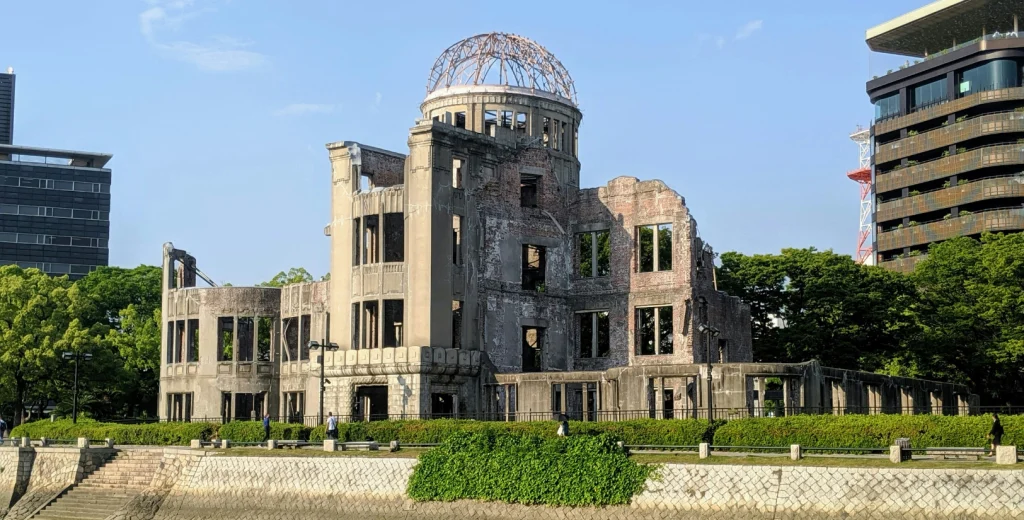
In a recently released deep-dive episode of the Anecdotally Speaking podcast, business narrative experts Mark and Shawn explore the profound intersection of historical trauma and modern leadership through the lens of one of the 20th century’s most improbable survival stories. Episode 284, titled "The Story You Tell Yourself," uses the life of Tsutomu Yamaguchi—the only person officially recognized by the Japanese government to have survived both the Hiroshima and Nagasaki atomic bombings—to illustrate how narrative framing determines an individual’s capacity for resilience and a leader’s ability to guide organizations through crisis. The discussion moves beyond the historical facts of the 1945 bombings to analyze the psychological mechanisms of "meaning-making," a process by which leaders and employees interpret data to form their professional and personal identities.
The Dual Survival of Tsutomu Yamaguchi
The core of the episode centers on a narrative account of Tsutomu Yamaguchi, a 29-year-old naval engineer for Mitsubishi Heavy Industries. In August 1945, Yamaguchi was concluding a three-month business trip to Hiroshima. On the morning of August 6, as he was walking to the Mitsubishi shipyard to finalize paperwork, the B-29 bomber Enola Gay dropped the "Little Boy" atomic bomb. Yamaguchi, who was approximately three kilometers from the hypocenter, witnessed a blinding flash and was thrown into a ditch by the resulting shockwave. Despite suffering ruptured eardrums and severe thermal burns across the left side of his upper body, he managed to find shelter and survived the night in a city that had been largely incinerated.
The following day, Yamaguchi navigated the wreckage of Hiroshima to reach the railway station, which miraculously remained functional on the city’s outskirts. He returned to his hometown of Nagasaki to seek medical treatment. On August 9, despite his debilitating injuries and bandages, Yamaguchi reported to the Mitsubishi office in Nagasaki to brief his supervisor on the devastation he had witnessed in Hiroshima. Historical accounts, echoed in the podcast, suggest his superior was skeptical, questioning how a single bomb could destroy an entire city. At that precise moment, the second atomic bomb, "Fat Man," was detonated over Nagasaki. Once again, Yamaguchi was roughly three kilometers from ground zero; once again, he survived.
Chronology of the 1945 Atomic Events
To understand the magnitude of the resilience discussed in the podcast, it is necessary to contextualize the timeline of the events Yamaguchi endured. The following chronology outlines the rapid succession of disasters that shaped his narrative:
- August 6, 1945 (8:15 AM): The first atomic bomb is dropped on Hiroshima. An estimated 60,000 to 80,000 people are killed instantly. Yamaguchi is injured but survives.
- August 7, 1945: Yamaguchi travels through the ruins of Hiroshima to reach a train heading for Nagasaki.
- August 8, 1945: Yamaguchi arrives in Nagasaki and receives basic medical treatment for his burns and hearing loss.
- August 9, 1945 (11:02 AM): While Yamaguchi is explaining the Hiroshima blast to his boss, the second atomic bomb is dropped on Nagasaki. Approximately 35,000 to 40,000 people are killed instantly.
- August 15, 1945: Japan announces its surrender, ending World War II.
- Post-1945: Yamaguchi spends decades recovering from radiation sickness and psychological trauma before becoming a vocal advocate for nuclear disarmament.
The Psychology of Narrative Framing: Lucky or Unlucky?
A central theme of the Anecdotally Speaking analysis is the concept of narrative framing. Mark and Shawn pose a rhetorical question to the audience: Was Tsutomu Yamaguchi the unluckiest man in history for being present at both atomic bombings, or the luckiest man for surviving both?
The podcast argues that while the external facts—the explosions, the radiation, the loss of life—remain static, the "meaning" of the story is entirely dependent on the frame the narrator chooses. In a leadership context, this is referred to as "meaning-making." Resilience is not merely the ability to "bounce back" from adversity but the ability to construct a story about that adversity that allows for continued action and growth. For Yamaguchi, the narrative eventually shifted from one of victimhood to one of purpose; he lived to be 93 years old, eventually sharing his story with the United Nations to ensure the horrors he witnessed were never repeated.
Supporting Data on Narrative in Leadership
The implications for modern corporate leadership are significant. Research in organizational psychology suggests that the way a leader frames a setback—be it a failed product launch, a market downturn, or a corporate restructuring—directly impacts employee morale and retention.

- Retention of Information: Studies by cognitive psychologist Jerome Bruner suggest that facts are 22 times more likely to be remembered if they are part of a story. Leaders who use narrative to explain "why" a change is happening are more likely to achieve alignment than those who rely solely on data.
- Psychological Safety: According to Google’s "Project Aristotle," psychological safety is the number one predictor of team success. Narrative storytelling builds this safety by humanizing leaders and allowing for the sharing of failures as "learning chapters" rather than "final endings."
- Resilience Metrics: Organizations that foster a "growth mindset" narrative—where challenges are viewed as opportunities for development—report 34% higher levels of employee engagement compared to those with a "fixed mindset" narrative.
Meaning-Making and Communicating Unpopular Decisions
The podcast episode also tackles a common leadership dilemma: how to communicate decisions that the leader may not personally agree with. This requires a high level of "narrative integrity." Mark and Shawn discuss how leaders can maintain authenticity by acknowledging the complexity of a situation rather than presenting a sanitized version of events.
By using storytelling techniques such as "foreshadowing"—preparing an audience for what is to come by planting seeds of the eventual outcome—leaders can reduce the shock of major organizational shifts. Furthermore, the role of "audience participation" in meaning-making is highlighted. Leaders should not just tell a story to their employees; they should provide a framework that allows employees to write their own roles within that story. This participation fosters a sense of agency, which is a critical component of resilience.
Official Recognition and Global Impact
For many years, the Japanese government only recognized Yamaguchi as a hibakusha (explosion-affected person) for the Nagasaki bombing. It was not until March 2009 that the government of Japan officially recognized him as a "double hibakusha," acknowledging his presence at both sites. This official certification was a landmark moment, providing a formal structure to a narrative that had previously been viewed by some as an urban legend or a statistical impossibility.
Yamaguchi’s story has since become a cornerstone of nuclear education. Before his death in 2010, he became a symbol of human endurance. His transition from a private citizen who rarely spoke of his trauma to a global advocate highlights the "redemptive narrative" arc often studied in psychology—where a person moves from a "contamination" event (the trauma) to a "redemption" event (the advocacy).
Broader Implications for the Modern Workforce
The discussion by Anecdote International serves as a reminder that in an era of rapid technological change and global volatility, the "soft skill" of storytelling is actually a "hard skill" for survival. The ability to manage the "story you tell yourself" is the foundation of mental health and professional longevity.
As organizations move toward 2026 and beyond, the demand for "human-centric" leadership is increasing. The podcast suggests that the most effective leaders of the future will be those who act as "Chief Storytelling Officers," helping their teams navigate the "blinding flashes" of industry disruption by providing a narrative that emphasizes survival, adaptation, and eventual triumph.
In summary, the story of Tsutomu Yamaguchi is more than a historical curiosity. It is a profound case study in the power of the human spirit to frame its own reality. Whether in the ruins of a post-war city or the boardroom of a multinational corporation, the narrative remains the same: the facts of our lives may be beyond our control, but the stories we tell about those facts define who we become. By mastering the art of the anecdote, leaders can transform "unlucky" circumstances into "lucky" opportunities for growth, ensuring that their organizations do not just survive the flash, but thrive in the aftermath.
