

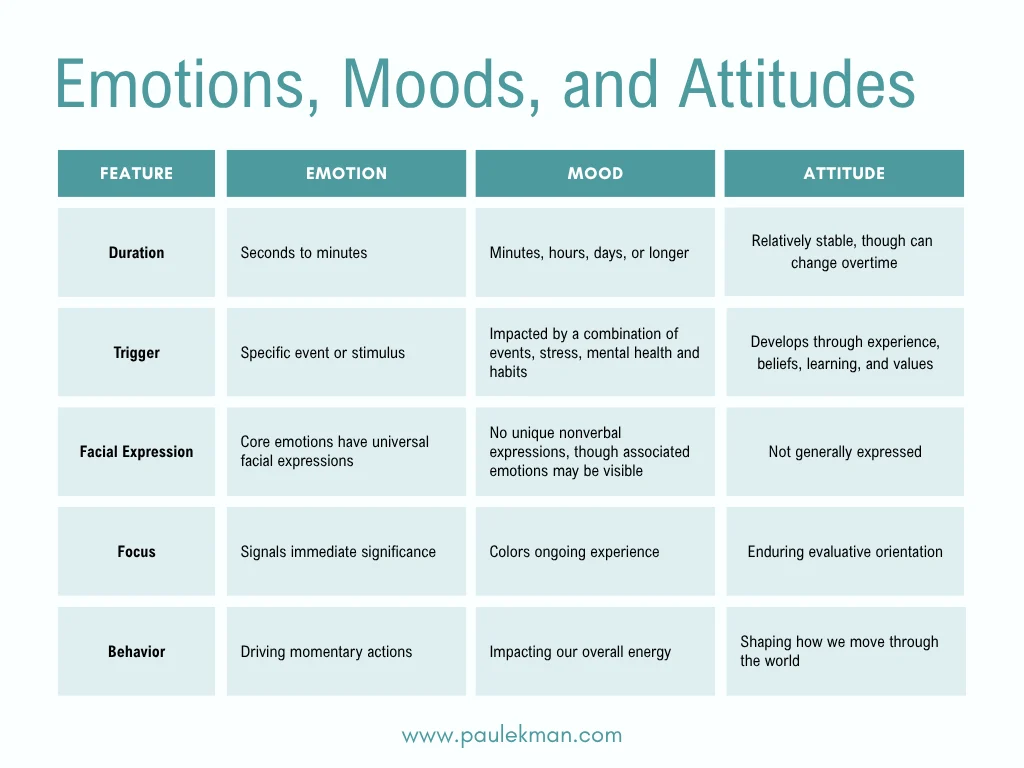
Building on prior explorations that delineated the nuances between moods and emotions, this comprehensive analysis expands the discourse to encompass a third pivotal psychological construct: attitudes. Emotions, moods, and attitudes collectively sculpt our subjective reality and our perception of the external world. However, they operate across divergent temporal scales and fulfill distinct psychological functions. A nuanced comprehension of their intricate interdependencies is instrumental in cultivating heightened emotional awareness, refining emotional regulation strategies, and fostering a more profound insight into our ingrained patterns of cognition and behavior. This article will delve into the definitions, characteristics, and interconnectedness of these three fundamental elements of human experience, drawing upon established psychological research and offering a framework for enhanced self-understanding.
The Fleeting Intensity of Emotions
Emotions, at their core, are rapid, automatic appraisal processes, deeply influenced by both our evolutionary heritage and the cumulative tapestry of our personal lived experiences. They are typically triggered when a significant event transpires in relation to our goals, fundamental needs, or overall well-being. This activation initiates a cascade of coordinated psychological and physiological changes, preparing the individual for action or reaction. By their very nature, emotions are characterized by their relative brevity, often manifesting as transient states that can range from mere fractions of a second to several minutes in duration. These potent internal signals are accompanied by observable physiological shifts, including alterations in heart rate, respiration, and hormonal activity, as well as distinct facial expressions. These somatic and expressive changes serve to ready the organism to address what is most pertinent in the immediate context.
For instance, the recognition of a potential threat, such as encountering a venomous snake, elicits a rapid fear response. This involves a surge of adrenaline, increased heart rate, dilated pupils, and a facial expression of surprise and fear, all designed to promote either flight or a heightened state of vigilance. Conversely, receiving unexpected positive news can trigger a joy response, characterized by physical sensations of warmth, a smile, and an overall sense of openness. Research in affective neuroscience consistently demonstrates the biological underpinnings of these emotional responses, highlighting the amygdala’s role in threat detection and the insula’s involvement in processing subjective bodily states. The universality of certain basic emotions, such as joy, sadness, anger, fear, surprise, and disgust, as first proposed by Paul Ekman, underscores their evolutionary significance in facilitating adaptive responses across diverse human populations.
The Pervasive Influence of Moods
In contrast to the acute nature of emotions, moods possess a more enduring quality. Moods are best understood as diffuse affective states that can persist for extended periods, ranging from several hours to days, and occasionally even longer. A key distinction lies in their often nebulous or absent trigger. Unlike emotions, which are typically directed toward a specific event, object, or person, moods often lack a clearly identifiable precipitating cause. It is not uncommon to awaken in a particular mood, or to find oneself gradually slipping into one without a discernible external impetus. This pervasive quality means that moods can color our entire experience of a given day, influencing our general outlook and our receptivity to emotional stimuli.
While moods may not typically elicit the pronounced facial expressions associated with many emotions, subtle indicators can often be observed. These may include variations in muscle tension, alterations in posture, or discernible changes in overall energy levels. For example, a person experiencing an irritable mood might exhibit a more hunched posture, furrowed brow, and a general air of restlessness, even if no specific event has provoked their annoyance. Rather than serving as a direct response to a singular situation, moods act more like an ambient emotional backdrop. They can significantly influence the ease with which certain emotions are subsequently triggered and can profoundly shape how we interpret events, engage in social interactions, and even process our own internal thoughts throughout the day. A generally positive mood, for instance, can lead to a more optimistic interpretation of ambiguous social cues, while a negative mood might foster a more pessimistic or critical outlook.
The prolonged nature of moods can also have a cumulative effect. Persistent exposure to stressors, even if individually they do not elicit intense emotional outbursts, can gradually lead to a more pervasive state of low mood or irritability. Conversely, periods of sustained positive experiences can foster a more optimistic and resilient mood state. The research on mood congruence, which demonstrates that our current mood influences the processing of emotional information, further illustrates the pervasive impact of these affective states.
The Enduring Framework of Attitudes
In contrast to emotions and moods, which are primarily affective states, attitudes represent a more stable and enduring evaluative orientation. Attitudes are not ephemeral feelings but rather relatively persistent judgments or evaluations of people, ideas, objects, behaviors, or experiences. Psychologists frequently conceptualize attitudes as comprising a tripartite structure, often referred to as the ABC model: Affective, Behavioral, and Cognitive components.
- Affective Component: This refers to the emotional feelings associated with the attitude object. For example, a positive attitude toward dogs might be accompanied by feelings of warmth and affection.
- Behavioral Component: This encompasses the tendency to act in a certain way toward the attitude object. Someone with a positive attitude toward exercise might be inclined to engage in regular physical activity.
- Cognitive Component: This involves the beliefs, thoughts, and knowledge we hold about the attitude object. Believing that dogs provide companionship and emotional support would be part of the cognitive component of a positive dog attitude.
Furthermore, attitudes are often categorized as either explicit or implicit. Explicit attitudes are those that we are consciously aware of and can readily report, such as our stated preference for a particular political party. Implicit attitudes, on the other hand, are unconscious biases or associations that can influence our behavior and judgments without our deliberate awareness, even if they contradict our explicit beliefs. These implicit attitudes are often formed through repeated experiences and societal conditioning.
Consider the example of attitudes toward public speaking. An individual might hold an explicit attitude that public speaking is a valuable skill for career advancement. However, their implicit attitude might be shaped by past negative experiences, such as feeling embarrassed during a childhood presentation. This implicit negativity could manifest as a subconscious avoidance of public speaking opportunities, even while their explicit attitude acknowledges its importance. Attitudes develop over time through a complex interplay of repeated emotional experiences, learning processes (including classical and operant conditioning), exposure to social and cultural norms, interpersonal relationships, and periods of personal reflection. While generally more stable than fleeting emotions or lingering moods, attitudes are not immutable. New experiences can serve to strengthen, weaken, or gradually reshape them. Crucially, unlike moods, attitudes are invariably directed toward a specific target. We hold attitudes about individuals, objects, policies, events, and even about our own internal emotional states. Because attitudes act as a filter through which we interpret new information and guide our responses, they fundamentally shape our subjective experience of the world, acting as an evaluative lens.
The Dynamic Interplay: How They Influence One Another
While emotions, moods, and attitudes are distinct psychological constructs, they are in a perpetual state of dynamic interaction, constantly influencing and being influenced by one another. This interplay is fundamental to understanding the complexity of human behavior and subjective experience.
Mood as a Facilitator of Emotion
Our prevailing mood significantly impacts the likelihood and intensity with which specific emotions are evoked. An individual experiencing an upbeat or positive mood is more likely to recover quickly from minor frustrations, viewing them as temporary inconveniences. Conversely, someone in an irritable or negative mood may find themselves reacting with disproportionate intensity to even minor setbacks. For example, a series of brief, intense emotional episodes, such as experiencing worry or frustration in rapid succession, can coalesce and contribute to the development or reinforcement of a prolonged post-condition, manifesting as an ongoing anxious or irritable mood. This illustrates how the cumulative effect of acute emotional experiences can shape our baseline affective state.
Attitudes as Architects of Emotional Experience
Attitudes play a critical role in both shaping and being shaped by our emotional landscape. Imagine two individuals receiving identical constructive criticism on a work project. One individual might hold a positive attitude toward feedback, viewing it as a valuable opportunity for growth and learning, and consequently experience feelings of motivation and excitement. The other individual, however, might harbor a negative attitude towards feedback, perceiving it as a personal threat or an indictment of their competence, leading them to experience emotions of anxiety, defensiveness, and annoyance. The external situation remains constant, yet their underlying attitudes profoundly influence how they interpret the situation and, in turn, the emotional responses they generate. This highlights how our pre-existing evaluative frameworks can act as powerful determinants of our emotional reactions.
Attitudes Toward Emotions: The Meta-Layer of Influence
A particularly significant and often overlooked form of attitude is our attitude toward emotions themselves. We may develop beliefs and judgments about the appropriateness or desirability of experiencing and expressing certain emotions. For instance, some individuals might develop the attitude that anger is inherently destructive and should always be suppressed, or that sadness signifies weakness and should be hidden. Conversely, others might view joy as something to be constantly shared or fear as a signal to be immediately acted upon. These attitudes are often forged over years through formative family experiences, cultural narratives, educational influences, and personal histories. Our attitudes toward specific emotions can profoundly influence our willingness to acknowledge, accept, express, or learn from them. This also connects directly to the concept of "display rules," which are learned social norms that dictate how, when, and to whom emotional expressions are considered appropriate. While certain facial expressions of emotion are considered universal across human cultures, the specific display rules governing their outward manifestation can vary significantly, contributing to observable differences in emotional expressiveness worldwide. For example, cultures that emphasize emotional restraint may discourage the overt display of sadness, while cultures that value emotional expressiveness might encourage it.
Cultivating Emotional Awareness: A Path to Wiser Responses
At the Paul Ekman Group, our foundational belief is that the cultivation of emotional awareness commences with the deliberate practice of observing our internal experiences with enhanced clarity and a spirit of genuine curiosity. By diligently learning to identify and understand our emotions, recognizing the pervasive influence of our moods, and becoming acutely aware of the attitudes that shape our interpretations and reactions, we empower ourselves to respond more wisely, compassionately, and effectively to both ourselves and those around us.
The development of these crucial skills is an ongoing process that requires consistent practice and dedication. However, these capacities can be significantly strengthened and refined over time through intentional effort. For individuals seeking to deepen their understanding of the science of emotion and enhance their emotional intelligence, the Paul Ekman Group offers a suite of research-based resources designed to facilitate this growth. These resources are grounded in decades of scientific inquiry into human emotion and its regulation, providing evidence-based strategies and insights for navigating the complexities of our inner lives and interpersonal interactions. By embracing a more informed and self-aware approach to our emotions, moods, and attitudes, we can foster greater personal well-being and more constructive relationships.
