


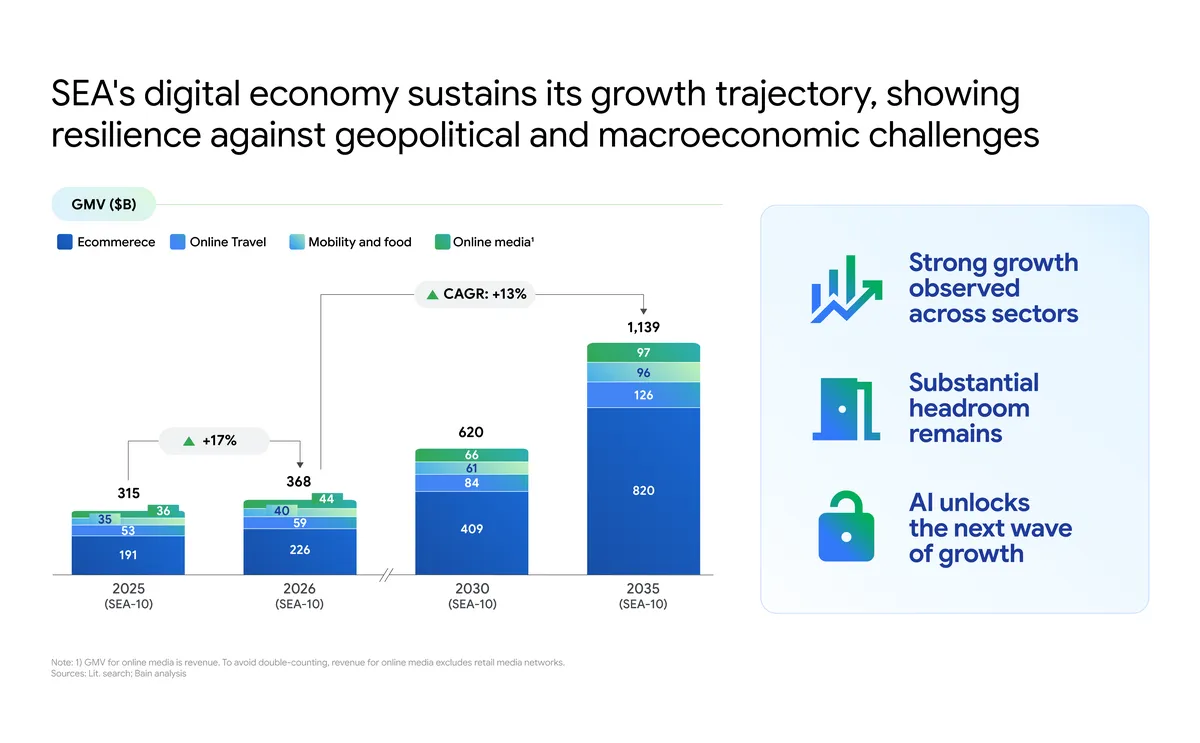
The digital landscape of Southeast Asia is undergoing a profound transformation as generative artificial intelligence (AI) transitions from an experimental novelty to a foundational pillar of the regional economy. According to the 11th edition of the e-Conomy SEA report, a collaborative study by Google, Temasek, and Bain & Company titled "Building the Intelligent Economy," the region’s digital economy is projected to reach $368 billion in Gross Merchandise Value (GMV) by 2026. This represents a robust 17% year-on-year growth rate, signaling a sustained acceleration that places the region on a definitive trajectory to surpass $1 trillion in value by 2035. The report underscores that generative AI has reached a critical mass, with 243 million people—approximately 58% of the working-age population—actively integrating the technology into their daily lives. This adoption rate is notably four times faster than the historical rollout of the mobile internet in the region, suggesting a paradigm shift in how consumers and businesses interact with digital platforms.
A Decade of Digital Evolution: The Chronology of Growth
The e-Conomy SEA report has tracked the region’s digital maturity since its inception in 2016. Initially focused on the rise of mobile connectivity and the burgeoning e-commerce sector, the research has documented several distinct phases of growth. The first phase, spanning roughly 2016 to 2019, was defined by the "mobile-first" revolution, where affordable smartphones and declining data costs brought millions of Southeast Asians online for the first time. The second phase was catalyzed by the COVID-19 pandemic between 2020 and 2022, which forced a rapid migration to digital services for essential needs, including grocery delivery and digital payments.
The current third phase, which began in late 2023, is characterized by the "AI-first" pivot. Unlike previous cycles that relied on hardware adoption, this era is driven by software sophistication and algorithmic efficiency. The report’s findings for 2026 indicate that the "low-hanging fruit" of user acquisition has been harvested, and the next frontier of value creation lies in deepening engagement through intelligent automation. Nitin Gajria, Managing Director for Southeast Asia and South Asia Frontier Markets at Google, noted that the region is no longer just a consumer of global digital trends but a leading laboratory for AI-driven commerce.
Sectoral Performance: E-commerce and Beyond
The $368 billion projection is anchored by the massive scale of the e-commerce sector, which is expected to contribute $226 billion in GMV by 2026, a 18% increase from previous years. The integration of AI within this sector has moved beyond simple recommendation engines. Shoppers are increasingly utilizing multimodal discovery—using images and voice alongside text—to find products. In-app AI assistants are now capable of guiding users through complex purchase journeys, such as comparing technical specifications for electronics or finding fashion items based on aesthetic descriptions. These advancements have yielded tangible results for retailers, with data showing a 10% increase in conversion rates and order volume uplifts of up to 75% for platforms that successfully deploy these tools.
The online travel sector, valued at $59 billion with a 10% annual growth rate, is also seeing a structural shift. While traditional search engines remain the primary starting point for travel planning, generative AI has now surpassed social media as the second-most used tool for organizing complex, multi-city itineraries. This shift suggests that consumers are seeking more personalized and utility-driven advice than what can be provided by static social media posts or influencer content.
In the realm of online media, revenue is projected to hit $44 billion, growing at 22% year-on-year. The primary driver here is the hyper-personalization of content feeds and advertisement targeting. By analyzing vast datasets in real-time, platforms are achieving a 10% to 20% uplift in quality engagement. Furthermore, commerce media—where advertising is integrated directly into shopping platforms—is emerging as a significant sub-sector, currently valued at approximately $4 billion.
Mobility and food delivery services are projected to reach $40 billion in GMV by 2026. Growth in this sector is being sustained through AI-powered operational efficiencies, such as predictive routing and "pooled" ride offerings that optimize vehicle usage and reduce wait times. These improvements have allowed platforms to maintain healthy transactional growth even as the initial post-pandemic surge in demand stabilizes.

Digital Financial Services and the "Unbanked" Opportunity
Perhaps the most significant volume of movement is seen in Digital Financial Services (DFS), which is projected to reach $1,650 billion in Gross Transaction Value (GTV) by 2026. This 16% growth reflects the deepening penetration of digital payments and the rise of digital-native wealth management platforms. In markets like Singapore, digital wealth platforms are leading the region, providing retail investors with access to sophisticated financial products previously reserved for institutional clients.
Beyond wealth management, AI is playing a crucial role in expanding credit access. In Southeast Asia, where a large portion of the population remains "unbanked" or "underbanked," traditional credit scoring models often fail due to a lack of formal financial history. AI algorithms are now being used to analyze alternative data points—such as digital transaction patterns and mobile usage—to provide more accurate risk assessments. This technology is facilitating broader access to loans and insurance products, fostering greater financial inclusion across the region’s emerging markets.
The Era of Agentic Commerce: Trust as the New Currency
A pivotal finding of the 2026 report is the emergence of "agentic commerce." This refers to a future where AI agents do not just suggest products but autonomously execute tasks on behalf of the user. The data suggests that the region is uniquely ready for this leap; 72% of users already rely on basic digital automation features like price tracking. More significantly, 75% of respondents expressed a willingness to allow AI agents to autonomously compare prices and complete transactions for them.
This readiness is underpinned by a high level of consumer trust. Approximately 62% of Southeast Asians report greater confidence in AI tools today than they did a year ago. The report identifies three primary drivers of this trust: a proven track record of AI performance (56%), rising familiarity with the technology (55%), and the perceived accuracy of AI outputs (53%). However, this trust is not unconditional. Consumers have voiced clear expectations for guardrails, including robust privacy safeguards (44%), transparency regarding AI limitations (36%), and the ability to reverse or cancel transactions initiated by an AI agent (30%).
Infrastructure and the Four Pillars of AI Adaptation
To sustain the projected 60-fold increase in regional AI usage by 2030, the report argues that the Southeast Asian digital ecosystem must adapt across four critical dimensions:
- Computational Infrastructure: There is an urgent need for continued investment in data centers and cloud computing power. Countries like Malaysia and Thailand are already seeing a surge in data center investments as they position themselves as regional hubs for AI processing.
- Data Governance and Privacy: As AI agents handle more sensitive personal and financial information, governments must harmonize data protection regulations across borders to ensure safe data flow while protecting individual rights.
- Digital Literacy and Talent: The rapid scaling of AI requires a workforce capable of building and managing these systems. This involves not just high-level engineering talent but also "AI-ready" workers across all sectors of the economy.
- Economic Inclusivity: Ensuring that the benefits of the AI economy are distributed across both urban and rural areas is essential for long-term stability. This includes maintaining the affordability of AI-powered services.
Strategic Implications and Regional Outlook
The implications of this report are significant for investors, policymakers, and business leaders. For venture capitalists, the focus is shifting away from simple platform plays toward companies that offer deep AI integration and proprietary data advantages. For governments, the challenge lies in creating a regulatory environment that encourages innovation without compromising consumer safety.
The projection of a $1.139 trillion digital economy by 2035 suggests that Southeast Asia is on the verge of becoming a global digital powerhouse. The region’s youthful, tech-savvy population, combined with a high degree of openness to new technologies, provides a fertile ground for the next generation of digital services. As Nitin Gajria and other industry leaders emphasize, the transition to an "intelligent economy" is no longer a distant prospect but a current reality. The success of this transition will depend on the ability of stakeholders to maintain the current momentum of trust while building the physical and regulatory infrastructure necessary to support an AI-driven future.
In conclusion, the 11th e-Conomy SEA report paints a picture of a region that has successfully navigated the complexities of post-pandemic recovery and is now aggressively pursuing a future defined by artificial intelligence. With a $368 billion milestone in sight for 2026 and a trillion-dollar horizon for 2035, Southeast Asia’s digital economy is set to remain one of the most dynamic and consequential growth stories of the 21st century.
