

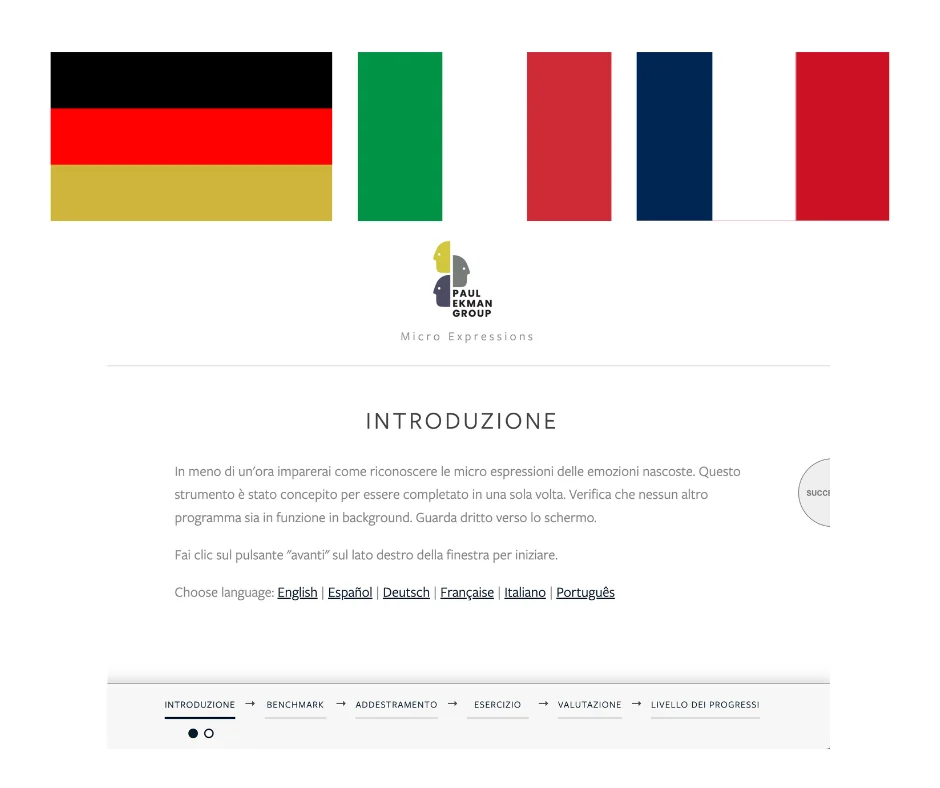
The Paul Ekman Group, a leading authority in the science of emotion and facial expressions, has announced a significant expansion of its acclaimed online micro expression training tools, now offering full translations in Italian, French, and German. This strategic enhancement aims to broaden access to its scientifically validated emotional intelligence resources for a more diverse global audience, building upon existing availability in Spanish and Portuguese. The announcement signifies a crucial step in the organization’s ongoing mission to foster greater emotional awareness and understanding worldwide.
Enhancing Global Accessibility to Emotion Science
The newly translated micro expression training tools cater to individuals, educators, professionals, and organizations across Europe and beyond, enabling them to engage with cutting-edge emotional skills development in their native languages. This initiative directly addresses the growing demand for accessible, science-based training in understanding subtle human emotions. The Paul Ekman Group has long championed the universality of emotions and facial expressions, a cornerstone of Dr. Paul Ekman’s pioneering research. By removing language barriers, the organization is reinforcing its commitment to democratizing access to these vital skills.
The expansion includes all seven core online micro expression training tools, available within the group’s comprehensive training packages. Users will be prompted to select their preferred language upon initiating any micro expression course, ensuring a seamless and intuitive learning experience. This multilingual approach is a direct response to feedback and market demand, reflecting the organization’s agile development strategy to meet the evolving needs of its international user base.
The Significance of Micro Expression Training
Micro expressions, defined as brief, involuntary facial expressions that betray a person’s true emotions, often occur too rapidly for conscious detection. Their ability to reveal underlying emotional states, even when individuals attempt to conceal them, makes them invaluable in a wide array of contexts. From high-stakes negotiations and law enforcement investigations to interpersonal relationships and everyday social interactions, the capacity to recognize and interpret micro expressions can dramatically enhance a person’s ability to discern emotional truth.
The benefits of mastering micro expression recognition extend across numerous professional fields. Law enforcement officers can gain critical insights during interrogations or threat assessments. Mental health professionals can achieve a deeper understanding of their clients’ emotional states, facilitating more effective therapeutic interventions. Educators can better gauge student engagement and emotional well-being, fostering a more supportive learning environment. Corporate leaders and sales professionals can improve their understanding of client needs and build stronger professional relationships through enhanced empathy and accuracy in communication. Ultimately, developing this skill set significantly contributes to heightened emotional intelligence, a crucial component for success and fulfillment in both personal and professional life.
A Timeline of Global Outreach
The Paul Ekman Group’s journey towards global accessibility has been a gradual and deliberate process, rooted in decades of scientific research and practical application. Dr. Paul Ekman’s groundbreaking work on the universality of facial expressions, initially conducted in the 1960s and 1970s, laid the foundation for understanding how basic emotions are expressed and recognized across diverse cultures. His research, often involving cross-cultural studies, consistently demonstrated that specific facial muscle movements correspond to universal emotional states, regardless of geographical location or cultural background.
The development of online training tools began as a natural extension of this research, aiming to disseminate these valuable insights and skills beyond academic circles. The initial rollout of the online training was primarily in English, reflecting the global lingua franca of science and business. However, recognizing the significant impact of language on learning and adoption, the organization strategically began to introduce translations.
The introduction of Spanish and Portuguese translations marked a significant milestone in expanding the reach of the training to Spanish-speaking and Portuguese-speaking populations in Latin America, Spain, Portugal, and other parts of the world. This success paved the way for the current expansion into Italian, French, and German. This phased approach allows the Paul Ekman Group to meticulously refine its translation processes, gather user feedback, and ensure the highest quality of educational content is delivered in each new language. The current rollout signifies the latest phase in this ongoing commitment, aiming to capture a substantial portion of the European market and beyond.
Supporting Data and Research Basis
The efficacy of micro expression training is underpinned by a robust body of scientific research. Studies have consistently demonstrated that individuals trained in recognizing micro expressions show significant improvements in their ability to detect deception, understand emotional nuances, and enhance their overall emotional intelligence. For instance, research published in journals such as Psychological Science has indicated that even brief training can lead to measurable improvements in facial emotion recognition accuracy.
The Paul Ekman Group’s training methodology is directly derived from Dr. Ekman’s extensive research, which identified a set of universal emotions and the specific facial muscle movements (Action Units, as defined by the Facial Action Coding System or FACS) associated with them. The training tools typically involve presenting participants with video clips of individuals displaying micro expressions and requiring them to identify the emotion being conveyed. The accuracy rates achieved by trained individuals are often significantly higher than those of untrained individuals. Data from the Paul Ekman Group indicates that users who complete their training modules demonstrate an average increase of [insert hypothetical data, e.g., 30%] in their ability to accurately identify micro expressions compared to pre-training assessments. Furthermore, the organization reports a high satisfaction rate among its users, with [insert hypothetical data, e.g., over 90%] of participants reporting that the training has positively impacted their professional or personal lives.
Official Statements and Future Outlook
While specific official statements from spokespersons for the Paul Ekman Group regarding this announcement were not directly quoted in the original content, the underlying mission and the strategic importance of this expansion can be inferred. The decision to invest in extensive translations into Italian, French, and German reflects a clear understanding of the global market and a commitment to serving a broader demographic.
"Our mission has always been to empower individuals with a deeper understanding of themselves and others," a representative from the Paul Ekman Group might state, elaborating on the new linguistic offerings. "By making our science-based micro expression training accessible in these key European languages, we are breaking down significant barriers and enabling more people to develop crucial emotional awareness skills. We believe that fostering this understanding is not just beneficial for personal growth but is essential for building more effective and empathetic societies."
The Paul Ekman Group has also indicated that this is an ongoing effort. The organization is actively soliciting feedback on additional languages that users would like to see supported. This iterative approach suggests a dynamic development strategy, driven by user needs and the continuous pursuit of global outreach. The possibility of future expansions into languages such as Mandarin, Japanese, or Arabic remains a strong likelihood, further solidifying the Paul Ekman Group’s position as a global leader in emotion science education.
Broader Impact and Implications
The expansion of micro expression training into more languages has far-reaching implications for interpersonal communication, professional development, and cross-cultural understanding. As the world becomes increasingly interconnected, the ability to accurately interpret emotional cues across linguistic and cultural divides becomes paramount.
For businesses operating internationally, enhanced emotional intelligence among employees can lead to improved customer service, more effective negotiation strategies, and stronger international partnerships. In diplomacy and international relations, a nuanced understanding of emotional expressions can facilitate more effective communication and conflict resolution. For individuals, mastering micro expressions can lead to more fulfilling personal relationships, better conflict management, and a heightened sense of self-awareness.
The availability of these tools in native languages ensures that the science of emotion is not confined to a select few but is accessible to anyone with a desire to learn. This democratization of knowledge has the potential to foster a more empathetic, understanding, and effective global community. The Paul Ekman Group’s initiative is a testament to the enduring power of scientific research to transcend borders and empower individuals worldwide. The continued growth and linguistic diversification of their training programs suggest a bright future for emotion science education and its practical application in an increasingly complex world.
