


The Evolution of the Full-Stack Paradigm
The concept of "full-stack" originated roughly a decade ago during the rise of modern web applications. At that time, software development was siloed: front-end developers managed user interfaces, back-end developers handled server-side logic, and database administrators managed data persistence. A "full-stack engineer" emerged as a generalist capable of navigating every layer, significantly reducing the friction of hand-offs between teams.
In the context of 2026, the definition has expanded to encompass the massive complexity of generative AI. According to Seroter, a full-stack AI approach means managing the entire value chain. This includes the physical hardware (compute), the foundational models (intelligence), the orchestration platforms (management), and the application interfaces (user experience). By controlling every link in this chain, a provider can optimize the interactions between layers—such as tuning a model to run more efficiently on a specific chip architecture—in a way that modular, multi-vendor systems cannot.
A Chronology of Google’s AI Integration
Google’s current full-stack dominance is not the result of a sudden pivot but a decades-long strategic investment in vertical integration. The timeline of this development reveals a persistent focus on owning the underlying infrastructure:
- 2013–2014: Google acquires DeepMind, signaling a shift toward frontier AI research. Simultaneously, the company begins the internal development of custom silicon to handle the burgeoning demands of neural networks.
- 2016: Google publicly announces the Tensor Processing Unit (TPU). This custom-designed ASIC (Application-Specific Integrated Circuit) was built specifically for machine learning, providing a significant performance-per-watt advantage over general-purpose GPUs.
- 2017: Google researchers publish the "Attention is All You Need" paper, introducing the Transformer architecture. This becomes the "DNA" for virtually all modern generative AI, from GPT-4 to Gemini.
- 2023–2024: The launch of the Gemini family of models marks the integration of Google’s research (DeepMind) with its infrastructure (TPUs) and its consumer products (Search and Workspace).
- 2025–2026: The introduction of "vibe coding" and the Antigravity platform represents the latest layer of the stack—abstracting complex coding into intuitive, agent-led development environments.
The Four Layers of the Modern AI Stack
To understand the "full stack," one must examine the specific layers Google has developed to create a closed-loop ecosystem.

1. Compute Infrastructure (The Foundation)
At the base of the stack lies the hardware. Google’s investment in TPUs, now in their latest iterations like the TPU v6, allows the company to bypass the supply chain bottlenecks and high margins associated with third-party chip manufacturers. Seroter notes that owning the supply chain allows for a level of reliability that is difficult to achieve when a developer is at the mercy of multiple hardware and cloud vendors.
2. Frontier Models (The Intelligence)
The second layer consists of the models themselves. The Gemini family, developed by Google DeepMind, serves as the "brain" of the stack. These models are natively multimodal, meaning they were trained on text, images, video, and code simultaneously. By developing these models in-house, Google can ensure they are perfectly calibrated for the TPUs they run on, leading to lower latency for end-users.
3. Orchestration and Platforms (The Management)
Between the model and the user lies the orchestration layer. This includes tools like the Gemini Enterprise Agent Platform and the newly integrated Firebase features within Google AI Studio. This layer allows developers to "ground" AI models in real-world data, ensuring that the AI doesn’t just generate text but performs actual work, such as parsing spreadsheets or managing cloud deployments.
4. User Interfaces (The Experience)
The final layer is where the AI meets the user. This includes ubiquitous applications like Google Maps, Gmail, and the Android operating system. By integrating AI directly into these surfaces, Google completes the stack, moving from raw electricity and silicon at the bottom to a helpful suggestion in a user’s inbox at the top.
Economic and Technical Implications of Vertical Integration
The primary advantage of a full-stack approach is economic. In a fragmented market, each vendor—the chip maker, the cloud provider, the model developer, and the software integrator—must take a profit margin. By the time a product reaches the consumer, these "margins on margins" lead to high subscription costs. Because Google manages the entire stack, they can eliminate these intermediate costs, offering more competitive pricing for enterprise customers and developers.

Technically, the full-stack approach solves the "brittleness" of modern AI. Seroter points out that if a failure occurs in a third-party model or a remote data center, a developer using a modular stack is often helpless until the provider issues a fix. In a full-stack environment, Google can detect a hardware failure at the TPU level and automatically reroute the model’s inference to a different cluster without the user—or the developer—ever noticing a dip in performance.
Addressing the "Lock-In" Concern
A common criticism of full-stack ecosystems is the risk of "vendor lock-in," where a customer becomes so dependent on one provider’s integrated tools that switching becomes prohibitively expensive. Seroter acknowledges this concern but argues that Google’s strategy is "opinionated but extensible."
Google has a long history of contributing foundational technology to the open-source community, including Kubernetes, TensorFlow, and the recent Gemma 4 open models. By allowing developers to plug in third-party models or export their data to other cloud environments, Google aims to win users based on the quality of the integrated experience rather than forced exclusivity. The "batteries included" philosophy means that while everything works best together, the individual components are designed to be compatible with the broader tech ecosystem.
Entry Points for the Next Generation of Builders
As AI development becomes more accessible, the "front doors" to the full stack have been redesigned to accommodate different skill levels. Seroter identifies three primary pathways for those looking to build within the Google ecosystem:
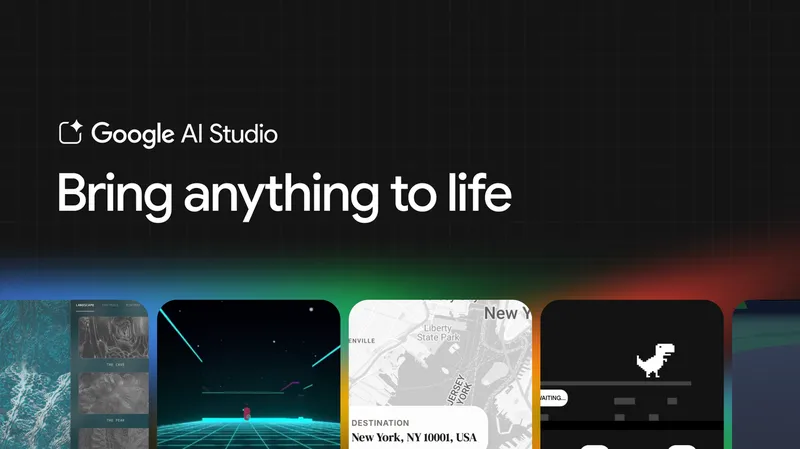
- Google AI Studio: Targeted at rapid prototyping, this tool allows creators to build web applications in minutes. The recent integration of "vibe coding" agents like Antigravity enables users to describe an app in natural language and deploy it to the cloud with a single click.
- Gemini Enterprise Platform: A low-code/no-code solution for business professionals. This allows for the automation of complex workflows—such as cleaning an inbox or analyzing financial reports—without requiring a computer science degree.
- Antigravity and Firebase: For professional developers, these platforms offer the most sophisticated orchestration capabilities. They allow for the building of "agents"—AI systems that can take independent action across various software environments.
Analysis: The Democratization of Development
The broader implication of the full-stack AI approach is the democratization of software creation. If the "stack" is fully integrated and managed by the provider, the barrier to entry for building complex software drops precipitously. We are entering an era of "vibe coding," where the technical debt and syntax requirements of traditional programming are handled by the underlying stack, leaving the human creator to focus on intent and design.
This shift suggests a future where the distinction between a "user" and a "developer" blurs. As full-stack AI tools become more intuitive, the ability to create a custom application to solve a specific personal or business problem will become as common as writing an email. For Google, the goal is to ensure that their full-stack architecture is the engine behind this transition, providing the necessary scale to support a world where every user is also a builder.
In conclusion, the "full stack" is no longer just a way to describe an engineer’s resume; it is a description of a massive, integrated technological machine. By owning the silicon, the models, and the apps, Google is betting that vertical integration is the only path to making AI both helpful and ubiquitous. As Seroter summarizes, the goal is to provide the confidence that anyone, regardless of their technical background, can get things done with the power of AI.
