

The Spanish verb dar represents one of the most significant linguistic hurdles and opportunities for students of the Romance languages. While its primary translation is "to give," its utility extends far beyond simple transactions of physical objects. As a high-frequency, irregular verb, dar serves as a foundational element in hundreds of idiomatic expressions, grammatical structures, and everyday interactions. To master dar is to gain access to a vital segment of Spanish fluency, yet its deceptive simplicity—characterized by a single-letter stem in many forms—belies a complex system of irregular endings and historical linguistic shifts.
Historically, the evolution of dar from its Latin root, dare, has resulted in a unique morphological profile. Unlike most -ar verbs, which follow a predictable pattern of endings, dar frequently adopts the characteristics of -er and -ir verbs, particularly in the preterite tense. This cross-pollination of conjugation groups makes it an outlier in the Spanish linguistic landscape, requiring a dedicated analytical approach to understand its various moods and applications.
Historical Context and Etymological Irregularity
The irregularity of dar is not a modern development but a result of centuries of phonetic evolution. In the present indicative, the first-person singular form "doy" aligns with a very exclusive group of Spanish verbs—including ser (soy), estar (estoy), and ir (voy)—that utilize the "-oy" ending. This group represents some of the most ancient and frequently used verbs in the language, which often resist the leveling effects of regular grammar rules over time.
Furthermore, the preterite forms of dar (di, diste, dio, dimos, disteis, dieron) are strikingly similar to those of the verb ver (to see). Linguists note that dar essentially "borrows" the endings typically reserved for second and third conjugation verbs (-er and -ir). This anomaly is significant because, while dar ends in -ar, its past tense behavior is entirely atypical for its class.
Another critical historical note involves the 1959 spelling reform by the Real Academia Española (RAE). Prior to this change, the forms "di" and "dio" were often written with accent marks (dí and dió). However, modern orthographic rules state that monosyllabic words do not carry an accent unless it is required to distinguish them from another word (diacritic accent). Since "di" and "dio" do not have common monosyllabic homonyms in the same grammatical category, the accents were removed, though they can still be found in older literary texts and historical documents.
The Hierarchy of Learning: A Strategic Approach to Conjugation
For language learners, the sheer volume of conjugation tables can be overwhelming. Pedagogical experts suggest a tiered approach to mastering dar, focusing on high-frequency forms before moving toward more specialized tenses.
The Foundation: Present Indicative
The present indicative is the most frequently utilized mood for dar. It is used for current actions, general truths, and many common idioms.
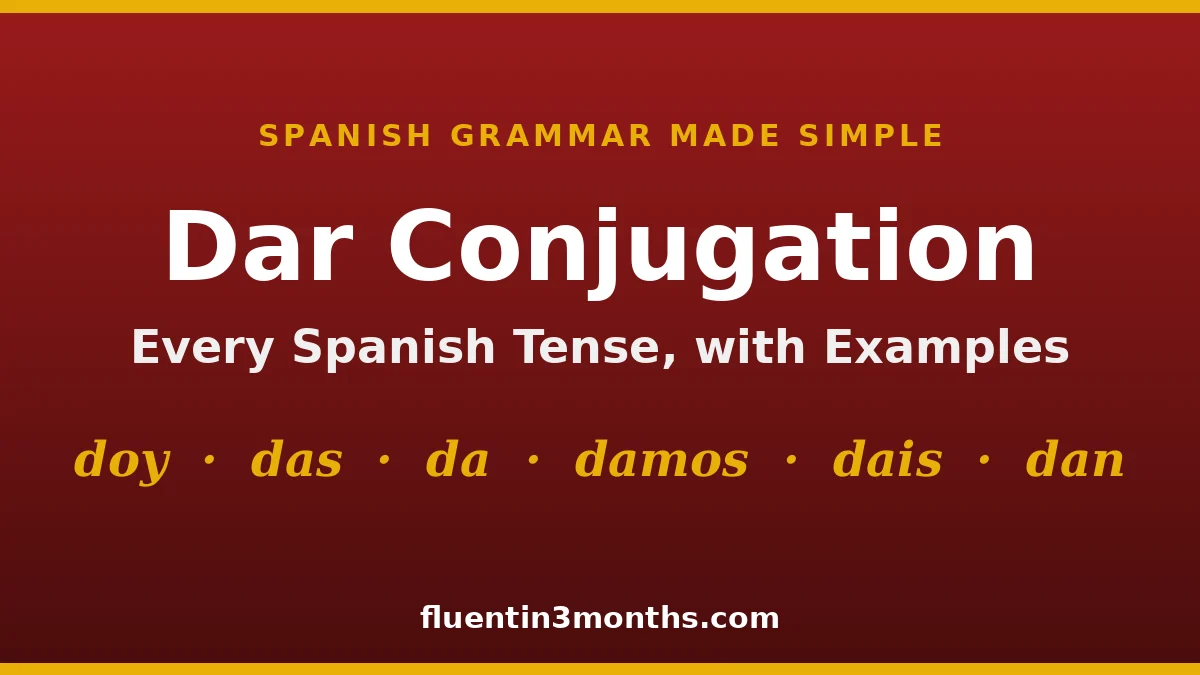
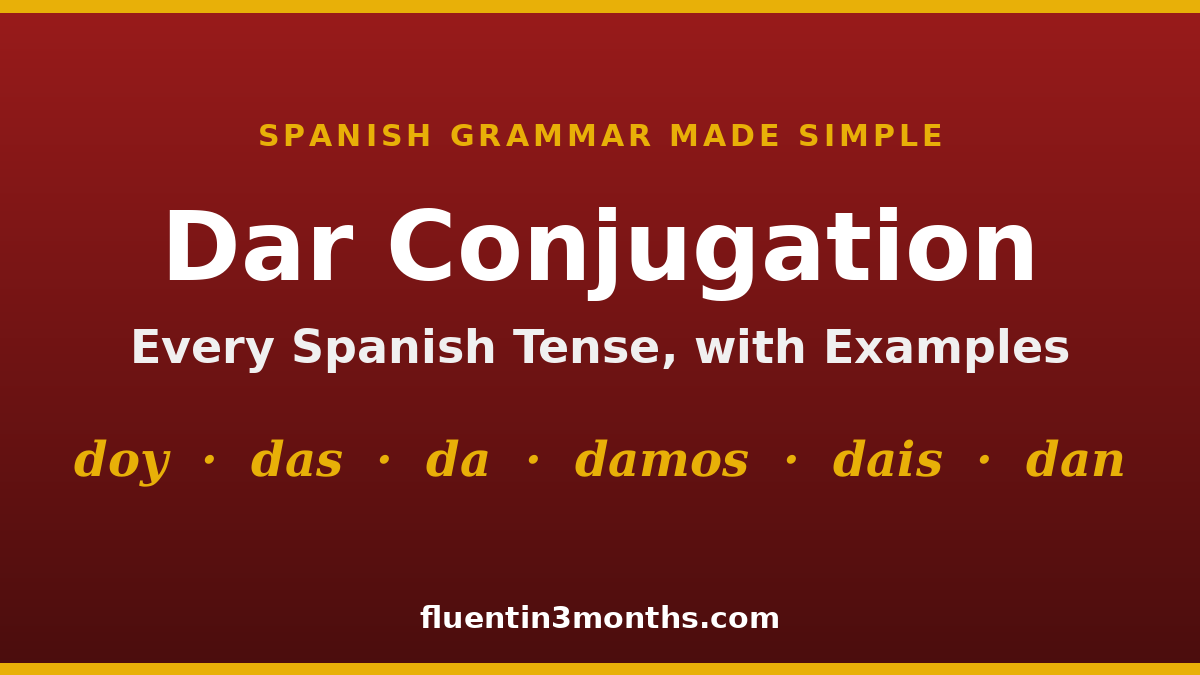
- yo doy (I give)
- tú das (you give – informal)
- él/ella/usted da (he/she gives, you give – formal)
- nosotros/as damos (we give)
- vosotros/as dais (you all give – Spain)
- ellos/ellas/ustedes dan (they/you all give)
The Narrative Past: Preterite and Imperfect
The preterite is used for completed actions in the past, while the imperfect is used for descriptions, habits, or ongoing past actions.
Preterite Indicative:
- yo di (I gave)
- tú diste (you gave)
- él/ella/usted dio (he/she/you gave)
- nosotros/as dimos (we gave)
- vosotros/as disteis (you all gave)
- ellos/ellas/ustedes dieron (they/you all gave)
Imperfect Indicative:
- yo daba (I used to give)
- tú dabas (you used to give)
- él/ella/usted daba (he/she/you used to give)
- nosotros/as dábamos (we used to give)
- vosotros/as dabais (you all used to give)
- ellos/ellas/ustedes daban (they/you all used to give)
Advanced Moods: Subjunctive and Imperative Applications
The subjunctive mood is essential for expressing doubt, desire, emotion, and hypothetical situations. In the case of dar, the present subjunctive requires a mandatory accent mark on the first and third-person singular forms (dé) to distinguish the verb from the preposition "de" (of/from).
Present Subjunctive
- yo dé
- tú des
- él/ella/usted dé
- nosotros/as demos
- vosotros/as deis
- ellos/ellas/ustedes den
The imperfect subjunctive, used in "if" clauses and past-tense emotional expressions, follows two patterns (-ra and -se), with the -ra form being more prevalent in contemporary spoken Spanish, particularly in the Americas.
Imperfect Subjunctive (Pattern 1)
- yo diera
- tú dieras
- él/ella/usted diera
- nosotros/as diéramos
- vosotros/as dierais
- ellos/ellas/ustedes dieran
The Imperative: Issuing Commands
The imperative mood for dar is frequently used in giving directions or requests. A notable irregularity occurs in the informal "tú" command, which is simply "da," whereas the negative command "no des" uses the subjunctive stem.
Compound Tenses and the Role of the Past Participle
The compound tenses of dar are formed using the auxiliary verb haber and the past participle "dado." Because the past participle remains constant, these tenses are often easier for learners to master once they have memorized the various forms of haber.
- Present Perfect: He dado (I have given) – used for recent past actions with relevance to the present.
- Pluperfect: Había dado (I had given) – used for actions that occurred before another past action.
- Future Perfect: Habré dado (I will have given) – used for actions that will be completed by a certain point in the future.
- Conditional Perfect: Habría dado (I would have given) – used for hypothetical past scenarios.
Semantic Expansion: The Idiomatic Power of Dar
The true utility of dar lies in its idiomatic versatility. In Spanish, dar often replaces verbs that, in English, would be entirely distinct. Understanding these "collocations" is vital for achieving a native-like cadence in speech.
- Dar un paseo: To take a walk. (Literally: "To give a walk").
- Darse cuenta de: To realize. (Literally: "To give oneself account of").
- Dar a luz: To give birth. (Literally: "To give to light").
- Dar igual: To not matter / To be all the same. (e.g., "Me da igual" – It’s all the same to me).
- Dar las gracias: To thank. (Literally: "To give the thanks").
- Dar ganas de: To feel like doing something. (e.g., "Me da ganas de comer" – I feel like eating).
- Dar recuerdos a: To give regards/greetings to someone.
- Dar un abrazo: To give a hug.
- Dar asco: To be disgusting. (Literally: "To give disgust").
- Dar saltos de alegría: To jump for joy.
Each of these idioms requires the correct conjugation of dar to match the subject and tense of the sentence. For instance, "I realized" becomes "Me di cuenta," utilizing the preterite form.
Expert Analysis: Pedagogical Implications and Common Errors
Linguistic researchers often cite dar as a "trap" verb for English speakers due to its brevity. One of the most common errors is the "over-regularization" of the preterite, where students may incorrectly say "damos" for the past (which is actually the same as the present) or attempt to use -ar endings like "dó" instead of the correct "dio."
Furthermore, the distinction between "dé" (verb) and "de" (preposition) remains a frequent orthographic error even among native speakers in informal writing. Experts emphasize that the accent mark on "dé" is not a stress indicator but a "tilde diacrítica," serving a purely functional role in sentence parsing.
Another area of confusion involves the reflexive use of the verb (darse). While dar is a transitive action (giving something to someone), darse often indicates a change in the subject’s state of mind or a reciprocal action. Misusing the reflexive pronoun can fundamentally change the meaning of a sentence, a nuance that requires significant practice to master.
Broader Impact on Spanish Fluency
The mastery of dar is often viewed by educators as a litmus test for intermediate Spanish proficiency. Because the verb is integrated into the very fabric of Spanish social interaction—from "dar permiso" (giving permission) to "dar la hora" (telling the time)—a lack of facility with its conjugations can lead to significant communication breakdowns.
Data from language acquisition studies suggest that students who prioritize high-frequency irregular verbs like dar, ir, and tener early in their studies reach conversational milestones up to 30% faster than those who focus strictly on regular verb patterns. This is due to the "anchor" effect: these verbs appear so frequently that they provide the structural framework for most sentences, allowing the speaker to focus more on specific vocabulary and less on grammatical construction.
In conclusion, the verb dar is much more than a simple translation of "to give." It is a multifaceted linguistic tool with a rich history of irregularity and a vast range of idiomatic applications. By understanding its unique conjugation patterns, particularly its tendency to borrow from other verb groups, and by internalizing its many idiomatic uses, learners can significantly enhance their communicative competence and move closer to true Spanish fluency. The journey to mastering dar is, in many ways, a journey into the heart of the Spanish language itself—demanding attention to detail but offering immense rewards in expressive capability.
