

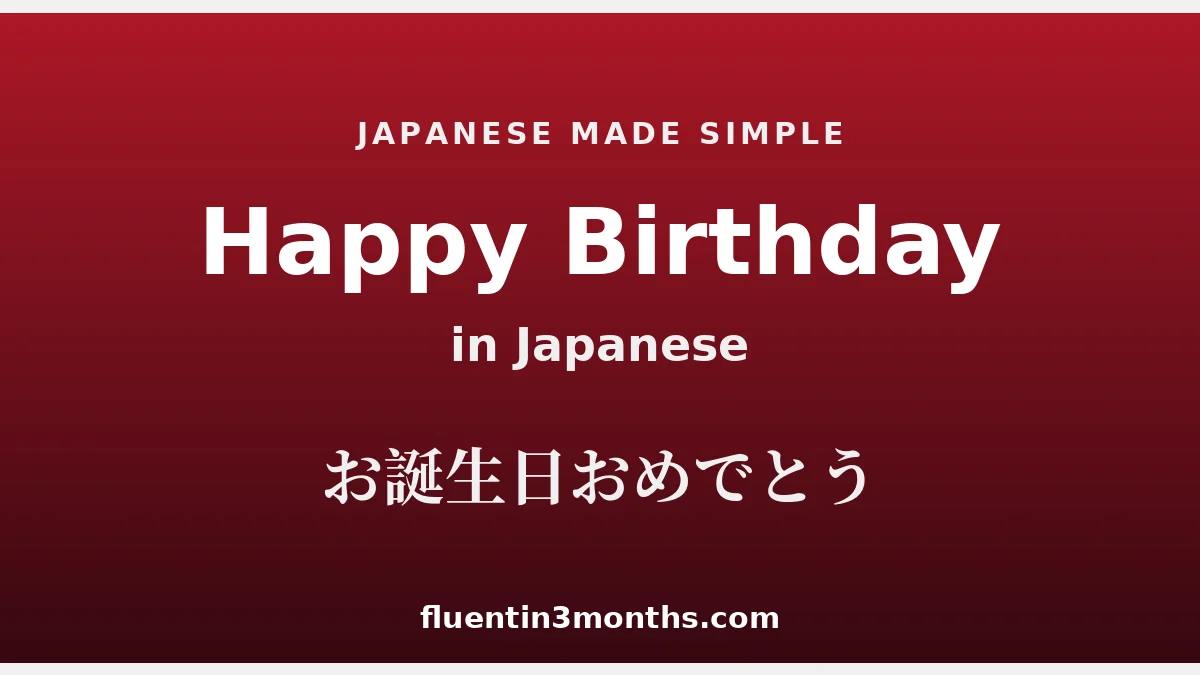
The Japanese language, renowned for its intricate system of honorifics and social hierarchy, offers a multifaceted approach to celebrating personal milestones. To the casual observer, the standard greeting for a birthday is "Otanjoubi omedetou gozaimasu" (お誕生日おめでとうございます). However, this phrase is more than a mere translation of "Happy Birthday." It serves as a window into the evolution of Japanese society, reflecting a transition from collective age-counting traditions to the individualized celebrations characteristic of the modern era. Understanding the linguistic nuances, the historical shift in age calculation, and the specific cultural milestones is essential for navigating social interactions in Japan effectively.
Linguistic Architecture of the Birthday Greeting
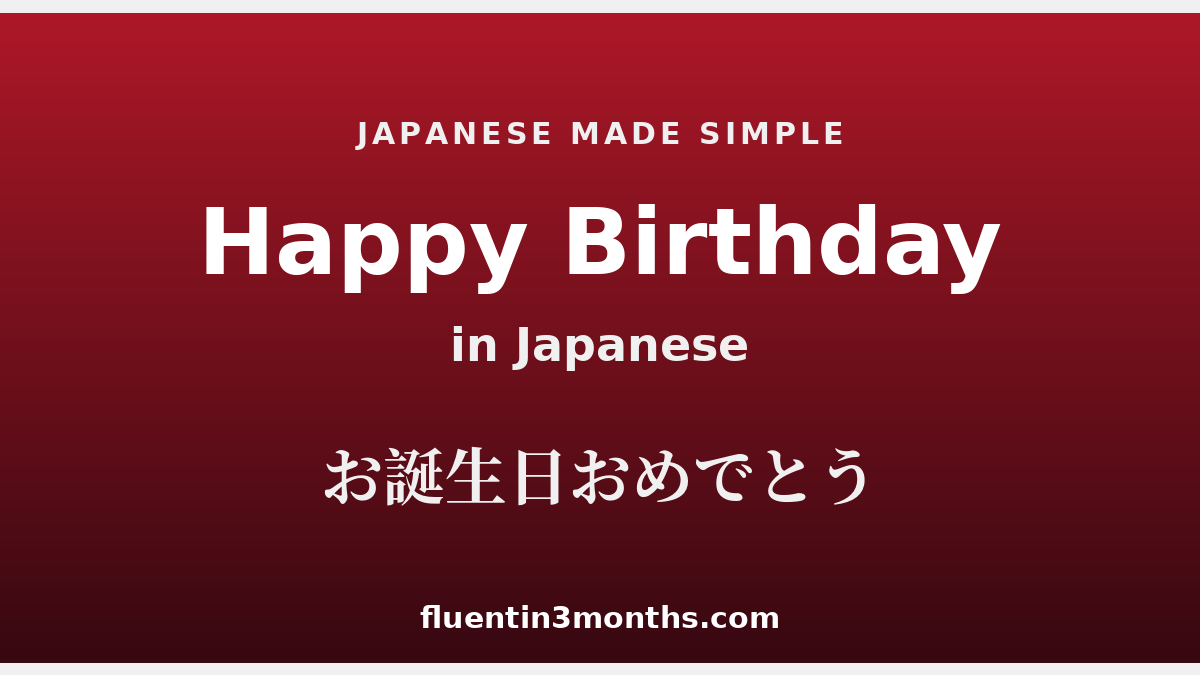
The primary phrase for wishing someone a happy birthday is structured to accommodate varying levels of social distance and respect. The most formal version, "Otanjoubi omedetou gozaimasu," is composed of four distinct elements. The prefix "O" (お) is an honorific that elevates the noun it precedes, in this case, "tanjoubi" (誕生日), which literally translates to "birth-life-day." The word "omedetou" (おめでとう) is derived from "medetai," meaning auspicious or joyous, and functions as the equivalent of "congratulations." Finally, "gozaimasu" (ございます) is a formal auxiliary verb that solidifies the politeness of the statement.
In casual settings, such as among close friends or younger family members, the phrase is often shortened to "Otanjoubi omedetou" or simply "Omedetou." Conversely, when addressing superiors, teachers, or elder relatives, the inclusion of "gozaimasu" is mandatory to maintain "Keigo" (honorific speech). Linguistic experts note that Japanese social harmony, or "Wa," relies heavily on these distinctions. Using a casual greeting with a superior is often viewed as a significant social transgression, whereas being overly formal with a friend may create an unintended sense of emotional distance.
Beyond native vocabulary, Japan has integrated the English loanword "Happy Birthday" into its lexicon, rendered in the Katakana script as "Happii Baasudee" (ハッピーバースデー). While this is rarely used in written formal correspondence, it is the standard phrase used when singing the globally recognized birthday tune. This linguistic duality reflects Japan’s broader "Zhong-ti Xi-yong" approach—maintaining Japanese spirit while adopting Western functional forms.
The Historical Shift: From Kazoedoshi to Man’nenrei
The concept of celebrating an individual’s birth date is a relatively modern phenomenon in Japan. For centuries, Japan utilized the "kazoedoshi" (数え年) system, a method of age calculation shared across East Asian cultures. Under this system, a child is considered one year old at the moment of birth, accounting for the time spent in the womb. Furthermore, instead of aging on their specific birth date, every member of society gained a year simultaneously on New Year’s Day (Ganjitsu).
This collective aging meant that an individual’s actual day of birth held little social significance. Age was a reflection of the number of calendar years one had lived through, rather than a personal anniversary. The transition to the Western-style "man’nenrei" (満年齢) system, where age increases on the actual anniversary of birth, was a protracted legal and cultural process.
The Japanese government first attempted to modernize age calculation with the "Act on Calculation of Age" in 1902 (Meiji 35). This was part of a broader effort during the Meiji Restoration to align Japanese administrative standards with those of the international community. However, the law saw limited adoption in daily life, as the traditional "kazoedoshi" system remained deeply ingrained in the rural and domestic spheres.
It was not until the post-World War II era that a definitive shift occurred. In 1950, the "Law Concerning the Counting of Age" was enacted, primarily to streamline the rationing system and administrative records during the occupation and reconstruction period. This law mandated the use of "man’nenrei" for all official purposes. Sociologists suggest that the adoption of individual birthdays was also fueled by the post-war economic boom and the influx of Western media, which popularized the imagery of birthday cakes, candles, and gift-giving.
Cultural Milestones and Longevity Celebrations
While modern birthdays in Japan often mirror Western traditions, several specific ages remain steeped in ancient symbolism. These milestones, known as "Ga no Iwai" (celebrations of longevity), are often more significant than standard annual birthdays.
The most prominent of these is the "Kanreki" (還暦), celebrated at age 60. Based on the traditional sexagenary cycle of the Chinese zodiac, the 60th year marks the completion of five cycles of the twelve zodiac animals. It is viewed as a symbolic rebirth or a "return" to the year of one’s birth. Traditionally, the celebrant is gifted a red vest ("chanchanko") and a red hat. In Japanese culture, red is the color associated with infants and is believed to ward off evil spirits, reinforcing the theme of a new beginning.
Other significant milestones include:
- Koki (古希): The 70th birthday, originating from a Chinese poem stating that reaching 70 is a "rare" achievement.
- Kiju (喜寿): The 77th birthday, named because the cursive character for "joy" (喜) resembles the characters for seventy-seven.
- Beiju (米寿): The 88th birthday, known as the "rice" birthday. The kanji for rice (米) can be decomposed into the characters for eight, ten, and eight (八十八).
- Hakuju (白寿): The 99th birthday, known as the "white" birthday. The kanji for white (白) is the kanji for hundred (百) minus the top stroke (representing one), symbolizing 100 minus one.
Data from the Ministry of Health, Labour and Welfare indicates that as Japan’s population continues to age, these longevity celebrations are gaining increased commercial and social importance. The gift-giving market surrounding these milestones has expanded, with high-end retailers offering specialized products for "Kanreki" and "Beiju" ceremonies.
Modern Traditions and the Birthday Industry
The contemporary Japanese birthday celebration is a hybrid of global trends and local aesthetics. Central to the celebration is the "shortcake" (ショートケーキ), typically a light sponge cake layered with whipped cream and fresh strawberries. Unlike the dense buttercream cakes common in North America, the Japanese birthday cake emphasizes a balance of sweetness and a light texture.
The economic impact of these celebrations is substantial. According to market research, the "anniversary market" in Japan—which includes birthdays, weddings, and seasonal festivals—is valued at several trillion yen. Retailers have capitalized on the concept of "Otanjoubi Purezento" (birthday presents), with a strong emphasis on presentation and wrapping, reflecting the Japanese cultural value of "Tsutsumi" (the art of wrapping).
In professional environments, birthday etiquette remains conservative. While it is becoming more common to acknowledge a colleague’s birthday, it is rarely celebrated with the same vigor as in Western offices. Instead, a simple, polite "Otanjoubi omedetou gozaimasu" is considered sufficient. Gift-giving in a professional context often follows the rules of "Omiyage" or "Temiyage," where the gift is modest and intended not to burden the recipient with a sense of heavy obligation (giri).
Sociolinguistic Implications and Social Media
The rise of social media platforms like LINE, Twitter, and Instagram has further transformed birthday interactions. On LINE, the most popular messaging app in Japan, users often send "stamps" or digital stickers to convey birthday wishes. These stickers range from highly formal to extremely casual and "kawaii" (cute), allowing users to navigate social hierarchy with visual cues.
However, the digital age has also introduced new complexities regarding "age-concealing" behavior. Historically, Japanese culture has been reserved regarding the public disclosure of age, particularly among women and in professional settings. This is rooted in a desire to maintain social harmony and avoid the potential for age-based discrimination or discomfort. While younger generations are more open about their ages online, the cultural tendency toward "Enryo" (restraint) remains a factor in how birthdays are publicized.
Conclusion
The evolution of "Happy Birthday" in Japan is a testament to the country’s ability to synthesize foreign influences with indigenous values. From the legal mandates of 1950 that established the modern counting system to the preservation of the 600-year-old "Kanreki" traditions, Japan maintains a unique chronological identity. For the language learner or the business professional, mastering the greeting is only the first step; the true challenge lies in recognizing the deep-seated history and the social "Ma" (space/timing) that dictates how these milestones are honored. As Japan continues to navigate its demographic challenges, these celebrations of life and longevity will likely remain a cornerstone of its social fabric, bridging the gap between a collective past and an individualized future.
