

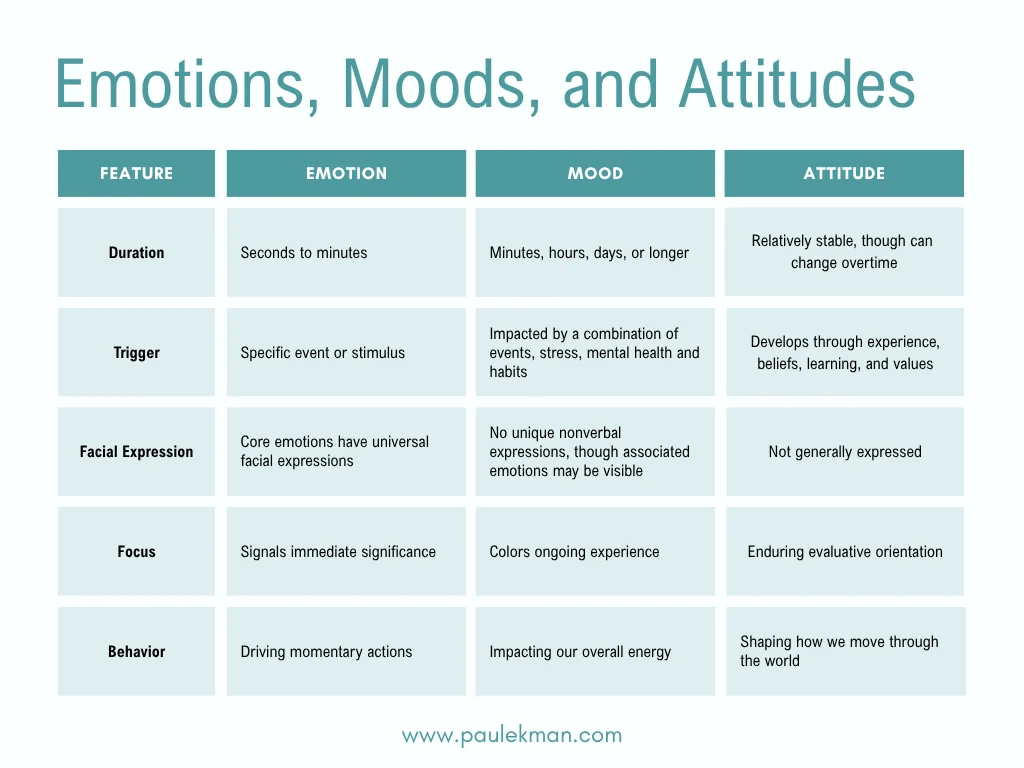
Building on previous discussions that illuminated the distinctions between moods and emotions, this expanded analysis delves into the intricate relationship between these affective states and a third crucial psychological construct: attitudes. While all three profoundly shape our perception of ourselves and the world, they operate across different temporal scales and fulfill unique psychological functions. A comprehensive understanding of their dynamic interplay is essential for cultivating deeper emotional awareness, enhancing emotional regulation, and gaining profound insights into our ingrained patterns of thought and behavior. This exploration seeks to provide a more nuanced perspective, drawing upon psychological research and offering a framework for individuals and organizations to better navigate the complexities of human experience.
The Ephemeral Nature of Emotions
Emotions, at their core, are rapid, automatic appraisal processes. These appraisals are deeply influenced by a confluence of evolutionary predispositions—innate responses honed over millennia to ensure survival—and the cumulative tapestry of personal experiences that define an individual’s life journey. An emotion is typically ignited when a stimulus, internal or external, is perceived as significant in relation to an individual’s goals, needs, or overall well-being. This perception triggers a cascade of coordinated psychological and physiological changes, preparing the organism to react effectively to the perceived situation.
By definition, emotions are transient phenomena, often lasting from mere fractions of a second to a few minutes. This brevity is a critical evolutionary advantage, allowing for swift responses to immediate challenges and opportunities. The physiological manifestations of emotions are widespread, encompassing alterations in autonomic nervous system activity, such as heart rate, respiration, and perspiration, as well as distinct facial expressions. These outward signals not only reflect internal states but also serve as crucial communication tools, conveying vital information to others about our internal experiences and intentions. Research by pioneers like Paul Ekman has established the universality of certain basic emotional expressions, suggesting a biological undergirding for these fundamental human experiences. For instance, studies have consistently shown that expressions of happiness, sadness, anger, fear, surprise, and disgust are recognized across diverse cultures, underscoring their deep evolutionary roots.
The Enduring Landscape of Moods
In stark contrast to the fleeting nature of emotions, moods possess a more protracted duration. Moods are characterized as diffuse affective states that can persist for hours, days, or even extended periods. A key differentiator from emotions is the frequent absence of a clearly identifiable trigger. Unlike an emotion that is typically directed towards a specific event, person, or object, moods often lack such precise attribution. Individuals may find themselves waking up in a particular mood, or gradually slipping into one without a discernible external cause. This can lead to a pervasive sense of unease or well-being that colors the entirety of one’s experience.
While emotions often manifest in distinct and recognizable facial expressions, moods tend to be more subtle. They may not elicit the dramatic physiological shifts associated with acute emotional responses. However, observable signs can include changes in muscle tension, posture, energy levels, and even speech patterns. These subtle cues can collectively signal the underlying affective tone of an individual.
Rather than serving as a direct response to a singular situation, moods act more like an ambient emotional backdrop. They exert a significant influence on how readily certain emotions are triggered, amplifying or dampening their intensity. Furthermore, moods can subtly shape our interpretation of events, social interactions, and even our own internal thoughts throughout the day. For example, an individual in a generally positive mood might interpret ambiguous social cues more favorably, while someone experiencing a negative mood may be more prone to perceive threats or slights. This pervasive influence underscores the importance of understanding and managing one’s mood state, as it can significantly impact overall quality of life and daily functioning. Studies on the impact of weather on mood, for instance, have shown correlations between prolonged periods of gray skies and increased reports of low mood, highlighting the environmental influences on our affective states.
The Evaluative Framework of Attitudes
Distinct from emotions and moods, which are essentially emotional states, attitudes are more stable evaluative judgments. They represent relatively enduring predispositions to respond in a particular way toward people, ideas, objects, behaviors, or experiences. Psychologists commonly conceptualize attitudes as comprising three interconnected components, often referred to as the ABC model:
- Affective Component: This refers to the emotional associations linked to the attitude object. It encompasses the feelings and emotional responses one experiences when thinking about or encountering the attitude object. For example, an attitude towards a particular brand of coffee might include the feeling of warmth and comfort associated with its aroma.
- Behavioral Component: This component reflects an individual’s tendency to act in a certain way toward the attitude object. It includes observable behaviors and predispositions to engage in specific actions. For instance, a positive attitude towards exercise might manifest as a consistent behavior of attending the gym regularly.
- Cognitive Component: This aspect involves the beliefs, knowledge, and thoughts an individual holds about the attitude object. It encompasses the information and perceptions that form the basis of the attitude. A belief that recycling is crucial for environmental preservation would fall under the cognitive component of an attitude towards recycling.
Attitudes can also be further categorized as either explicit or implicit. Explicit attitudes are those that individuals are consciously aware of and can readily report. They are typically formed through deliberate thought and reasoning. In contrast, implicit attitudes are unconscious or subconscious, yet they still exert a significant influence on our thoughts, feelings, and behaviors. These attitudes are often formed through associative learning and repeated exposure. For example, an individual might consciously believe they are not prejudiced against a certain group (explicit attitude), yet implicitly hold negative associations that influence their interactions (implicit attitude). Research utilizing implicit association tests (IATs) has provided substantial evidence for the existence and impact of these unconscious biases.
Consider the example of public speaking. An individual’s attitude towards public speaking might encompass: the belief that it is an essential skill for career advancement (cognitive); the memory of feeling embarrassed and anxious during a past presentation (affective); and a tendency to actively seek out or avoid opportunities to speak in front of groups (behavioral).
While attitudes are generally more stable and resistant to change than emotions or moods, they are not immutable. They are dynamic constructs that develop and evolve over time. This development is influenced by a multitude of factors, including repeated emotional experiences, learning processes such as classical and operant conditioning, the internalization of social and cultural norms, interpersonal relationships, and personal reflection. New experiences, particularly those that are emotionally charged or involve significant learning, can either reinforce existing attitudes, weaken them, or gradually reshape them. For instance, consistent positive reinforcement for giving presentations could gradually transform a negative attitude towards public speaking into a more positive one.
Crucially, unlike moods, attitudes are always directed toward a specific object or entity. We can hold attitudes towards individuals, objects, policies, events, or even towards our own internal states, including our emotions. Because attitudes serve as an evaluative lens through which we perceive and interpret new information, they significantly influence our responses and predispositions. They provide a framework for making sense of the world and guiding our actions.
The Symbiotic Relationship: How They Influence One Another
Despite their distinct characteristics, emotions, moods, and attitudes are not isolated psychological phenomena; they are in constant, dynamic interaction, forming a complex web of influence.
Moods as a Precursor and Amplifier of Emotions
Our prevailing mood state significantly impacts the likelihood and intensity with which specific emotions arise. An individual experiencing an upbeat mood may find it easier to bounce back from minor frustrations, viewing them as temporary setbacks rather than significant affronts. Conversely, someone in an irritable mood might react with disproportionate anger or frustration to even minor inconveniences. This phenomenon is akin to a tinted lens; a positive mood tints our perception and reactions more favorably, while a negative mood can magnify perceived negativity. Furthermore, a series of brief, intense emotions, such as experiencing worry or frustration repeatedly, can coalesce over time to form a more sustained, pervasive post-condition—an anxious or irritable mood. This highlights how the cumulative effect of short-term emotional experiences can shape our long-term affective landscape.
Attitudes as a Mediator and Shaper of Emotional Experience
Attitudes play a pivotal role in both shaping and being shaped by our emotional lives. Consider the scenario of two individuals receiving identical constructive feedback. One individual, holding an attitude that views feedback as a valuable opportunity for learning and growth, might experience feelings of excitement and motivation. In contrast, another individual, who harbors an attitude that perceives feedback as a personal threat or criticism, might experience anxiety and annoyance. The external stimulus is the same, but their underlying attitudes dictate how they evaluate the situation and, consequently, the emotions they experience. This demonstrates the powerful mediating role of attitudes in translating objective events into subjective emotional responses.
Attitudes Toward Emotions: The Meta-Level Influence
A particularly significant type of attitude involves our stance towards emotions themselves. These "attitudes toward emotions" are often deeply ingrained and developed over years through familial influences, cultural conditioning, educational experiences, and personal history. For instance, one might develop the belief that anger is inherently dangerous and should be suppressed, or that sadness signifies weakness and should be hidden. Conversely, joy might be perceived as something to be openly shared, or fear as a signal to be immediately acted upon.
These deeply held beliefs about emotions profoundly influence our willingness and ability to acknowledge, accept, express, and learn from them. If we believe sadness is a sign of weakness, we are less likely to allow ourselves to feel and process it, potentially leading to its accumulation or expression in maladaptive ways. These attitudes are also closely linked to the concept of "display rules"—the culturally learned norms that dictate how, when, and to whom emotional expressions are considered appropriate. While certain facial expressions of emotion are universally recognized, the specific display rules governing their expression can vary dramatically across cultures. This variation can lead to significant differences in how emotions are outwardly expressed and perceived worldwide, impacting cross-cultural communication and social interactions. For example, cultures that value stoicism might discourage overt displays of sadness, while others might encourage communal grieving rituals.
Cultivating Emotional Intelligence and Self-Awareness
At the Paul Ekman Group, we firmly believe that the cornerstone of emotional intelligence lies in developing the capacity to observe one’s internal experiences with clarity, curiosity, and non-judgment. By diligently learning to identify and label our emotions, understand the underlying moods that may be influencing them, and recognize the attitudes that are shaping our interpretations and reactions, we can cultivate a more mindful and compassionate approach to ourselves and others. This enhanced self-awareness empowers us to respond to situations with greater wisdom and less reactivity.
Developing these skills is not an instantaneous achievement but rather a continuous practice that can be honed and strengthened over time. Through consistent effort and intentional application, individuals can significantly improve their emotional regulation and interpersonal effectiveness. For those seeking to deepen their understanding of the science of emotion and further cultivate their emotional awareness, the Paul Ekman Group offers a range of research-based resources designed to support this journey. These resources aim to provide practical tools and theoretical frameworks grounded in decades of scientific inquiry into human emotion.
The intricate interplay of emotions, moods, and attitudes forms the bedrock of our subjective experience. By demystifying these fundamental psychological constructs and understanding their dynamic relationships, we equip ourselves with the essential knowledge to navigate the complexities of our inner world and foster more meaningful and fulfilling connections with others. This ongoing exploration is vital for personal growth, professional success, and the cultivation of a more empathetic and understanding society.
