

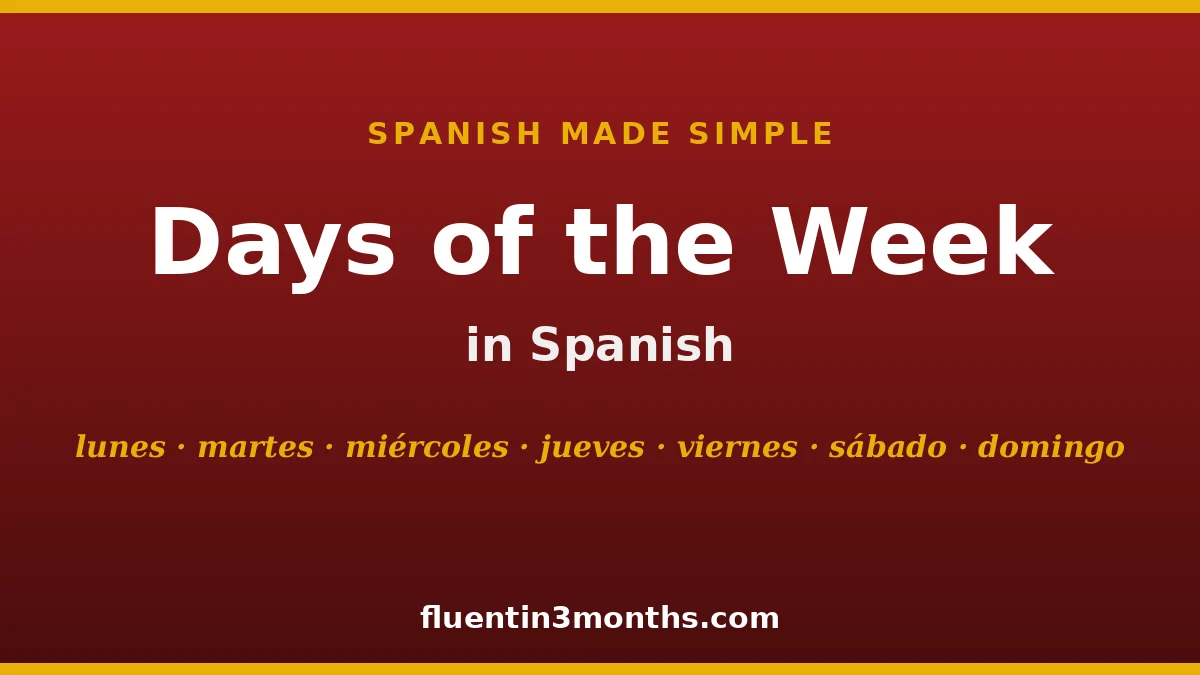
The acquisition of temporal vocabulary represents a critical milestone in the journey toward Spanish language proficiency, serving as a foundational pillar for daily communication, professional scheduling, and cultural integration. For the more than 500 million Spanish speakers worldwide, the days of the week—lunes, martes, miércoles, jueves, viernes, sábado, and domingo—are not merely labels for time but are deeply rooted in a blend of Greco-Roman mythology and Judeo-Christian tradition. Understanding these terms requires more than rote memorization; it necessitates an appreciation of specific grammatical protocols, phonetic nuances, and the historical evolution of the Romance languages. As global interconnectedness increases, the ability to navigate the Spanish calendar has become an essential skill for travelers, business professionals, and students alike.
The Linguistic Foundation of the Spanish Week
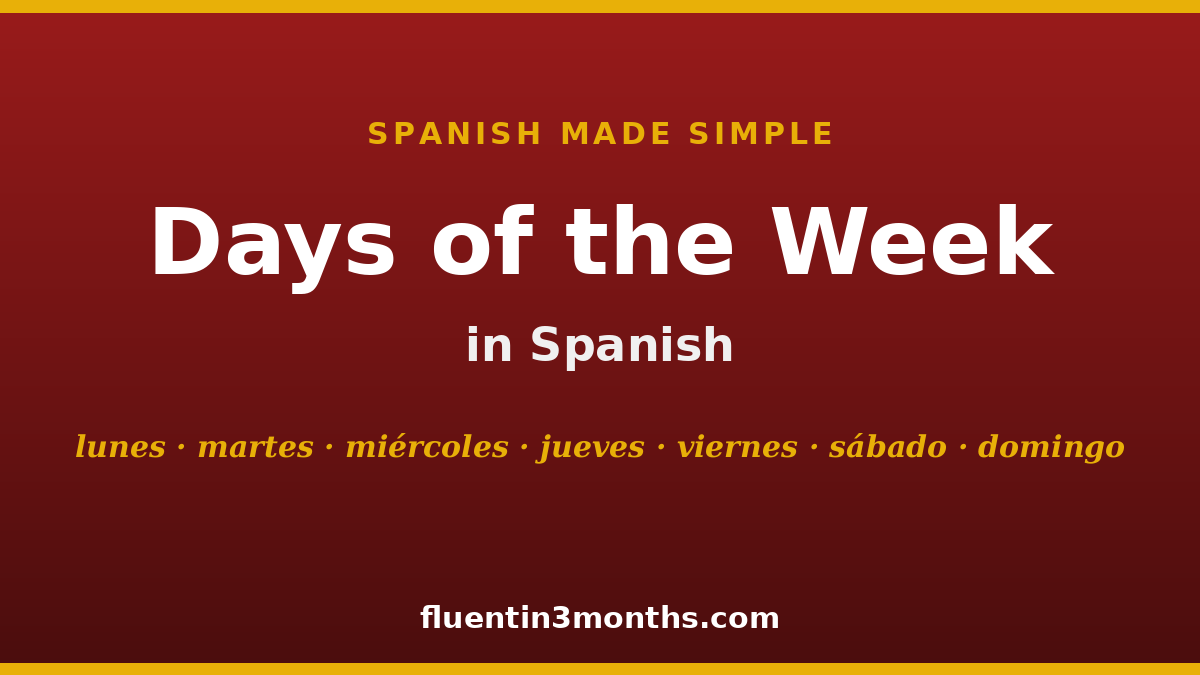
The Spanish week is composed of seven distinct nouns, all of which are grammatically masculine. To the English-speaking learner, the phonetic structure of these words offers a gateway into the broader vowel sounds and consonantal shifts characteristic of the Spanish language.
- Lunes (Monday): Pronounced LOO-nes.
- Martes (Tuesday): Pronounced MAR-tes.
- Miércoles (Wednesday): Pronounced MYAIR-koh-les.
- Jueves (Thursday): Pronounced HWEH-ves.
- Viernes (Friday): Pronounced VYAIR-nes.
- Sábado (Saturday): Pronounced SAH-bah-doh.
- Domingo (Sunday): Pronounced doh-MEEN-goh.
A primary point of emphasis for educators and linguistic experts is the use of written accents, known as tildes. In Spanish, the words miércoles and sábado carry these marks to indicate vocal stress on syllables that deviate from standard Spanish stress patterns. In miércoles, the stress falls on the antepenultimate syllable, as it does in sábado. Failure to include these accents in formal writing is categorized as a significant orthographic error by the Real Academia Española (RAE), the official body responsible for overseeing the Spanish language.
Orthographic Standards and Capitalization Rules
One of the most frequent errors among native English speakers learning Spanish is the improper capitalization of the days of the week. Unlike English, which treats days as proper nouns requiring a capital letter, Spanish categorizes them as common nouns. According to the RAE, lunes, martes, and the rest of the week should always be written in lowercase unless they appear at the very beginning of a sentence or form part of a formal proper title (such as a specific holiday name).
This rule extends to months (enero, febrero) and seasons (primavera, verano). Linguistic analysts suggest that this distinction reflects a fundamental difference in how the two languages perceive the status of temporal markers. While English elevates them to the status of names, Spanish treats them as descriptive elements of the natural and social cycle. For professionals drafting correspondence in Spanish, adhering to lowercase conventions is a hallmark of high-level literacy and cultural competence.
Chronological Structure and the Monday Start
The Spanish-speaking world predominantly adheres to the international standard ISO 8601, which designates Monday (lunes) as the first day of the week. This stands in contrast to the traditional North American calendar layout, which places Sunday (domingo) in the leftmost column.
In Spain and most of Latin America, the workweek begins on lunes, and the weekend (el fin de semana) is viewed as a cohesive unit at the end of the seven-day cycle. While some regions in Latin America influenced by U.S. commercial standards may occasionally use Sunday-start calendars, the Monday-start remains the cultural and administrative norm. For those booking travel, scheduling international meetings, or using digital calendar interfaces, this shift is vital to avoid logistical errors.
Grammatical Application and the Role of the Article
A significant hurdle for learners is the transition from the English preposition "on" to the Spanish definite article. In English, one says, "I will see you on Monday." In Spanish, the preposition en (on/in) is never used for this purpose. Instead, the masculine definite article el (singular) or los (plural) serves as the temporal indicator.
- Singular usage: El lunes voy a la oficina (On Monday, I am going to the office).
- Plural usage: Los lunes voy al gimnasio (On Mondays, I go to the gym).
This distinction is crucial because it differentiates between a one-time event and a recurring habit. Furthermore, the days of the week exhibit unique pluralization rules. The five weekdays (lunes through viernes) are "invariable," meaning the spelling of the word does not change regardless of whether it is singular or plural. The transition from singular to plural is indicated solely by the change from el to los. Conversely, sábado and domingo follow standard Spanish pluralization by adding an "-s" to become sábados and domingos.
Etymological Origins: From Planets to Prayer
The history of the Spanish days of the week offers a fascinating look into the Roman Empire’s influence on the Iberian Peninsula. Five of the days are directly derived from the Planetae (planets) recognized by the Romans, which were in turn named after their deities.
- Lunes: Derived from Luna (the Moon).
- Martes: Derived from Mars (the God of War).
- Miércoles: Derived from Mercury (the Messenger God).
- Jueves: Derived from Jupiter (the King of the Gods).
- Viernes: Derived from Venus (the Goddess of Love).
The weekend days, however, reflect the subsequent Christianization of the Roman world. Originally, the Romans referred to Saturday as dies Saturni (Day of Saturn), a name preserved in English. However, Spanish adopted sábado from the Hebrew Shabbat (Sabbath), reaching Spanish via the Latin sabbatum. Similarly, Sunday was originally dies Solis (Day of the Sun), but was renamed dies Dominicus (The Lord’s Day) in the 4th century by the Emperor Constantine. This evolved into the modern Spanish domingo.
Linguistic historians note that this blend of pagan and religious etymology provides a roadmap of Western civilization’s cultural shifts, preserved within the daily vocabulary of the Spanish language.
Practical Vocabulary for Temporal Fluency
Beyond the names of the days themselves, a suite of adverbial phrases is required to navigate time effectively. In a professional or social setting, these phrases allow for nuance and precision.
- Hoy: Today.
- Ayer: Yesterday.
- Mañana: Tomorrow (also means "morning").
- Pasado mañana: The day after tomorrow.
- Anteayer: The day before yesterday.
- La semana que viene: Next week.
- La semana pasada: Last week.
- Próximo: Next (e.g., el próximo jueves).
- Esta tarde: This afternoon.
The phrase fin de semana is ubiquitous in Spanish-speaking cultures, often shortened to el finde in casual Iberian Spanish. Understanding these terms is essential for interpreting news reports, historical timelines, and legal documents where precise dates and intervals are specified.
Analytical Perspective: The Impact of Temporal Literacy
Linguistic experts argue that mastering temporal vocabulary is one of the highest-yield activities for a language learner. Because time-related discussions occur in the opening minutes of most human interactions—whether arranging a business lunch, confirming a medical appointment, or discussing current events—proficiency in this area immediately boosts the speaker’s perceived fluency.
From a sociological standpoint, the way a culture labels and organizes its week reflects its values. The transition of domingo from "Day of the Sun" to "The Lord’s Day" underscores the deep-seated influence of Catholicism in Spanish-speaking nations. Similarly, the secular, lowercase treatment of these days in modern orthography reflects the move toward linguistic standardization and practical utility in the modern era.
Conclusion and Future Implications
As the Spanish language continues to grow in influence—driven by the economic development of Latin American markets and the demographic shifts in the United States—the demand for accurate linguistic education is at an all-time high. Educational institutions are increasingly focusing on "functional fluency," which prioritizes high-frequency vocabulary like the days of the week.
By moving beyond simple lists and investigating the grammar, history, and cultural context of the Spanish calendar, learners gain a more robust and resilient command of the language. Whether one is reading a newspaper in Madrid, setting a deadline in Mexico City, or studying history in Bogotá, the seven days of the week serve as the essential grid upon which the Spanish-speaking world is built. Through careful study of these terms, the learner does more than just tell time; they begin to speak the language of the culture itself.
