

The German verb haben serves as a fundamental pillar of the Germanic linguistic structure, functioning far beyond its primary definition of "to have." As the primary auxiliary verb used to construct the Perfekt (present perfect) tense, haben is the most frequently utilized tool for expressing past actions in daily German discourse. Linguistic experts assert that a comprehensive mastery of haben provides learners with the necessary framework to unlock nearly the entire spectrum of German verbs, as the majority of the lexicon relies on this auxiliary to indicate completed actions. Understanding the nuances of its conjugation, its irregular morphological shifts, and its distinction from the auxiliary sein is essential for any student seeking professional or academic fluency in the German language.
The Morphological Architecture of Haben in the Present Tense
In the hierarchy of German verbs, haben is classified as irregular, or more specifically, a "mixed" verb. While it follows standard patterns in several tenses, its present tense (Präsens) forms contain a significant phonetic contraction that often serves as a primary hurdle for novice learners. In the second-person singular (du) and third-person singular (er/sie/es) forms, the verb undergoes a "b-drop," a linguistic evolution intended to facilitate easier pronunciation in high-frequency speech.
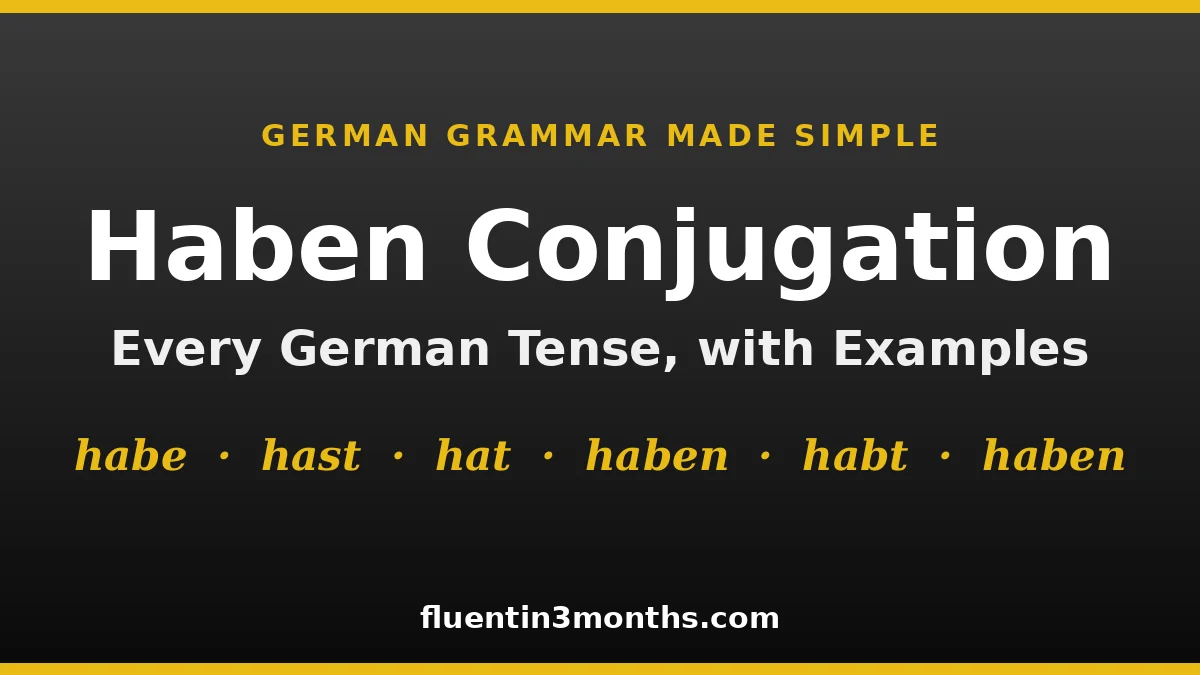
The standard present tense conjugation is as follows:
- Ich habe (I have)
- Du hast (You have – informal singular)
- Er/sie/es hat (He/she/it has)
- Wir haben (We have)
- Ihr habt (You all have – informal plural)
- Sie/Sie haben (They/You – formal)
Data from linguistic frequency studies suggest that the "b-drop" in hast and hat is a result of centuries of phonetic erosion. Similar to the English transition from "haveth" to "has," German speakers historically streamlined these forms due to their constant usage. Educators emphasize that correcting the common error of using "habst" or "habt" (for he/she/it) early in the learning process is critical for achieving a native-like cadence.
Historical Context and the Evolution of Irregularity
The irregularity of haben is not an isolated grammatical quirk but a documented evolutionary trait shared with other high-frequency verbs like sein (to be) and werden (to become). Linguists categorize the past tense (Präteritum) and past participle (Partizip II) of haben within the "mixed" verb family. While it adopts the dental suffix "-te" or "-t" characteristic of weak (regular) verbs—seen in hatte and gehabt—the stem itself undergoes a transformation from "hab-" to "hatt-."
This shift mirrors the "weak" conjugation pattern of verbs such as machen (machen, machte, gemacht), yet the doubling of the "t" and the subsequent vowel shift in the subjunctive (Konjunktiv II) form hätte distinguish it as a unique linguistic entity. Historical records of Old High German show a more consistent stem, but as the language moved toward Middle High German, the streamlining of auxiliary verbs became more pronounced to support the increasing complexity of compound tenses.
The Auxiliary Role: Haben vs. Sein in the Perfekt Tense
One of the most critical functions of haben is its role as an auxiliary in the Perfekt tense. In German, the past is typically expressed through a combination of a helping verb and a past participle. Statistically, haben is the dominant auxiliary, used for all transitive verbs (verbs that take a direct object) and most intransitive verbs.
The selection between haben and sein as an auxiliary is governed by specific grammatical rules:
- Haben: Used for verbs denoting a state, reflexive verbs, and any verb taking an accusative object (e.g., Ich habe den Film gesehen – I have seen the film).
- Sein: Reserved for verbs of motion (e.g., gehen, fahren), verbs indicating a change of state (e.g., aufwachen, sterben), and the verbs sein and bleiben themselves.
Linguistic analysis indicates that approximately 80% of German verbs utilize haben in the Perfekt tense. Consequently, learners are often advised to default to haben when in doubt, though the mastery of the sein-exception list remains a prerequisite for advanced proficiency.
Chronology of Tenses: From Simple to Compound
A structural analysis of haben across various tenses reveals the verb’s versatility. In German, there are only two "simple" tenses that consist of a single word; all others are "compound" tenses requiring an auxiliary.
The Simple Tenses:
- Präsens (Present): Used for current states and future intentions.
- Präteritum (Simple Past): Primarily used in written narratives, though haben and sein are notable exceptions where the Präteritum (ich hatte) is frequently preferred over the Perfekt (ich habe gehabt) even in spoken conversation.
The Compound Tenses:
The Perfekt, Plusquamperfekt (Past Perfect), and Futur (Future) tenses demonstrate the recursive nature of German grammar. In these instances, haben acts as its own auxiliary.
- Perfekt: Ich habe gehabt (I have had).
- Plusquamperfekt: Ich hatte gehabt (I had had).
- Futur I: Ich werde haben (I will have).
- Futur II: Ich werde gehabt haben (I will have had).
Educational frameworks note that while Futur II is statistically rare in spoken German, the Perfekt and Präteritum of haben are foundational to A1 and A2 level certifications under the Common European Framework of Reference for Languages (CEFR).
The Subjunctive Mood and Social Etiquette
Beyond possession and tense construction, haben plays a vital role in German social pragmatics through the Konjunktiv II (Subjunctive II). This mood is used to express hypotheticals, wishes, and, most importantly, polite requests.
The form hätte (the subjunctive of hatte) is ubiquitous in service industry interactions. The phrase "Ich hätte gern…" (I would like to have…) is the standard professional and polite method for ordering in restaurants or requesting assistance in retail. This is contrasted with the Konjunktiv I, which is primarily used in journalistic reporting and legal contexts to indicate indirect speech (e.g., Er sagte, er habe kein Geld – He said he has no money).
Idiomatic Divergence: When "Have" Does Not Equal "Haben"
A significant challenge for English and Romance language speakers is the idiomatic application of haben. In several instances, German employs haben where English uses "to be." Failure to recognize these idiomatic clusters is a common marker of non-native speech.
Key idiomatic uses of haben include:
- Physical States: Hunger haben (to be hungry), Durst haben (to be thirsty), Angst haben (to be afraid).
- Abstract Concepts: Recht haben (to be right), Zeit haben (to have time), Glück haben (to be lucky).
Conversely, a major point of divergence occurs with age. While Spanish (tener… años) and French (avoir… ans) use their respective equivalents of "to have," German aligns with English in using the verb "to be" (sein). For example, "Ich bin 20 Jahre alt" is the only correct form; "Ich habe 20 Jahre" is a frequent but incorrect literal translation from other languages.
Broader Impact on Language Acquisition and Pedagogy
The strategic importance of haben has led to shifts in pedagogical methodologies. Modern language programs, such as the "Speak from Day One" approach popularized by polyglot Benny Lewis, emphasize the early acquisition of high-utility verbs like haben to build communicative confidence. By focusing on the six present-tense forms and the polite hätte form, learners can navigate a vast array of social and practical situations before mastering the wider complexities of German cases and syntax.
Linguistic experts argue that the "utility-first" model of learning haben serves as a psychological catalyst for students. Because haben is the engine for the past tense, acquiring it early allows learners to share personal narratives and histories, which are essential for building relationships in a second language.
Conclusion: Implications for Global Communication
As the German language continues to be a dominant force in European commerce, science, and technology, the precision with which it is spoken remains a high priority for international professionals. Haben is more than a grammatical requirement; it is a versatile instrument of expression. From the simplicity of stating possession to the complexity of hypothetical past-perfect constructions, the verb permeates every layer of German communication.
For the estimated 15.4 million people currently learning German worldwide, the mastery of haben represents a significant milestone. It marks the transition from basic labeling of the world to the ability to navigate time, express desire with politeness, and describe the nuances of the human condition. As this guide illustrates, while the verb may be irregular in form, its value in the pursuit of linguistic fluency is absolute.
