

Sales professionals frequently inquire about the singular most potent principle of influence within the sales process. While the complexities of each sales encounter necessitate a nuanced approach, extensive research and practical application consistently point to the principle of consistency as the paramount driver of influence in successful sales. This seemingly counterintuitive assertion stems from a fundamental observation: the most effective salespeople talk less. This may challenge conventional notions of sales, which often conjure images of relentless product pitches and persuasive monologues. However, over two decades of dedicated study into sales methodologies, including the analysis of countless scholarly articles, industry reports, and seminal works, reveal a recurring theme: top-tier sales performers dedicate significantly more time to asking incisive questions and actively listening than they do to speaking.
The Power of Listening: Uncovering Customer Needs
Industry experts widely suggest that highly effective salespeople utilize only 25% to 30% of their allotted conversation time for speaking. The remaining 70% to 75% is strategically employed to meticulously uncover what is most important to the customer. This is precisely where the principle of consistency, as articulated by renowned social psychologist Dr. Robert Cialdini, exerts its profound influence. Cialdini’s principle posits that individuals experience both internal psychological pressure and external social pressure to act in accordance with their prior statements and behaviors. Humans possess an innate desire to perceive themselves as individuals who honor their commitments, and this self-perception is further reinforced by favorable regard from others when such follow-through occurs. In essence, people are inherently motivated to align their actions with their expressed words, a phenomenon with substantial implications for the sales arena.
Consistency as a Sales Catalyst
The application of this principle in sales is elegantly straightforward. Astute salespeople do not merely employ questions as a tool for information gathering. Instead, they leverage questions to guide customers in articulating their true wants, needs, and aspirations. Once these core desires are clearly articulated, the salesperson is then positioned to demonstrate how their proposed solution directly addresses and aligns with the very priorities the customer has already identified as critical. This approach resonates with a core tenet often shared in sales training: "People don’t resist their own values." When a proposed solution is intrinsically linked to a customer’s pre-existing values and stated needs, the decision to move forward becomes a natural extension of their own expressed desires, rather than an external imposition.
The "Store X" vs. "Store Y" Analogy: Navigating the Customer’s Path
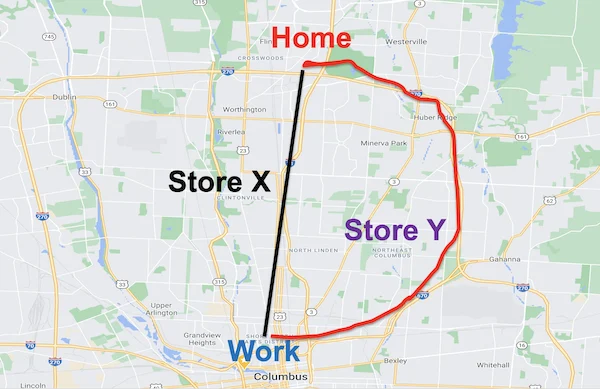
To illustrate this concept, consider a common real-world scenario. Imagine an individual who commutes approximately 15 miles to work and follows the same daily route. A simple request from home might be, "Would you stop at the store on your way home and pick up batteries and bug spray?" If the required items are readily available at "Store X," a business conveniently located just a minute or two off the usual commute, the request is likely to be met with an enthusiastic "yes." The reason is straightforward: Store X is already integrated into the individual’s established path, requiring minimal deviation and effort.

However, the scenario changes dramatically if the items are exclusively available at "Store Y," a location several miles off the intended route, potentially adding 20 minutes or more to the journey. In this instance, hesitation is probable. The reluctance is not necessarily a lack of willingness to assist but rather the inconvenience it introduces, disrupting the established, effortless routine.
This analogy directly mirrors many sales interactions. When salespeople invest time in asking thoughtful, probing questions early in the discovery process, customers are empowered to articulate their objectives, identify their challenges, prioritize their needs, and define their desired outcomes. The salesperson can then strategically present their offering as a seamless solution that directly addresses these customer-defined priorities, effectively creating a "direct route" towards resolution. In this context, the purchase transforms into the equivalent of stopping at Store X – it is already on the customer’s chosen path.
Conversely, when salespeople bypass or inadequately conduct the discovery phase, they often find themselves attempting to persuade customers to embark on an entirely different, and often circuitous, journey. This leads to extended periods of explanation, convincing, defending the offering, and overcoming objections, all because the foundational step of establishing the customer’s intended destination was neglected. This is akin to the "Store Y" scenario – it is more challenging, time-consuming, and ultimately, it feels like being "sold to." This aligns with the widely quoted sentiment by sales guru Jeffrey Gitomer: "People don’t like to be sold, but they love to buy."
The Strategic Advantage of Probing Questions
The most impactful sales conversations do not force individuals toward a destination they have not chosen. Instead, they facilitate progress toward outcomes that the customer has already identified as significant. This underscores the power of consistency. When customers articulate their priorities, and a salesperson can authentically connect their solution to those very priorities, the act of saying "yes" becomes a natural and comfortable decision, as it is consistent with what they have already expressed they want.
Data Supporting the Efficacy of Consultative Selling
The effectiveness of this customer-centric, question-driven approach is supported by numerous studies. A 2021 report by CSO Insights revealed that sales teams employing a more consultative selling approach, which emphasizes in-depth discovery and understanding of customer needs, achieved a win rate that was 10-15% higher than those relying on more transactional methods. Furthermore, research published in the Journal of Personal Selling & Sales Management has consistently shown that active listening and effective questioning are positively correlated with customer satisfaction and loyalty. The data suggests that rather than a relentless pursuit of closing the deal, the focus on understanding and aligning with customer values creates a more sustainable and profitable sales environment.

Broader Implications for Sales Strategy and Training
The implications of this principle extend beyond individual sales interactions. For sales organizations, it underscores the critical need for comprehensive training programs that prioritize the development of questioning and listening skills. Sales methodologies that emphasize product features and benefits without a deep understanding of customer context are likely to be less effective in today’s discerning market. Companies that invest in teaching their sales teams how to uncover and align with customer values are not just improving their win rates; they are building stronger, more trusting relationships that can lead to repeat business and valuable referrals.
The current economic climate, characterized by increasing complexity and informed buyers, further amplifies the importance of this approach. Buyers are less receptive to generic pitches and more inclined to engage with sales professionals who demonstrate a genuine understanding of their unique challenges and goals. The ability to consistently align solutions with pre-established customer needs becomes a significant competitive differentiator.
The Future of Sales: A Dialogue of Discovery
In conclusion, the question for sales professionals to consider is not merely about knowing their product or their competition, although these are fundamental. The most critical element is mastering the art of asking the right questions. The shortest, most efficient, and most influential path to a sale is often paved by skillfully guiding customers to follow the path they have already chosen for themselves. Are your sales questions leading your customers towards "Store X," a path of convenience and alignment, or are they inadvertently forcing them toward "Store Y," a route of inconvenience and resistance? The answer to this question can illuminate why some sales conversations flow effortlessly towards a mutually beneficial outcome, while others devolve into an arduous uphill battle.
Brian Ahearn, Chief Influence Officer at Influence PEOPLE and a faculty member at the Cialdini Institute, is a recognized authority in the field of ethical influence. As one of the few Cialdini Method Certified Trainers globally, personally trained by Dr. Robert Cialdini, Ahearn’s work focuses on applying proven influence principles to enhance sales and business interactions. His bestselling books, including Influence PEOPLE and Persuasive Selling, along with his widely viewed LinkedIn learning courses and TEDx Talk on pre-suasion, demonstrate his commitment to empowering professionals with the knowledge and strategies to achieve greater success through understanding and leveraging the science of influence.
