


The question of artificial intelligence’s role in content creation, particularly within the realm of influence and thought leadership, has resurfaced as a critical point of discussion. A recent LinkedIn post, beginning with the provocative statement, "I don’t use AI to write my content," has ignited a debate that extends beyond mere tool usage to the very essence of authenticity and expertise. The author of the post clarified that this was not a declaration of superiority, but rather a point that the value of the content, irrespective of its origin, is paramount. This perspective, while holding a degree of truth, overlooks a crucial distinction: the difference between leveraging AI to enhance one’s thinking and allowing it to supplant it entirely.
The Erosion of Authentic Expertise
The core of the concern lies in the potential for AI to create a disconnect between a public persona and the actual source of their ideas and insights. Imagine a scenario where an individual has meticulously cultivated an audience through books, online courses, and regular content, only for that audience to discover, upon direct interaction, that the expressed knowledge and unique perspectives are not genuinely their own. This hypothetical situation mirrors the fall of the musical group Milli Vanilli in the late 1980s. The duo achieved immense success, selling millions of albums and garnering prestigious awards, only for their careers to implode when it was revealed they had not performed the vocals on their hit songs. The issue was not the quality of the music itself, which remained unchanged, but the fundamental breach of trust stemming from a lack of authenticity.
This parallels the concern that AI-generated content could lead to a modern-day equivalent of the Milli Vanilli scandal in the digital sphere. While the factual accuracy or informational value of an AI-generated piece might be high, the absence of genuine human experience, lived insight, and developed conviction can lead to a profound disappointment for those who have invested their trust and admiration in an individual’s supposed expertise. Renowned thinkers like Dallas Willard or C.S. Lewis, whose works have shaped countless minds, would not suddenly lose their intellectual weight if it were revealed they hadn’t authored their books. However, the respect and personal connection audiences feel towards such figures are intrinsically linked to the belief that these ideas originated from their unique journeys, reflections, and intellectual development.
The Principle of Authority and its AI Challenge
Dr. Robert Cialdini’s well-established principles of influence, particularly the principle of Authority, are central to this discussion. People are naturally inclined to place greater trust in individuals who demonstrate genuine expertise. However, the efficacy of this principle hinges on the "genuineness" of that expertise. When AI is responsible for generating ideas, crafting examples, formulating stories, and drawing conclusions, the demonstrable expertise shifts from the individual to their ability to prompt the AI effectively. This distinction is significant: showcasing advanced prompting skills is not equivalent to showcasing personal knowledge, experience, or developed intellectual capacity.
AI as a Tool, Not a Replacement
It is crucial to emphasize that this critique is not an indictment of AI itself. Many professionals, including those in fields requiring significant intellectual output, are finding AI to be an invaluable asset. AI can serve as a powerful tool for organizing thoughts, challenging assumptions, refining clarity, and editing written work. It can act as a sophisticated brainstorming partner, much like discussing an idea with a trusted colleague or friend. AI can help identify blind spots in reasoning and improve the overall flow and polish of communication.
However, the critical boundary lies in recognizing AI as a collaborator, not a substitute for the author’s own lived experience. The stories an individual has personally navigated, the mistakes they have learned from, the hard-won lessons they have internalized, and the deeply held convictions they have cultivated are elements that AI, by its very nature, cannot replicate. These are the foundational elements that imbue a voice with uniqueness and authenticity.
The Future of Expertise in the AI Era
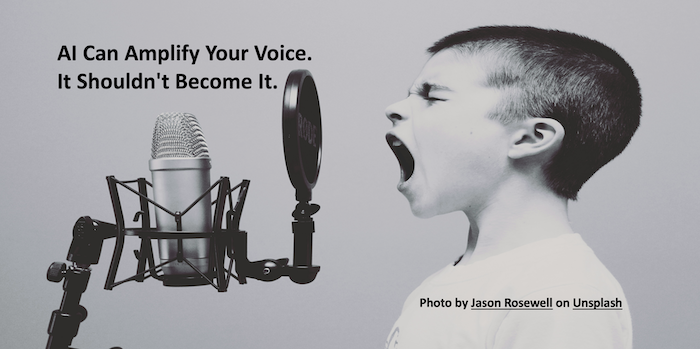
The individuals poised to benefit most from AI in the coming decade are unlikely to be those who rely on it most heavily for content generation. Instead, it will likely be those who have dedicated years to developing deep, genuine expertise and then strategically employ AI to communicate that expertise more effectively. AI possesses the capacity to amplify a voice, to extend its reach and impact. However, it should never be allowed to become the voice itself.
The challenge, therefore, for influencers, thought leaders, and creators across all disciplines, is to navigate this evolving landscape with integrity. The goal should be to harness the efficiencies and capabilities of AI without sacrificing the core of what makes their contributions valuable: their unique human perspective, shaped by experience and authentic thought.
Broader Implications for Trust and Influence
The implications of this distinction extend beyond individual creators to the broader ecosystem of information and influence. As AI becomes more sophisticated, the potential for generating seemingly authoritative content at scale increases. This raises concerns about the dilution of genuine expertise and the potential for widespread misinformation or inauthentic influence.
Timeline of AI Integration in Content Creation:
- Early 2010s: Basic AI tools emerge for grammar checking and rudimentary text generation.
- Mid-to-Late 2010s: Natural Language Processing (NLP) advancements lead to more sophisticated AI writing assistants capable of generating paragraphs and suggesting content.
- Early 2020s: Large Language Models (LLMs) like GPT-3 and subsequent iterations become widely accessible, enabling the creation of highly coherent and contextually relevant text, sparking broader discussions about AI’s creative capabilities.
- Present Day: Advanced AI tools are integrated into various content creation workflows, leading to debates about ethical use, authenticity, and the definition of authorship.
Supporting Data and Trends:
- Growth in AI Adoption: Global AI market size is projected to grow significantly, with a Compound Annual Growth Rate (CAGR) of over 37% from 2023 to 2030, according to Grand View Research. This indicates a widespread embrace of AI technologies across industries.
- Content Volume Surge: The proliferation of digital content is immense. Platforms like social media generate billions of posts daily, and the demand for fresh, engaging content is constant. AI offers a potential solution to meet this demand.
- Audience Demand for Authenticity: Surveys consistently show that consumers value authenticity in brands and individuals. For example, a 2023 Edelman Trust Barometer report indicated that 60% of consumers say they are more likely to buy from a brand that is authentic. This underscores the importance of genuine human connection in building trust.
Analysis of Implications:
The increasing reliance on AI for content creation presents a dual-edged sword. On one hand, it democratizes content production, lowers barriers to entry, and enhances efficiency. On the other hand, it poses a significant challenge to the concept of authorial voice and genuine expertise. The potential for AI to generate plausible yet unoriginal or uninspired content could lead to a glut of superficial material, making it harder for truly insightful and experienced voices to stand out.
Furthermore, the ethical considerations surrounding AI-generated content are evolving. Issues of intellectual property, transparency, and the potential for manipulation are becoming increasingly important. Audiences are becoming more discerning, and a sustained lack of authenticity, even if initially masked by well-crafted AI output, is likely to lead to a decline in trust and influence.
Conclusion: The Enduring Value of Human Experience
The debate over AI and content creation is not about whether to use the tools, but how to use them. AI can be a powerful amplifier, a sophisticated editor, and an insightful collaborator. However, it cannot replicate the depth of human experience, the nuance of lived perspective, or the conviction born from genuine struggle and learning. The individuals who will thrive in this new era are those who can skillfully integrate AI into their workflow while staying firmly grounded in their own unique expertise, ensuring that their voice remains their own, amplified but never replaced.
A question to ponder: Where do you draw the line between using AI as a tool and allowing it to become the author of your expertise?
Brian Ahearn is the Chief Influence Officer at Influence PEOPLE and a faculty member at the Cialdini Institute. An author, TEDx presenter, international speaker, coach, and consultant, Brian helps clients apply influence in everyday situations to boost results. As one of only a dozen Cialdini Method Certified Trainers in the world, Brian was personally trained and endorsed by Robert Cialdini, Ph.D., the most cited living social psychologist on the science of ethical influence. Brian’s first book, Influence PEOPLE, was named one of the 100 Best Influence Books of All Time by Book Authority. Persuasive Selling and Influenced from Above were Amazon new release bestsellers. His LinkedIn courses on persuasive selling and coaching have been viewed by over 850,000 people around the world and his TEDx Talk on pre-suasion has more than a million views.
