

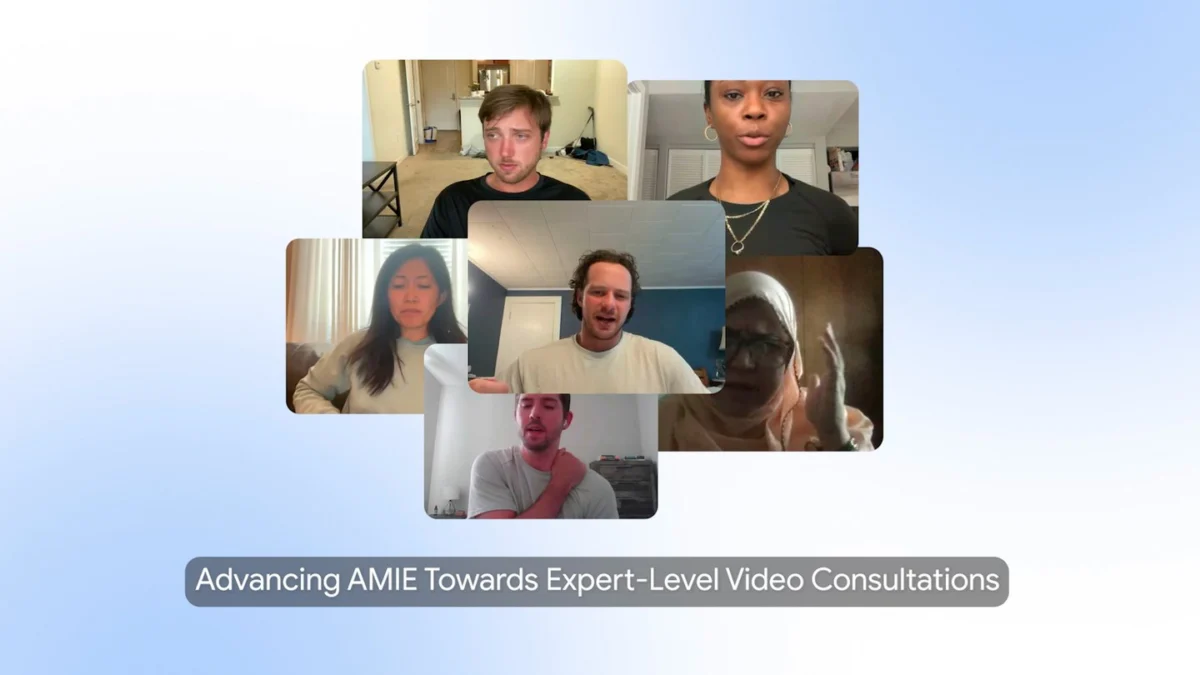
Google Research and Google DeepMind have announced a significant milestone in the evolution of medical artificial intelligence with the advancement of AMIE (Articulate Medical Intelligence Explorer), a research system now capable of conducting real-time clinical video consultations. This development represents a shift from text-based diagnostic tools to a multimodal interface that can interpret visual and auditory cues, mirroring the nuanced interactions of a traditional doctor-patient visit. By integrating the advanced reasoning of Gemini with the low-latency responsiveness of Project Astra, the research team has demonstrated that an AI agent can not only process verbal information but also observe physical signs such as a patient’s gait, the sound of a cough, or visible symptoms of distress.
The transition to video-based interaction marks a pivotal moment in the quest to create "expert-level" AI for healthcare. While previous iterations of medical AI focused largely on processing EHR (Electronic Health Record) data or answering medical queries via text, AMIE’s new capabilities allow it to engage in the dynamic, real-time observation essential for clinical diagnosis. This breakthrough was detailed in a first-of-its-kind study that compared the AI’s performance against human primary care physicians in simulated environments, yielding results that suggest AI could soon play a more substantial role in supporting global healthcare delivery.
The Technical Foundation: Gemini and Project Astra
At the core of the enhanced AMIE system is a sophisticated multi-agent architecture built upon Google’s most capable AI models. The system leverages Gemini, Google’s frontier multimodal model, which provides the underlying logic and medical knowledge base. However, the move to real-time video required more than just static knowledge; it required the ability to perceive and react to the world in real time. To achieve this, researchers integrated Project Astra, a universal AI agent technology designed for high-speed, multimodal perception and conversation.
This integration allows AMIE to function as a "seeing and hearing" diagnostic agent. The multi-agent architecture operates by delegating specific tasks—such as visual analysis, auditory processing, and diagnostic reasoning—to specialized sub-systems that communicate instantaneously. For example, during a video call, one part of the system might focus on identifying dermatological patterns on a patient’s skin, while another analyzes the cadence of the patient’s speech for signs of neurological impairment. A central "reasoning agent" then synthesizes these inputs to guide the consultation forward, asking follow-up questions or requesting the patient to perform specific movements.
Methodology of the Clinical Evaluation
To validate these advancements, Google conducted a randomized, controlled study utilizing simulated consultations. This methodology is a standard in medical education and research, employing "patient actors"—individuals trained to portray specific medical conditions with consistency. The study compared AMIE’s performance in these video-based interactions against a cohort of board-certified primary care physicians (PCPs).
The evaluators used a comprehensive set of clinical competencies to judge both the human doctors and the AI system. These metrics included:
- History-taking thoroughness: The ability to extract all relevant medical history and symptoms from the patient.
- Diagnostic accuracy: The correctness of the differential diagnosis provided at the conclusion of the session.
- Management appropriateness: The quality and safety of the proposed treatment plan or next steps.
- Communication quality: The empathy, clarity, and professional rapport established during the consultation.
The results of the study were notably favorable toward the AI system. Clinical evaluators, blinded to whether they were reviewing a human or an AI performance in many instances, rated AMIE at an expert level across these core competencies. Perhaps most surprisingly, the patient actors involved in the study reported a preference for the video-based AI experience over previous text-based iterations, citing a greater sense of connection and a more "natural" feeling to the diagnostic process.
A Chronology of Google’s Medical AI Development
The advancement of AMIE is the latest step in a decade-long journey for Google in the healthcare sector. Understanding the timeline of this development provides context for the current breakthrough:
- 2016–2018: Specialized Diagnostic Models. Google’s early efforts focused on "narrow" AI, such as deep learning models designed to detect diabetic retinopathy from retinal scans or identify cancerous cells in pathology slides. These models outperformed humans in specific tasks but lacked general medical reasoning.
- 2019–2021: Large Language Model Integration. With the rise of Transformers, Google began exploring how LLMs could process medical text. This period saw the development of initial models capable of passing medical licensing exams, though they remained prone to "hallucinations."
- 2022: Med-PaLM. Google introduced Med-PaLM, the first LLM to reach a passing score on USMLE-style questions. This demonstrated that AI could organize and retrieve vast amounts of medical knowledge.
- 2023: Med-PaLM 2 and AMIE 1.0. Med-PaLM 2 achieved "expert" levels on medical exams. Simultaneously, the first version of AMIE was introduced as a research project focused on "Articulate" intelligence—moving beyond simple answers to conversational diagnostic exploration via text.
- 2024: Multimodal AMIE. The current iteration integrates video and audio through Gemini and Project Astra, marking the shift from a "medical chatbot" to a "virtual clinician."
Supporting Data and Comparative Performance
In the reported study, AMIE’s performance was analyzed through the lens of 32 different axes of clinical quality. Data suggests that the AI system was particularly adept at maintaining a structured approach to the consultation. While human physicians are often under extreme time pressure—averaging only 15 to 20 minutes per patient in many clinical settings—AMIE was able to process information and iterate on its diagnostic hypothesis without the same temporal constraints, leading to high marks in "thoroughness."
One significant data point from the research indicates that AMIE’s diagnostic accuracy in the simulated environment was non-inferior, and in some categories superior, to the human PCP control group. Researchers attribute this to the AI’s ability to cross-reference symptoms against an exhaustive database of rare diseases and clinical guidelines in real time, a task that is cognitively demanding for even the most experienced human clinicians. Furthermore, the communication quality scores highlighted that the AI did not suffer from "compassion fatigue," consistently maintaining a polite and inquisitive tone that patient actors found reassuring.
Official Responses and Strategic Positioning
Google Research and DeepMind have maintained a cautious but optimistic tone regarding these findings. In the official project documentation, the team emphasizes that AMIE is "a research system" and is not yet intended for real-world clinical use. This distinction is crucial, as the transition from a simulated environment with actors to a chaotic, real-world clinical setting presents significant hurdles.
"When you visit a doctor, a consultation extends far beyond words," the research team noted in their blog. "A physician notices a cough, observes gait, or registers visible signs of discomfort." By mimicking these human traits, Google aims to bridge the gap between digital health and physical medicine. The strategic goal is not to replace physicians but to provide a "highly capable, accessible assistant" that can handle preliminary screenings, especially in regions where the patient-to-doctor ratio is dangerously low.
External reactions from the medical community have been a mix of intrigue and caution. While some digital health advocates see this as the "holy grail" of telemedicine, others point out that simulated actors do not represent the complexity of real patients, who may have multiple comorbidities, cognitive impairments, or difficulty using technology.
Broader Impact and Implications for Healthcare
The implications of an expert-level, audio-visual medical AI are profound. If successfully deployed, AMIE could redefine the "front door" of healthcare. In many parts of the world, patients wait weeks or months for a primary care appointment. A real-time AI system could provide immediate, high-quality triage, identifying which patients need urgent human intervention and which can be managed with home care or routine follow-ups.
Furthermore, the "virtual physical exam" capability is a transformative feature for telemedicine. Currently, remote consultations are limited by what the patient can describe. An AI that can guide a patient to "move the camera closer to the throat" or "walk toward the camera to check balance" effectively turns any smartphone into a diagnostic tool. This could significantly lower the cost of care and increase the frequency of monitoring for chronic conditions.
However, several challenges remain before AMIE can move from the laboratory to the clinic:
- Regulatory Approval: Systems like AMIE will likely be classified as "Software as a Medical Device" (SaMD), requiring rigorous clinical trials and FDA-level scrutiny.
- Bias and Equity: Ensuring the AI performs equally well across different ethnicities, ages, and accents is a primary concern for Google’s ethics teams.
- The "Human Touch": There are aspects of medicine—such as delivering terminal news or performing physical palpation—that an AI cannot replicate. The future will likely involve a hybrid model where AI handles data-heavy diagnostics while humans focus on procedural interventions and complex emotional support.
Conclusion and Future Outlook
The advancement of AMIE into the realm of real-time video consultation represents a landmark achievement in multimodal AI. By combining the linguistic prowess of Gemini with the sensory capabilities of Project Astra, Google has created a system that perceives the patient as a whole person rather than just a set of data points.
As the research moves forward, the focus will shift toward "responsible real-world deployment." This involves testing the system in diverse clinical environments, ensuring data privacy, and refining the AI’s ability to handle the unpredictability of human health. While the era of the "AI doctor" is still in its research phase, the success of AMIE suggests that the technology is no longer a matter of "if," but "when" and "how" it will be integrated into the global medical fabric. For now, AMIE stands as a powerful demonstration of how artificial intelligence can be tuned to the frequencies of human health, offering a glimpse into a future where expert medical advice is as accessible as a video call.
