


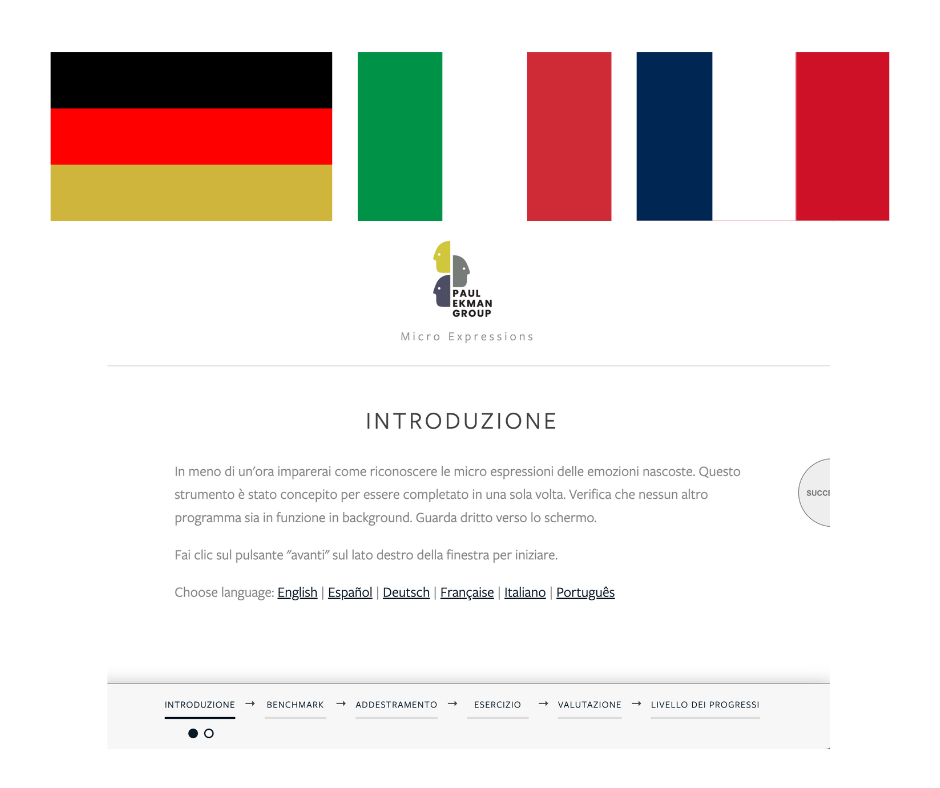
The Paul Ekman Group, a leader in emotional awareness and micro expression training, has announced a significant expansion of its online training platform, making its renowned science-based tools accessible to a broader international audience. Effective immediately, users can now access all seven core micro expression training tools in Italian, French, and German, in addition to the existing Spanish and Portuguese language options. This strategic move underscores the organization’s commitment to democratizing the science of emotional intelligence and making crucial communication skills universally available.
The expansion is a direct response to growing global demand for sophisticated tools that can enhance an individual’s ability to understand and interpret subtle human emotions. Micro expressions, defined as brief, involuntary facial movements that betray a person’s true feelings, are critical for effective communication, empathy, and discerning truth in a wide array of personal and professional contexts. By offering these tools in multiple languages, the Paul Ekman Group aims to empower individuals across diverse linguistic backgrounds with the ability to better understand themselves and others, fostering more accurate perceptions and empathetic interactions.
A Timeline of Global Accessibility
The journey towards multilingual accessibility for Paul Ekman Group’s training tools has been a gradual but deliberate process. While the core micro expression training modules have been available in English for years, the organization began its international outreach with translations into Spanish and Portuguese. This initial phase, which commenced approximately two years ago, provided valuable insights into the technical requirements and user engagement patterns for non-English speaking demographics.
The decision to add Italian, French, and German was informed by extensive market research and direct feedback from educators, professionals, and individuals across Europe who expressed a strong interest in accessing the training in their native tongues. The development and integration of these new language versions represent a significant investment in translation, localization, and platform adaptation, culminating in the comprehensive rollout announced today. Users will be prompted to select their preferred language upon initiating any micro expression course, ensuring a seamless and intuitive learning experience from the outset.
The Science Behind Micro Expressions and Their Significance
Micro expressions are fleeting, involuntary facial expressions that flash across a person’s face for a fraction of a second, revealing a genuine emotional state that may be consciously concealed. Discovered and extensively researched by Dr. Paul Ekman, these expressions are considered universal, meaning they are consistent across cultures and are part of our innate human biological makeup. The ability to recognize these subtle cues is not merely an academic pursuit but a practical skill with profound implications.
For instance, in law enforcement and national security, the accurate detection of micro expressions can aid in threat assessment, interrogation, and building trust. In the corporate world, leaders can leverage this knowledge to better understand employee morale, customer sentiment, and negotiation dynamics, leading to more effective management and improved business outcomes. In healthcare, particularly in mental health professions, recognizing micro expressions can enhance diagnostic accuracy and strengthen the therapeutic alliance between patient and provider. Educators can use these skills to gauge student engagement and comprehension, while individuals in interpersonal relationships can cultivate deeper empathy and resolve misunderstandings more effectively.
Data from studies on emotional intelligence consistently highlights the correlation between the ability to read nonverbal cues, including micro expressions, and overall success in various life domains. For example, a meta-analysis published in the Journal of Personality and Social Psychology found that individuals with higher emotional intelligence, which often includes the ability to decode subtle emotional signals, tend to exhibit better job performance, leadership effectiveness, and healthier relationships. The Paul Ekman Group’s training programs are designed to equip individuals with the precise skills to identify these micro expressions with a high degree of accuracy, often exceeding 80% in trained individuals.
Expanding Accessibility: A Global Imperative
Dr. Ekman’s foundational research, which has been instrumental in shaping the field of nonverbal communication, has always emphasized the universality of human emotions and their associated facial expressions. His groundbreaking work in New Guinea, for instance, demonstrated that even in preliterate societies, people expressed basic emotions like happiness, sadness, anger, fear, surprise, and disgust in recognizable ways. This universality forms the bedrock of the Paul Ekman Group’s mission to promote emotional awareness on a global scale.
With its training tools and resources already reaching individuals in over 230 countries, the addition of Italian, French, and German represents another significant stride towards fulfilling this mission. The organization recognizes that language barriers can be a substantial impediment to learning and professional development. By investing in multilingual content, the Paul Ekman Group is actively working to dismantle these barriers, ensuring that the profound benefits of emotional intelligence training are not confined to English-speaking populations. This initiative is particularly crucial for professionals and organizations in regions where English is not the primary language, enabling them to integrate these vital skills into their daily operations and personal lives with greater ease and effectiveness.
What the Training Packages Encompass
The comprehensive online micro expression training packages offered by the Paul Ekman Group consist of seven core tools. These tools are designed to systematically teach users how to identify the subtle, rapid facial movements associated with universal emotions. Each module typically includes:
- Instructional Videos: Featuring Dr. Paul Ekman and other leading experts, these videos explain the theoretical underpinnings of micro expressions and provide detailed demonstrations.
- Interactive Quizzes: Users are presented with short video clips of individuals displaying micro expressions and are tasked with identifying the emotion being expressed. These quizzes are crucial for developing and refining recognition skills.
- Progress Tracking: The platform allows users to monitor their performance, identify areas for improvement, and track their progress over time.
- Real-World Examples: Training often incorporates examples from diverse scenarios, illustrating how micro expressions manifest in everyday interactions, media, and high-stakes situations.
The decision to translate all seven core tools ensures that the depth and breadth of the original training are maintained, providing a robust learning experience regardless of the language chosen. The user interface, including instructions, feedback mechanisms, and all training content, has been meticulously translated to ensure clarity and accuracy.
Implications and Future Outlook
The expansion of the Paul Ekman Group’s online training into Italian, French, and German carries significant implications for various sectors. For businesses operating internationally, this means their employees can now acquire a shared understanding of emotional communication, leading to improved cross-cultural collaboration and client relations. Educational institutions can integrate these tools into their curricula, fostering emotional intelligence development from an early age. For individuals, it opens up new avenues for personal growth, enabling them to navigate social complexities with greater confidence and empathy.
The move also signals a broader trend in the e-learning industry towards hyper-localization. As online education continues to grow, the demand for content that is not only accurate but also culturally and linguistically resonant will only increase. The Paul Ekman Group is positioning itself as a leader in this evolving landscape by proactively addressing the linguistic needs of a global user base.
Looking ahead, the Paul Ekman Group has indicated that this is not the end of their multilingual expansion. The organization is actively exploring further language additions based on user demand and market potential. They have encouraged users to provide feedback on languages they would like to see added in the future, fostering a collaborative approach to content development. This proactive engagement with their global community suggests a long-term commitment to making emotional science accessible to everyone, everywhere.
In conclusion, the availability of Paul Ekman Group’s micro expression training tools in Italian, French, and German marks a pivotal moment in the global dissemination of emotional intelligence education. By bridging language divides, the organization is empowering more individuals worldwide with the critical skills needed to understand human emotions, foster empathy, and build stronger connections in an increasingly interconnected world. The organization’s continued commitment to accessibility and linguistic diversity promises further advancements in making the science of emotions a universally understood and applied discipline.
