

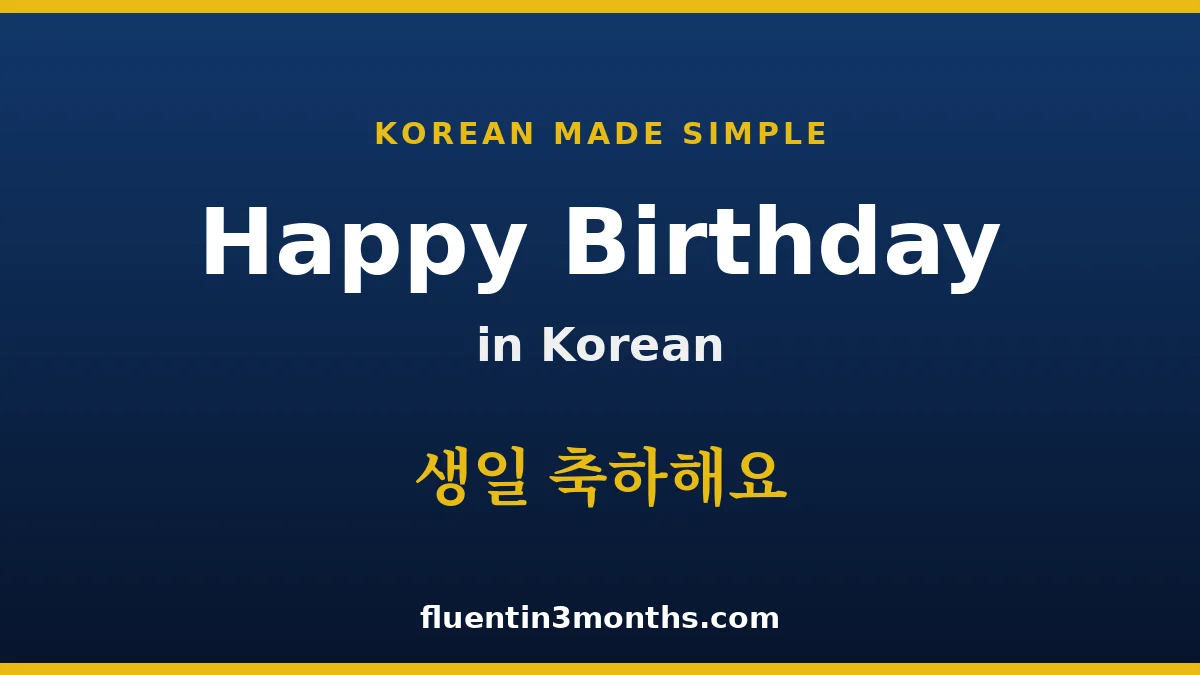
The linguistic landscape of South Korea is defined by a sophisticated interplay between social hierarchy, age, and grammatical honorifics, a complexity most visible during the celebration of birthdays. As the nation navigates a significant transition in its legal age-counting system, the traditional methods of greeting and celebration remain deeply rooted in Confucian values. Understanding the nuances of saying "happy birthday" in Korean—primarily through the standard phrase "saengil chukhahaeyo"—requires an appreciation of the country’s unique blend of historical custom and modern legislative reform.
The Linguistic Framework of Korean Birthday Greetings
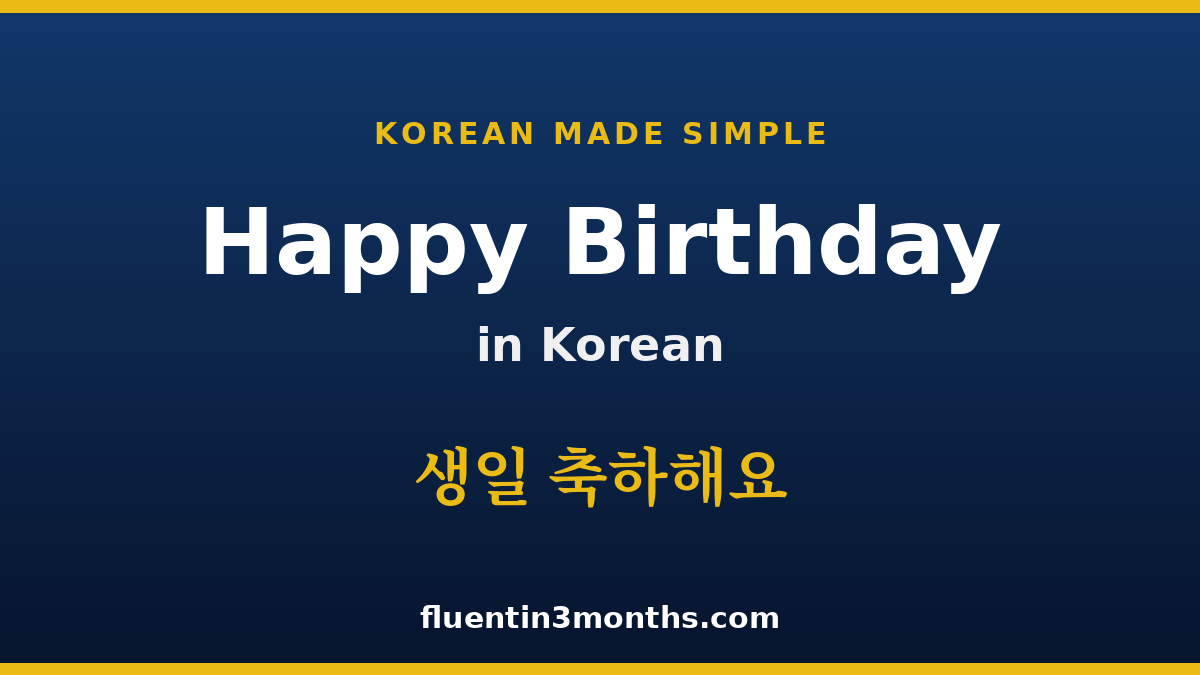
In the Korean language, a birthday greeting is not merely a well-wish but a reflection of the relationship between the speaker and the recipient. The most versatile expression is "saengil chukhahaeyo" (생일 축하해요). This phrase is composed of "saengil" (birthday), "chukha" (congratulation), and the polite ending "-haeyo." This version serves as the "gold standard" for general use, appropriate for colleagues, acquaintances, and those of similar social standing where a degree of formality is still required.
However, the Korean language utilizes a system of speech levels known as "jondaemal" (polite/formal speech) and "banmal" (casual speech). The choice of greeting must be calibrated based on the "nunchi"—or social intuition—of the speaker. Linguists categorize these greetings into four primary tiers:
- The Highly Formal/Honorific (Saengsin chukhadeurimnida): This version is reserved for those significantly higher in the social or familial hierarchy, such as grandparents, parents, or high-ranking mentors. It replaces the standard word for birthday, "saengil," with the honorific "saengsin." Furthermore, it utilizes the humble verb "deurida" (to give/offer) instead of the standard "hada" (to do).
- The Standard Formal (Saengil chukhahamnida): This is the version most commonly heard in the Korean birthday song. It uses the "-hamnida" ending, which provides a layer of ceremonial respect often found in public settings or professional environments.
- The Polite Informal (Saengil chukhahaeyo): As the most common everyday greeting, it balances friendliness with respect, making it the safest choice for non-native speakers.
- The Casual (Saengil chukhahae): Dropping the final "yo" makes the phrase "banmal." This is strictly reserved for close friends, younger siblings, or children. Using this with a superior or an elder is considered a significant social faux pas.
Legislative Reform: The Transition to "International Age"
A pivotal shift in Korean culture occurred in June 2023, when the South Korean government officially abolished the traditional "Korean age" system for administrative and civil purposes. Previously, South Koreans were considered one year old at birth and gained a year every New Year’s Day. This meant a baby born on December 31 would turn two years old on January 1, despite being only two days old by international standards.
The Ministry of Government Legislation spearheaded this change to resolve "unnecessary social and economic costs." According to a 2022 survey conducted by the ministry, approximately 82% of South Koreans supported the transition to the international system ("man nai"). The confusion caused by the dual systems often led to legal disputes regarding insurance premiums, retirement eligibility, and medical dosages.
While the "international age" is now the legal standard, the traditional "year age" (yeon nai)—calculated by subtracting the birth year from the current year—remains in effect for specific regulations. These include the age for military conscription and the legal age for purchasing alcohol and tobacco, which remains at 19 under the year-age calculation to simplify enforcement for retailers.
Historical Context and Cultural Rituals
The celebration of birthdays in Korea is inextricably linked to historical survival and maternal gratitude. Perhaps the most iconic tradition is the consumption of "miyeokguk" (seaweed soup). This tradition stems from the practice of new mothers eating the nutrient-rich soup to aid in postpartum recovery. By eating seaweed soup on their birthdays, individuals symbolically honor their mothers and acknowledge the pain and care associated with their birth.
Furthermore, historical infant mortality rates led to the elevation of the first birthday, known as "doljanchi." In centuries past, reaching one’s first year was a milestone of survival. The centerpiece of this celebration is the "doljabi" ritual. During this event, the child is placed before a variety of objects, each representing a potential future:
- Thread: Symbolizes a long and healthy life.
- Money or Rice: Indicates future wealth and abundance.
- Pencil or Book: Predicts academic excellence or a career as a scholar.
- Stethoscope or Gavel: Modern additions representing careers in medicine or law.
The choice the child makes is celebrated by the family as a playful glimpse into the child’s destiny. While modern healthcare has rendered the "survival" aspect of the first birthday less critical, the "doljanchi" remains one of the most significant social events in a Korean family’s life, often involving large banquet halls and hundreds of guests.
The Scientific Legacy of Hangul
The precision of Korean birthday greetings is supported by the unique structure of "Hangul," the Korean alphabet. Commissioned by King Sejong the Great in 1443 and promulgated in 1446 via the "Hunminjeongeum" (The Correct Sounds for the Instruction of the People), Hangul was designed to increase literacy among the common people.
Unlike many writing systems that evolved organically over millennia, Hangul was a conscious invention. The shapes of the consonants were designed to mimic the position of the speaker’s mouth and tongue. For instance, the letter "ㄱ" (g/k) represents the root of the tongue blocking the throat. This scientific approach makes the language highly phonetic, though the nuances of "batchim" (final consonants) and "liaison" (where sounds carry over to the next syllable) mean that romanized versions like "saengil chukhahaeyo" are often inadequate for true pronunciation mastery.
Social Dynamics and the Birthday Song
The Korean birthday song follows the melody of the Western "Happy Birthday to You" but adapts the lyrics to fit the formal "-hamnida" speech style. The lyrics are:
- "Saeng-il chuk-ha-ham-ni-da" (Happy birthday to you)
- "Saeng-il chuk-ha-ham-ni-da" (Happy birthday to you)
- "Ji-gu-e-seo u-ju-e-seo" (In the world, in the universe—though often replaced with the person’s name)
- "Gajang saranghamnida" (I/we love you the most)
Even in casual settings, the use of the formal "hamnida" in the song highlights the cultural default toward respect during milestone events. In the digital age, these greetings have migrated to platforms like KakaoTalk, where the use of "emoticons" and digital gift certificates ("Gifting") has become a standard way for the younger generation to celebrate birthdays. Despite the digital medium, the choice between "chukhahae" and "chukhahaeyo" remains a critical decision that defines the digital etiquette of the user.
Analysis of Implications for the Future
The 2023 age reform represents a broader push toward globalization within South Korea. By aligning with international standards, the country is reducing the "Korea-specific" friction in international business and legal sectors. However, sociologists note that the "social age" hierarchy is unlikely to disappear quickly. In Korean society, even a one-year difference in age can determine who speaks casually and who must use honorifics.
"The law might change the number on a passport, but it doesn’t immediately change the Confucian hierarchy," notes linguistic analyst Dr. Kim Ji-won. "Koreans will likely continue to ask for each other’s birth year rather than their ‘age’ to establish the correct speech level (jondaemal vs. banmal)."
As South Korea continues to export its culture through the "Hallyu" (Korean Wave), the global interest in these linguistic nuances has surged. Language learners are no longer just memorizing phrases; they are studying the underlying social structures of respect and history that those phrases represent.
Conclusion
Mastering the Korean birthday greeting is an entry point into a culture that deeply values hierarchy, history, and familial bonds. From the seaweed soup that honors a mother’s sacrifice to the legislative shift toward the international age system, birthdays in South Korea are a microcosm of a nation that respects its past while aggressively modernizing for the future. Whether one uses the casual "saengil chukhahae" or the highly respectful "saengsin chukhadeurimnida," the gesture remains a profound acknowledgment of the recipient’s place within the intricate web of Korean society.
