

In the dynamic landscape of modern commerce, the ability to weave information into a compelling narrative has emerged as a cornerstone of effective leadership and organizational success. Beyond mere data dissemination, storytelling in business presentations is recognized as a strategic imperative, enabling leaders to secure deals, gain budget approvals, and guide teams through complex transitions. This approach transcends simply recounting personal anecdotes; it involves framing information within a narrative structure, employing proven techniques that captivate audiences and inspire decisive action. The shift from presenting flat lists of facts to crafting engaging stories reflects a deeper understanding of human cognition and persuasion, transforming routine business communication into a potent tool for influence and change.
The Evolution of Business Communication and the Rise of Narrative
For decades, business presentations often prioritized sheer volume of data and logical argumentation, assuming that the intrinsic merit of facts would be sufficient to sway stakeholders. Early corporate communication models emphasized exhaustive reporting and analytical rigor, often resulting in dense, text-heavy slides that struggled to retain audience attention. However, as information overload became a defining characteristic of the digital age, and attention spans reportedly shortened, a critical need arose for more engaging and memorable communication strategies. The advent of visual communication tools and the increasing influence of consumer marketing principles on internal and external corporate messaging spurred a re-evaluation of presentation methodologies.
This evolution has culminated in the widespread recognition of storytelling as a fundamental business skill. Research from institutions like Harvard Business Review and numerous communication consultancies consistently highlights that narratives are not only more engaging but also significantly more memorable than bullet points or raw statistics. Psychologically, human brains are hardwired for stories; they activate more neural pathways, foster empathy, and facilitate a deeper understanding and retention of complex information. This cognitive preference for narrative explains why leaders who master storytelling are better equipped to forge emotional connections, build trust, and ultimately drive desired outcomes.
Seven Essential Storytelling Frameworks for Business Presentations
Developing proficiency in business storytelling requires a structured approach. Here are seven established presentation examples that demonstrate how to seamlessly integrate narrative elements into business communications, moving beyond conventional reporting to create truly impactful experiences.
1. Embracing the Hero’s Journey Structure
At its core, a compelling story adheres to a fundamental structure: a protagonist faces a challenge, seeks guidance, overcomes adversity with newfound tools, and achieves a resolution. In the context of a business presentation, establishing this clear beginning, middle, and end is paramount. The narrative arc typically starts with the identification of a problem or existing state, progresses through the introduction of a solution or intervention, and concludes with a vision of a transformed future.
This structure, often likened to Joseph Campbell’s "Hero’s Journey," is a powerful framework because it mirrors universal human experiences of struggle and triumph. For a business presentation, it requires the presenter to clearly define who embodies the ‘hero’ and who plays the ‘mentor.’ Without this clarity, the narrative risks becoming disjointed or failing to resonate with the audience’s own experiences and aspirations. The "moment of realization" (identifying the problem), the "moment of intervention" (providing the solution), and the "happily ever after" (the positive future state) must be distinctly articulated to guide the audience through the narrative journey effectively.
2. Positioning the Audience as the Hero

A common pitfall in business presentations is for the presenter or their organization to inadvertently assume the role of the hero. This often manifests as lengthy discourses on company history, impressive client rosters, or a litany of awards. While such information can build credibility, when it dominates the narrative, it shifts the focus away from the audience’s needs and challenges.
Effective storytelling in business, conversely, positions the audience as the hero. This strategic choice is rooted in empathetic communication: the audience is inherently interested in how a product, service, or idea addresses their problems. They are the ones facing the challenges, and they are the ones who need a pathway to resolution. By framing the narrative around the audience’s journey, their struggles, and their potential for success, the presenter creates an immediate and personal connection. This approach fosters a sense of shared purpose and demonstrates that the presenter understands and values the audience’s perspective, thereby increasing engagement and receptiveness to the proposed solutions.
3. The Presenter’s Role as the Guiding Mentor
If the audience is the hero, then the presenter naturally assumes the role of the mentor. This distinction is crucial. A mentor is not seeking glory or self-aggrandizement; instead, their primary objective is to equip the hero with the necessary tools, insights, and strategies to overcome their challenges. This shift in perspective fundamentally alters the presentation’s tone and content.
Consider a presentation for a meal kit delivery service. A "hero" presenter might boast about "the freshest ingredients, the most creative menu, and over 1,000 five-star reviews." While factual, this approach is self-serving and fails to address the audience’s pain points directly. A "mentor" presenter, however, would articulate the audience’s struggle: "One of the most difficult things about being a parent is feeling torn between spending time with your children and cooking them a fresh, healthy meal." They then offer their service as the solution, "What if someone could come alongside you and cut the time it takes you to cook for your family in half? Our meal kit delivery service does precisely that… saving the average family 5 hours per week. No more choosing between time in the kitchen or time with your children; we enable you to do both." This reorientation empowers the audience and positions the presenter as a valuable ally, fostering trust and making the solution far more appealing.
4. Leveraging Contrast with the Presentation Sparkline™ Framework
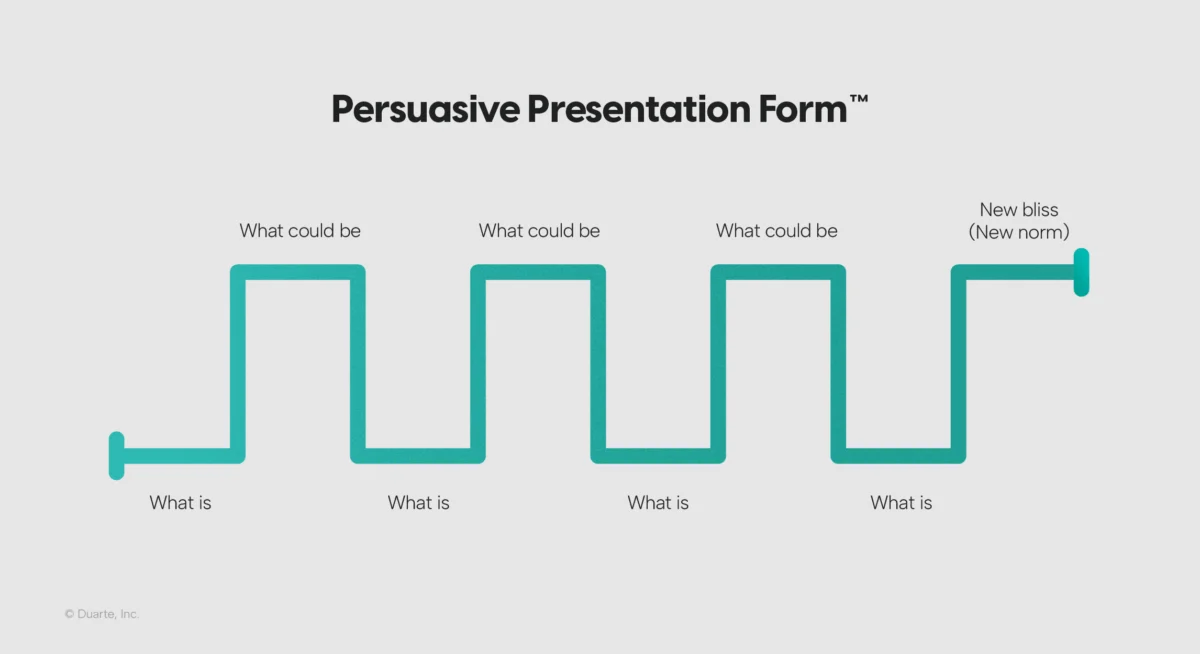
Engaging storytelling thrives on contrast, moving beyond linear, predictable sequences. A simple narrative like "Sarah wakes up and gets in her car and goes to work…" lacks tension. Introducing "but then" creates dramatic shifts: "Sarah wakes up and gets in her car to go to work, but then she has a flat tire." This disruption immediately elevates engagement. In business presentations, this principle translates into the Presentation Sparkline™ framework, which strategically oscillates between "what is" (the current problematic reality) and "what could be" (the desirable future state).
Traditional reports tend to dwell on "what is," often detailing current challenges and data without sufficient aspiration for change. Conversely, a typical pitch might focus excessively on an idealized "what could be," potentially appearing unrealistic. Neither extreme sustains audience engagement effectively. The Sparkline™ framework, popularized by communication expert Nancy Duarte, proposes a dynamic interplay between these two states. By repeatedly highlighting the gap between the present reality and the proposed future, the presenter creates a compelling tension that keeps the audience invested. Iconic speeches, such as Steve Jobs’ 2007 iPhone launch and Dr. Martin Luther King, Jr.’s "I Have a Dream" speech, exemplify this pattern, masterfully using contrast to build momentum and inspire action. This rhythmic alternation between problem and solution, current state and future vision, holds attention and drives home the necessity and benefit of the proposed change.
5. Crafting S.T.A.R. Moments™ (Something They’ll Always Remember)
Human memory is notoriously fallible when it comes to retaining large volumes of factual information. However, people are remarkably adept at recalling specific, emotionally resonant moments. This understanding underpins the concept of S.T.A.R. Moments™ – "Something They’ll Always Remember." These are distinct, impactful segments within a presentation designed to create a lasting impression, often by making abstract concepts tangible or by injecting an element of surprise.
A prime example is Al Gore’s presentation on climate change, which formed the basis for An Inconvenient Truth. Faced with the challenge of conveying the alarming projected rise in CO2 concentration over the next 50 years, Gore and his team at Duarte created a memorable visual. Instead of simply displaying a graph, Gore stood on a hydraulic lift that physically rose alongside the projected CO2 numbers, allowing the audience to viscerally experience the scale of the increase. This transformed a complex data point into an unforgettable, experiential moment, underscoring the urgency of the issue more effectively than any statistic alone. S.T.A.R. Moments are crucial for ensuring that the core message of a presentation endures long after the event itself.

6. Integrating Data Storytelling for Impact
One of the significant challenges in modern business communication is translating complex data into meaningful and actionable insights. Raw data, by itself, is devoid of inherent meaning; it requires a narrative to provide context, interpretation, and emotional resonance. Data storytelling bridges this gap, transforming statistics into compelling narratives that inform and persuade.
Presenters have several powerful options for data storytelling: they can underscore the sheer magnitude of a data point, humanize the data to connect it to individual experiences, or strategically surprise the audience with unexpected revelations. Steve Jobs’ 2008 MacBook Air reveal offers a classic illustration of the latter. Rather than merely stating the laptop’s thickness as ".76 inches," Jobs famously slid the ultra-thin device into a standard manila envelope. This unexpected visual demonstration provided a tangible, relatable unit of measurement that shocked the audience and instantly conveyed the groundbreaking nature of the product, making the data point about its slimness incredibly impactful and memorable. This technique elevates data from being just numbers to becoming a key plot point in the overarching story.
7. Concluding with a Vision of "New Bliss"
Every effective story culminates in a resolution, a "happily ever after." In business storytelling, this conclusion is termed "new bliss." It’s not a fantastical fairytale ending but rather a concrete, attainable vision of a future state that has been transformed by the proposed solution. This "new bliss" is the desired outcome for the audience-as-hero, a clear picture of how their challenges have been addressed and how their lives or operations have improved.
The "new bliss" serves as the powerful call to action, illustrating the tangible benefits of embracing the mentor’s (presenter’s) solutions. It articulates the positive implications, the problem-solving efficacy, and the value proposition in a way that resonates deeply with the audience’s aspirations. By painting a vivid and realistic picture of this improved future, the presenter solidifies the emotional and logical case for their ideas, ensuring that the presentation ends not just with information, but with inspiration and a clear path forward. This final narrative flourish empowers the audience to envision themselves within this improved reality, thereby compelling them to act.
Broader Impact and Strategic Implications
Mastering business storytelling transcends individual presentation skills; it is a critical organizational capability that propels strategic objectives. From closing pivotal deals and aligning disparate teams to successfully implementing complex change initiatives, the ability to tell the right story, at the right moment, in the right way, directly impacts an organization’s bottom line and cultural cohesion. Businesses that cultivate a storytelling culture often experience enhanced stakeholder engagement, improved employee morale, and stronger brand loyalty.
Effective storytelling enables leaders to communicate vision and strategy with clarity and conviction, fostering a shared understanding and commitment across the enterprise. It allows companies to articulate their corporate narrative, shaping perceptions internally and externally. In an increasingly competitive and information-saturated world, the capacity to transform dry facts into engaging, persuasive narratives is no longer a soft skill but a hard requirement for sustained growth and influence. Investing in business storytelling training, therefore, represents a strategic investment in an organization’s future, equipping its leaders and teams with the tools to navigate complexity, inspire action, and achieve ambitious goals.
