


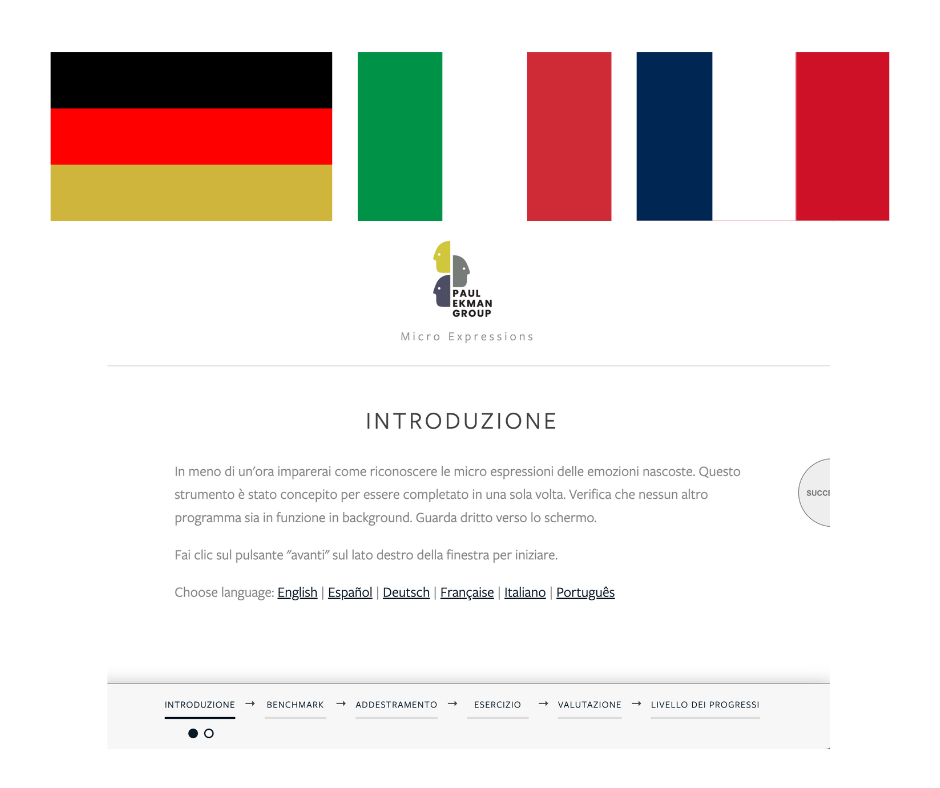
The Paul Ekman Group, a leader in emotional awareness and micro expression training, has announced a significant expansion of its online learning platform, now offering its comprehensive suite of micro expression training tools in Italian, French, and German. This strategic move aims to broaden accessibility to its science-based curriculum, catering to a wider global audience and reinforcing the company’s commitment to making advanced emotional intelligence skills available worldwide.
The newly introduced language options encompass all seven core online micro expression training modules, which are bundled into three distinct training packages. These additions bring the total number of languages supported by the Paul Ekman Group’s online tools to five, following previous translations into Spanish and Portuguese. The company has confirmed that users will be prompted to select their preferred language upon commencing any micro expression course, ensuring a seamless and intuitive learning experience.
A Growing Need for Emotional Intelligence in a Globalized World
The expansion comes at a time when the demand for enhanced emotional intelligence and the ability to accurately interpret human emotions is escalating across various professional sectors and personal development spheres. Micro expressions, defined as fleeting, involuntary facial movements that betray a person’s true emotional state, are increasingly recognized as critical tools for effective communication, conflict resolution, and building trust.
Dr. Paul Ekman, a renowned psychologist and pioneer in the study of emotions and their expressions, has dedicated his career to understanding the universality of these emotional signals. His research, which has spanned decades and involved extensive cross-cultural studies, has consistently demonstrated that certain basic emotions and their corresponding facial expressions are universally recognized, irrespective of cultural background. This foundational research underpins the efficacy of the training programs now being made available in multiple languages.
The Paul Ekman Group’s mission is to empower individuals and organizations with the skills to better understand themselves and others by fostering heightened emotional awareness. By providing training in native languages, the company seeks to dismantle linguistic barriers that may have previously limited access to this valuable knowledge. This initiative is particularly significant for educators, mental health professionals, law enforcement officers, corporate leaders, and anyone seeking to improve their interpersonal skills and navigate complex social dynamics with greater insight and empathy.
Background and Chronology of Expansion
The journey towards this multilingual offering has been a progressive one, reflecting the Paul Ekman Group’s long-term vision for global reach. While specific dates for the initial development of the online training tools are not publicly detailed, the gradual introduction of language translations signifies a strategic and phased approach to market penetration.
The initial availability of the tools in English has served as the foundation. The subsequent addition of Spanish and Portuguese marked the first significant step in broadening the platform’s accessibility to non-English speaking markets, particularly in Latin America and parts of Europe. The recent launch of Italian, French, and German represents a substantial leap forward, opening up access to a vast demographic in the heart of Europe.
This expansion can be viewed as a response to increasing global interconnectedness and the growing recognition of emotional intelligence as a critical competency. As businesses operate across borders and individuals engage in international collaborations, the ability to understand and respond to a diverse range of emotional cues becomes paramount.
Supporting Data and Industry Trends
The emphasis on emotional intelligence training is supported by a growing body of research highlighting its impact on various outcomes. Studies have consistently shown that individuals with higher emotional intelligence tend to exhibit:
- Improved Leadership Effectiveness: Research published in journals such as the Journal of Applied Psychology has linked emotional intelligence to better decision-making, team management, and overall leadership performance. A meta-analysis by O’Boyle et al. (2011) found a significant positive correlation between emotional intelligence and job performance across a wide range of occupations.
- Enhanced Interpersonal Relationships: The ability to understand and manage one’s own emotions, as well as to recognize and respond effectively to the emotions of others, is fundamental to building strong personal and professional relationships.
- Increased Empathy and Conflict Resolution: Training in micro expressions, by its nature, cultivates empathy by enabling individuals to perceive and understand the subtle emotional states of others, which is crucial for de-escalating conflicts and fostering understanding.
- Better Deception Detection: A core application of micro expression training lies in its ability to improve the detection of deception, a skill highly valued in fields such as law enforcement, security, and forensic psychology. Ekman’s own extensive research has contributed significantly to this area.
The market for emotional intelligence training is experiencing robust growth. Reports from market research firms indicate a compound annual growth rate (CAGR) in the global emotional intelligence market, driven by increasing awareness of its benefits in both personal and professional development. The expansion of online training platforms, such as that of the Paul Ekman Group, is a key factor enabling this growth by making these skills more accessible and affordable.
Official Statements and Reactions (Inferred)
While direct quotes from specific individuals within the Paul Ekman Group regarding this particular announcement were not provided in the original content, the expansion itself speaks volumes about the company’s strategic priorities and its commitment to its core mission.
A representative statement, likely reflecting the sentiment within the organization, might convey: "Our goal has always been to democratize the understanding of human emotion. By translating our scientifically validated micro expression training tools into Italian, French, and German, we are taking a significant step towards making these essential skills accessible to millions more individuals globally. We believe that fostering emotional awareness is crucial for building a more empathetic and understanding world, and this expansion is a testament to that belief."
The availability of these tools in multiple languages is also likely to be met with positive reception from educators, trainers, and organizations in the respective language markets. Professionals who have previously relied on English-language resources may now find it easier to integrate these advanced training methods into their curricula or professional development programs.
Broader Impact and Implications
The implications of this multilingual expansion are far-reaching:
- Increased Global Collaboration: Professionals in fields requiring nuanced interpersonal interactions, such as international diplomacy, global business negotiations, and cross-cultural psychology, will benefit immensely from the ability to train in their native languages. This can lead to more effective communication and reduced misunderstandings in global collaborations.
- Enhanced Educational Opportunities: Educators and academic institutions in Italy, France, and Germany can now more readily incorporate micro expression training into their psychology, sociology, and communication studies programs. This could foster a new generation of emotionally intelligent professionals.
- Improved Public Services: Law enforcement, emergency services, and mental health providers in these countries will gain access to tools that can enhance their ability to assess situations, understand individuals’ emotional states, and provide more effective support.
- Personal Development: Individuals seeking to improve their personal relationships, understand family dynamics better, or simply gain deeper self-awareness will have a more accessible pathway to acquiring these valuable skills.
The commitment to making these tools available is further underscored by the company’s proactive approach to feedback and future development. The announcement includes an invitation for users to suggest additional languages they would like to see supported, indicating an ongoing dedication to adapting to the needs of their global user base. This iterative approach to product development, driven by user demand and a commitment to accessibility, is a hallmark of forward-thinking educational technology companies.
Future Outlook and Ongoing Development
The Paul Ekman Group has signaled that this expansion is not an endpoint but rather a significant milestone in their ongoing efforts to disseminate emotion science globally. The company is actively exploring the development of additional language offerings, indicating a long-term strategy to break down linguistic barriers in emotional intelligence training. This forward-looking perspective suggests that the company is investing in robust translation and localization processes to ensure the quality and cultural relevance of its educational content across diverse linguistic landscapes.
In conclusion, the launch of micro expression training tools in Italian, French, and German by the Paul Ekman Group represents a pivotal moment in the global accessibility of advanced emotional intelligence education. By leveraging Dr. Ekman’s seminal research and making it available in more languages, the company is empowering a broader segment of the world’s population to cultivate essential skills for navigating the complexities of human interaction, fostering greater understanding, empathy, and effective communication across diverse cultures and contexts. The ongoing commitment to expansion suggests a future where advanced emotional literacy is a more universally attainable skill.
