

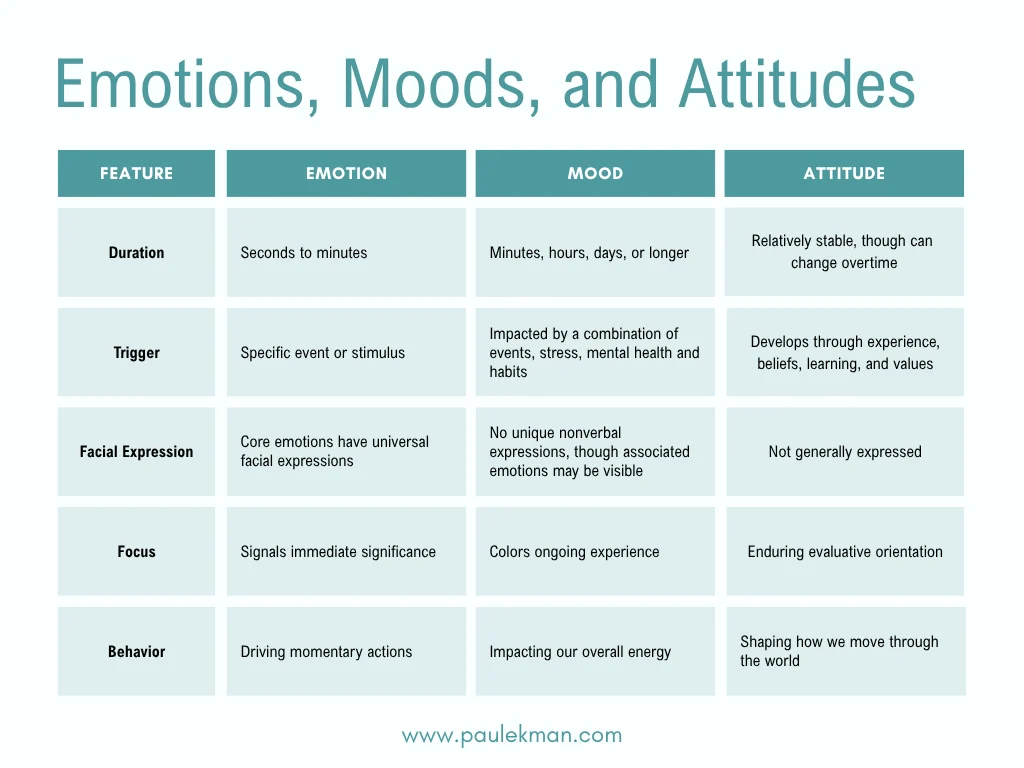
Building on previous explorations into the subtle yet significant differences between moods and emotions, this expanded discourse delves into a third crucial psychological construct: attitudes. These three interconnected elements—emotions, moods, and attitudes—collectively sculpt our perception of ourselves and the world around us. While they all exert a profound influence, they operate on distinct temporal scales and fulfill varied psychological functions. A comprehensive understanding of their intricate interplay is paramount for cultivating heightened emotional awareness, enhancing emotional regulation, and gaining deeper insights into our ingrained patterns of thought and behavior. This analysis aims to provide a clear, data-supported distinction between these concepts, offering a framework for more nuanced self-understanding and interpersonal interaction.
The Fleeting Intensity of Emotions
Emotions are fundamentally automatic appraisal processes, shaped by both our deep-seated evolutionary heritage and our unique life experiences. They are triggered when an event or stimulus is perceived as significant in relation to our goals, needs, or overall well-being. This perception sets in motion a cascade of coordinated psychological and physiological changes designed to facilitate an appropriate response. By their very nature, emotions are relatively brief, typically lasting from a fraction of a second to several minutes. This temporal brevity is a key characteristic, differentiating them from the more sustained states of mood.
Physiologically, emotions manifest through widespread bodily changes. This includes alterations in autonomic nervous system activity, which governs involuntary bodily functions such as heart rate, respiration, and digestion. Research in psychophysiology has demonstrated distinct patterns of autonomic response associated with different emotions. For instance, studies using electrodermal activity and cardiovascular measures have shown that fear, anger, and joy elicit differential physiological signatures. Furthermore, emotions are often expressed outwardly through distinct facial expressions. Pioneering work by Paul Ekman, for example, has identified universal facial expressions corresponding to basic emotions like happiness, sadness, anger, fear, surprise, and disgust, suggesting a biological basis for their recognition across cultures. These coordinated psychological and physiological shifts prepare the individual to engage with or withdraw from the eliciting situation, serving an adaptive function. The intensity of an emotion can vary significantly, from mild annoyance to overwhelming rage, but its characteristic is its transient nature.
The Pervasive Influence of Moods
In contrast to the acute nature of emotions, moods are more diffuse and enduring affective states. They can persist for hours, days, or even longer, creating a pervasive emotional backdrop to our experiences. A defining characteristic of moods is their lack of a clearly identifiable trigger. Unlike emotions, which are typically directed towards a specific event or object, moods often emerge without an obvious cause. This can lead to a sense of inexplicable feelings, such as waking up in a good mood or gradually slipping into a negative one without a discernible reason.
While moods may not elicit the distinct facial expressions associated with many emotions, subtle physical manifestations can be observed. These might include changes in muscle tension, posture, or overall energy levels. For example, an individual in a low mood might exhibit slumped posture and reduced physical activity, whereas someone in a cheerful mood might display more animated movements and an open posture.
Moods function as a general affective tone that influences how we interpret and react to the world. They can modulate the likelihood and intensity of specific emotions. For example, an individual in a generally positive mood may find it easier to bounce back from minor frustrations, experiencing them as less impactful. Conversely, someone in an irritable or negative mood may be more prone to experiencing minor setbacks as significant annoyances, leading to more pronounced emotional reactions. This phenomenon is supported by research in affective science, which suggests that moods act as a form of cognitive priming, making certain emotional responses more accessible. For instance, a study published in the Journal of Personality and Social Psychology found that participants in a negative mood were more likely to recall negative memories and interpret ambiguous situations negatively. This continuous affective filtering can shape our daily experiences, influencing our interactions, our interpretations of social cues, and even the nature of our internal thoughts.
The Stable Evaluations of Attitudes
Unlike emotions and moods, which are transient affective states, attitudes represent more enduring evaluations of people, ideas, objects, behaviors, or experiences. Psychologists typically conceptualize attitudes as comprising a tripartite structure, often referred to as the ABC model:
- Affective Component: This refers to the emotional associations linked to the attitude object. For example, a positive attitude towards a certain brand of coffee might be associated with feelings of warmth, comfort, and pleasure.
- Behavioral Component: This encompasses the tendency to act in a certain way towards the attitude object. A positive attitude towards recycling might manifest as a consistent behavior of sorting waste and participating in recycling programs.
- Cognitive Component: This involves the beliefs and thoughts we hold about the attitude object. For instance, an attitude towards a political candidate will be informed by beliefs about their policies, track record, and character.
Attitudes can also be categorized as explicit or implicit. Explicit attitudes are those that we are consciously aware of and can readily report. For example, an explicit attitude towards exercise might be "I believe exercise is good for my health and I intend to exercise regularly." Implicit attitudes, on the other hand, are unconscious biases or associations that influence our thoughts, feelings, and behaviors without our direct awareness. These can be particularly influential in areas like intergroup relations or consumer preferences.
The development of attitudes is a dynamic process, shaped over time through a variety of mechanisms. Repeated emotional experiences play a significant role. For example, consistently positive experiences with a particular type of cuisine can lead to a favorable attitude towards it. Learning, including classical and operant conditioning, is also crucial. If a particular behavior is rewarded, we are more likely to develop a positive attitude towards it. Social and cultural norms, as well as relationships with others, heavily influence our attitudes. We often internalize the attitudes prevalent in our social circles and communities. Personal reflection and critical evaluation can also lead to the modification or reinforcement of existing attitudes.
While generally more stable than emotions or moods, attitudes are not immutable. New experiences, persuasive communication, and significant life events can gradually reshape them. For instance, a negative experience with a product previously held in high regard can weaken or even reverse a positive attitude. Crucially, attitudes are always directed towards a specific object or entity. We can hold attitudes towards individuals, inanimate objects, abstract concepts like policies, significant events, or even towards our own internal emotional experiences. Because attitudes function as an evaluative lens, they profoundly influence how we interpret incoming information and how we are predisposed to respond to situations. This evaluative function can lead to confirmation bias, where individuals tend to seek out and interpret information that aligns with their existing attitudes, further reinforcing them.
The Interplay: A Dynamic Equilibrium
Despite their distinct characteristics, emotions, moods, and attitudes are in constant and dynamic interaction, influencing and being influenced by one another in a complex web of psychological processes.
Moods as Emotional Amplifiers and Modulators
The prevailing mood significantly impacts the ease with which specific emotions arise and the intensity with which they are experienced. For example, an individual in an upbeat mood might find it easier to shake off minor frustrations, experiencing them with less intensity and recovering more quickly. Conversely, someone in an irritable mood might react more strongly to minor setbacks, interpreting them as more significant and experiencing a heightened sense of annoyance or anger. This phenomenon has been empirically supported; studies have shown that individuals in negative moods are more likely to perceive ambiguous social cues negatively and exhibit more aggressive responses. Moreover, a series of short, intense emotional experiences, such as recurring periods of worry or frustration, can coalesce into a more prolonged and pervasive post-condition, manifesting as an anxious or irritable mood. This suggests a feedback loop where acute emotional responses can contribute to the formation and maintenance of chronic mood states.
Attitudes as Filters and Drivers of Emotional Response
Attitudes play a critical role in shaping our emotional landscape, acting as both a filter for incoming information and a driver of specific emotional reactions. Consider two individuals receiving identical constructive feedback. One, holding a positive attitude towards feedback as a valuable opportunity for growth, might experience excitement and a sense of motivation. The other, with an attitude that frames feedback as a personal threat or criticism, may experience anxiety, defensiveness, and annoyance. The external situation remains constant, but their pre-existing attitudes dictate their subjective appraisal and, consequently, the emotions they experience. This interaction highlights how deeply ingrained beliefs and evaluations can predetermine our emotional responses, even in the face of objectively similar circumstances. Research on cognitive appraisal theory underscores this point, emphasizing that it is our interpretation of events, heavily influenced by our attitudes, that ultimately generates emotional experience.
The Significance of Attitudes Towards Emotions
A particularly potent and often overlooked aspect of attitudes is our disposition towards emotions themselves. We can develop attitudes that label certain emotions as desirable or undesirable, valid or invalid. For instance, societal norms and personal upbringing can lead to attitudes such as "anger is a sign of weakness," "sadness should always be hidden," or "joy is meant to be shared openly." These evaluations, often formed over years through family dynamics, cultural teachings, educational experiences, and personal history, profoundly influence how we engage with our own emotional lives. Our attitudes toward emotions dictate our willingness to acknowledge, accept, express, or learn from them. This also directly relates to the concept of "display rules," which are learned social norms that govern the appropriateness of expressing emotions in particular contexts and to specific individuals. While certain facial expressions of emotion are universally recognized, the rules dictating when, how, and to whom these expressions are displayed can vary significantly across cultures, contributing to observed differences in emotional expression worldwide. For example, cultures that emphasize collectivism may have different display rules for expressing negative emotions compared to individualistic cultures.
Cultivating Emotional Intelligence for Enhanced Well-being
At the Paul Ekman Group, the foundational principle for fostering emotional intelligence is the cultivation of the ability to observe our internal experiences with heightened clarity and a spirit of curiosity. By diligently recognizing our emotions as they arise, understanding the pervasive influence of our moods, and becoming acutely aware of the attitudes that shape our interpretations, we equip ourselves to respond more wisely, compassionately, and effectively to ourselves and to others. This journey of developing emotional awareness is not a singular event but an ongoing practice, a skill that can be consistently strengthened and refined over time.
For individuals seeking to deepen their understanding and application of emotional science, the Paul Ekman Group offers a range of research-based resources. These include comprehensive training programs, informative publications, and access to cutting-edge research, all designed to empower individuals with the tools necessary for greater emotional insight and mastery. By embracing the nuanced interplay of emotions, moods, and attitudes, we can unlock a more profound understanding of human behavior and foster more harmonious and productive relationships.
