

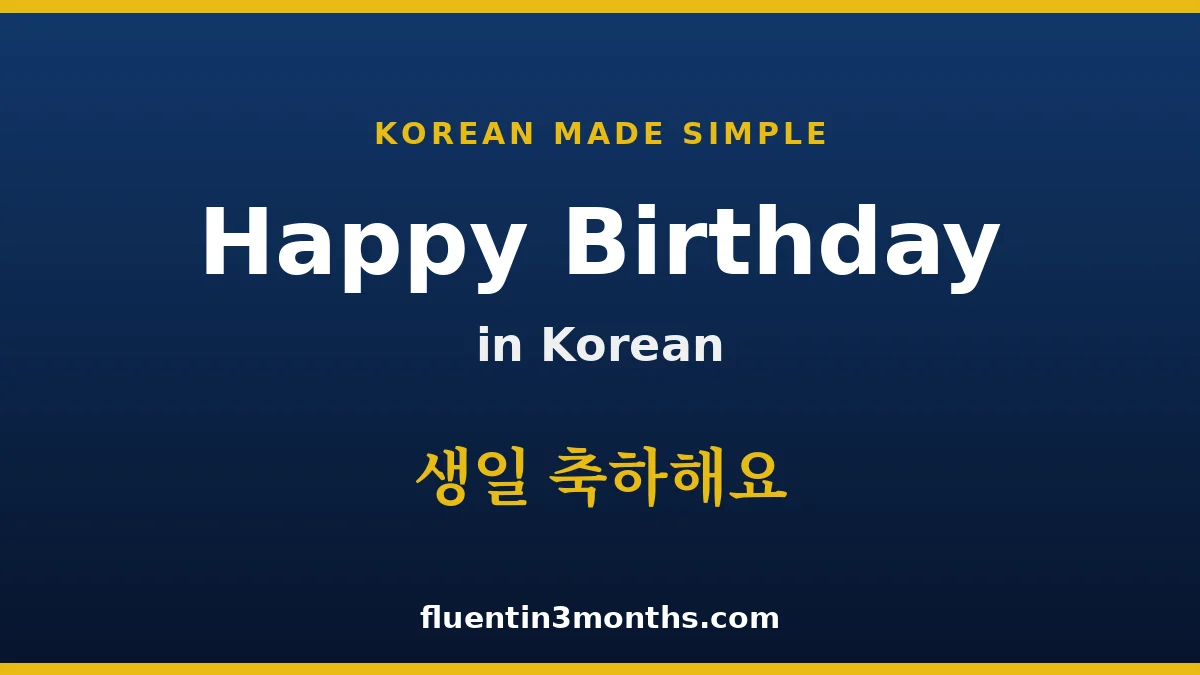
The phrase saengil chukhahaeyo serves as the foundational pillar for birthday celebrations across the Korean Peninsula, representing a blend of linguistic precision and cultural etiquette. While it translates directly to "Happy Birthday," the application of this greeting is far from a one-size-fits-all endeavor. In the context of South Korean society, where hierarchical structures and respect for seniority are deeply embedded in the language, choosing the correct version of a birthday wish is a vital social skill. This linguistic landscape was further complicated—and eventually streamlined—by significant legislative changes in 2023 regarding how age is calculated within the country. Understanding these nuances requires a deep dive into the mechanics of the Korean language, the historical weight of its traditions, and the modern legal shifts that have redefined the Korean concept of time and aging.
The Linguistic Mechanics of Korean Birthday Greetings
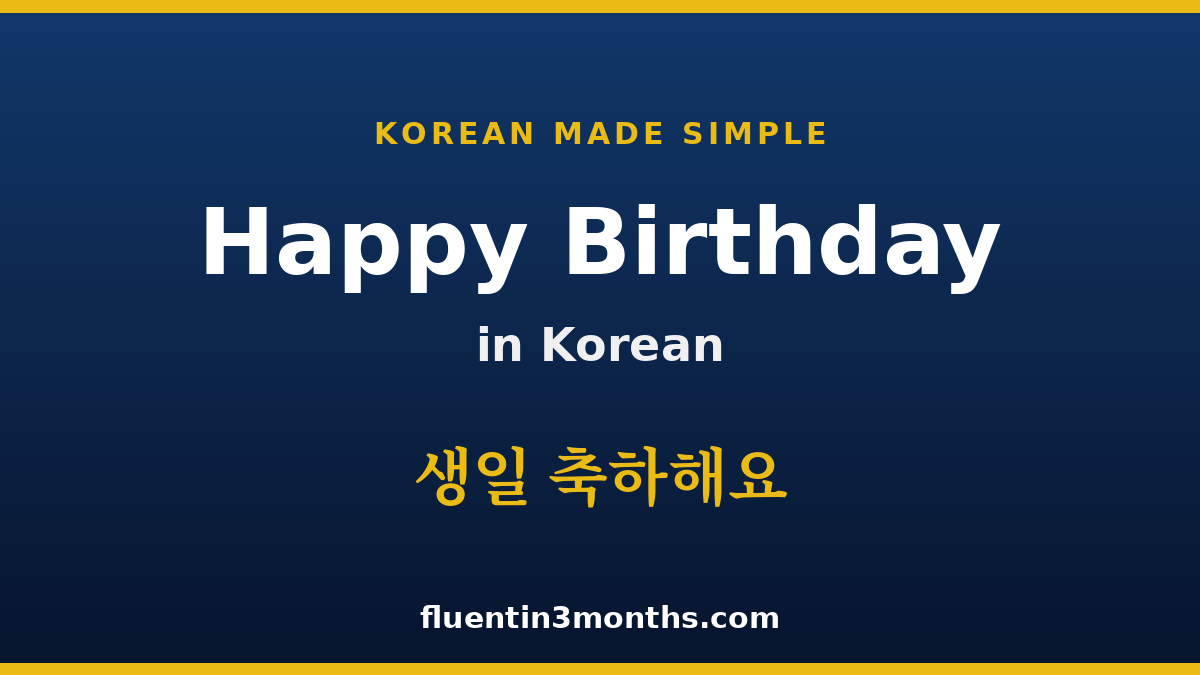
The standard polite form, saengil chukhahaeyo, is composed of two primary parts: saengil (birthday) and chukhahae (to congratulate), followed by the polite ending -yo. This version is the most versatile, suitable for colleagues, acquaintances, and those of a similar social standing. However, the Korean language operates on a complex system of honorifics known as jondaemal and casual speech known as banmal.
For those in a close, intimate relationship—such as close friends of the same age or younger siblings—the polite suffix is dropped, resulting in saengil chukhahae. Conversely, when addressing individuals of significantly higher status or age, such as grandparents, parents, or high-ranking mentors, the vocabulary itself shifts. In these instances, the word for birthday changes from the standard saengil to the honorific saengsin. Furthermore, the verb "to congratulate" is paired with the humble verb deurida (to give/offer to a superior), resulting in the highly respectful saengsin chukhadeurimnida. This distinction is not merely grammatical; it is a reflection of the Confucian values that prioritize filial piety and social harmony.
The 2023 Age Law A Chronology of Reform
One of the most significant shifts in Korean social fabric occurred on June 28, 2023, when South Korea officially abolished the "Korean age" system in favor of the international standard for all judicial and administrative matters. Prior to this reform, South Koreans were subject to three different methods of age calculation, leading to widespread administrative confusion and social disputes.
Historically, the "Korean age" system (seneun nai) dictated that a child was one year old at birth, accounting for the time spent in the womb. Furthermore, everyone in the country would "age up" simultaneously on New Year’s Day, regardless of their actual birth date. This meant a child born on December 31 would technically turn two years old on January 1, despite having lived for only two days.
The timeline for this transition began in earnest during the 2022 presidential campaign, where President Yoon Suk Yeol pledged to standardize the age system to reduce "unnecessary social and economic costs." In December 2022, the South Korean National Assembly passed the amendments to the Civil Act and the General Act on Public Administration. Upon the law’s implementation in June 2023, the Ministry of Government Legislation reported that the move was aimed at resolving legal disputes arising from age-related contracts, such as insurance policies and retirement eligibility. While the "year age" (yeon nai) system—calculating age by subtracting the birth year from the current year—is still used for the military draft and the legal drinking age, the move toward "man nai" (international age) has fundamentally altered how birthdays are perceived in the social sphere.
Cultural Traditions The Symbolic Power of Seaweed Soup
In South Korea, a birthday is rarely celebrated without miyeokguk, or seaweed soup. This tradition is rooted in maternal health and gratitude. Rich in iodine and calcium, seaweed soup is the primary dish served to mothers following childbirth to aid in recovery and lactation. By eating miyeokguk on their own birthdays, individuals symbolically honor their mothers’ sacrifice and the care provided during their infancy.
Data from cultural historians suggests that this practice dates back to the Goryeo Dynasty, observing that whales were seen eating seaweed to recover after giving birth. This observation was integrated into folk medicine and eventually became a staple of Korean culinary identity. In a modern context, while younger generations may opt for Western-style cakes and parties, the presence of miyeokguk remains a non-negotiable element of a traditional Korean birthday breakfast.
The First Birthday Milestone The Doljanchi
Perhaps the most significant birthday in a Korean person’s life is the first, known as the doljanchi. This celebration carries immense historical weight, originating from a time when infant mortality rates were high due to poor sanitation and lack of medical resources. Reaching the one-year mark was a major milestone that warranted a village-wide celebration.
The centerpiece of the doljanchi is the doljabi, a fortune-telling ritual. During this event, the child is placed before a variety of objects, each representing a different career path or destiny. Common items include:
- Thread: Symbolizing a long and healthy life.
- Money or Rice: Representing future wealth and abundance.
- Books or Brushes: Indicating a future as a scholar or intellectual.
- Stethoscope or Gavel: Modern additions representing careers in medicine or law.
According to a 2021 survey by a Korean parenting magazine, over 80% of parents still perform the doljabi, though the ceremony has moved from traditional homes to specialized "buffet-style" venues. The choice of the child is met with cheers and is seen as a playful yet significant omen of their future potential.
The Korean Birthday Song and Linguistic Integration
While the melody of the Korean birthday song is identical to the internationally recognized "Happy Birthday to You," the lyrics are adapted to fit Korean grammatical structures. The standard lyrics are:
- Saengil chukha hamnida (Happy birthday to you)
- Saengil chukha hamnida (Happy birthday to you)
- Saranghaneun [Name] ssi (Dear [Name])
- Saengil chukha hamnida (Happy birthday to you)
Interestingly, even in casual settings, the song often retains the formal hamnida ending. This reflects the performative nature of the song as a "ceremonial" address rather than a standard conversation. For language learners, practicing this song provides a rhythmic way to internalize the pronunciation of the aspirated "kh" sound in chukha and the fluidity of Korean vowels.
Analysis of Societal Implications and Global Impact
The global rise of the "Hallyu" or Korean Wave has led to a surge in international interest in Korean language and customs. Data from language-learning platforms like Duolingo and King Sejong Institute Foundation show that Korean is one of the fastest-growing languages globally. Consequently, the nuances of birthday greetings have become a point of cultural literacy for millions of non-Koreans.
The 2023 age reform also serves as a case study in how law can influence culture. While the legal system now recognizes the international age, social hierarchy in Korea is still often determined by "academic year" or birth year. This creates a dual-reality where an individual may be 25 legally but 26 or 27 in social interactions. Sociologists argue that while the law has simplified administrative tasks, the deep-seated "senior-junior" (seonbae-hubae) relationship remains the dominant force in Korean social networking.
Conclusion
Mastering birthday greetings in Korean is an entry point into understanding the broader values of the nation. It requires more than just memorizing a phrase; it demands an awareness of the recipient’s age, their relationship to the speaker, and the historical context of the celebration. From the legislative shifts of 2023 to the ancient tradition of seaweed soup, the Korean birthday is a nexus of the old and the new. For the student of the language or the casual observer, these customs offer a window into a culture that deeply values respect, family, and the shared milestones of life. As Korea continues to align itself with global standards while fiercely protecting its unique heritage, the simple act of saying "saengil chukhahaeyo" remains a powerful gesture of connection and continuity.
