

The Italian verb avere stands as one of the most critical pillars of the Italian language, serving both as a primary verb denoting possession and as an indispensable auxiliary for the construction of compound tenses. Linguistically classified as a second-conjugation irregular verb, its utility is so pervasive that mastery of its various forms is considered a prerequisite for achieving even basic functional fluency. Beyond its literal translation of "to have," avere facilitates the expression of age, physical sensations, and emotional states, often where the English language would utilize the verb "to be." Understanding the structural nuances and orthographic requirements of avere is essential for any student of Romance languages, as it provides the scaffolding for complex sentence structures and narrative depth.
The Orthographic Significance of the Silent H
One of the most distinctive features of avere is the presence of the silent letter "h" in several of its present tense forms. While the "h" is never pronounced in standard Italian, its inclusion in written communication is mandatory for semantic clarity. The forms ho (I have), hai (you have), ha (he/she/it has), and hanno (they have) utilize the "h" as a diacritic to distinguish them from common homophones. Without this orthographic marker, these words would be confused with o (or), ai (to the), a (to/at), and anno (year).
Linguistic historians note that this convention is a vestige of the verb’s Latin root, habēre. While the phonetic "h" vanished during the transition from Latin to Vulgar Latin and eventually into the Italian vernacular, the written "h" was retained—and in some cases reintroduced during the Renaissance—to maintain a visual link to its etymological origins and to prevent grammatical ambiguity. For the modern learner, this represents a critical area where written accuracy directly impacts the intelligibility of the message.
The Present Indicative: A Functional Foundation
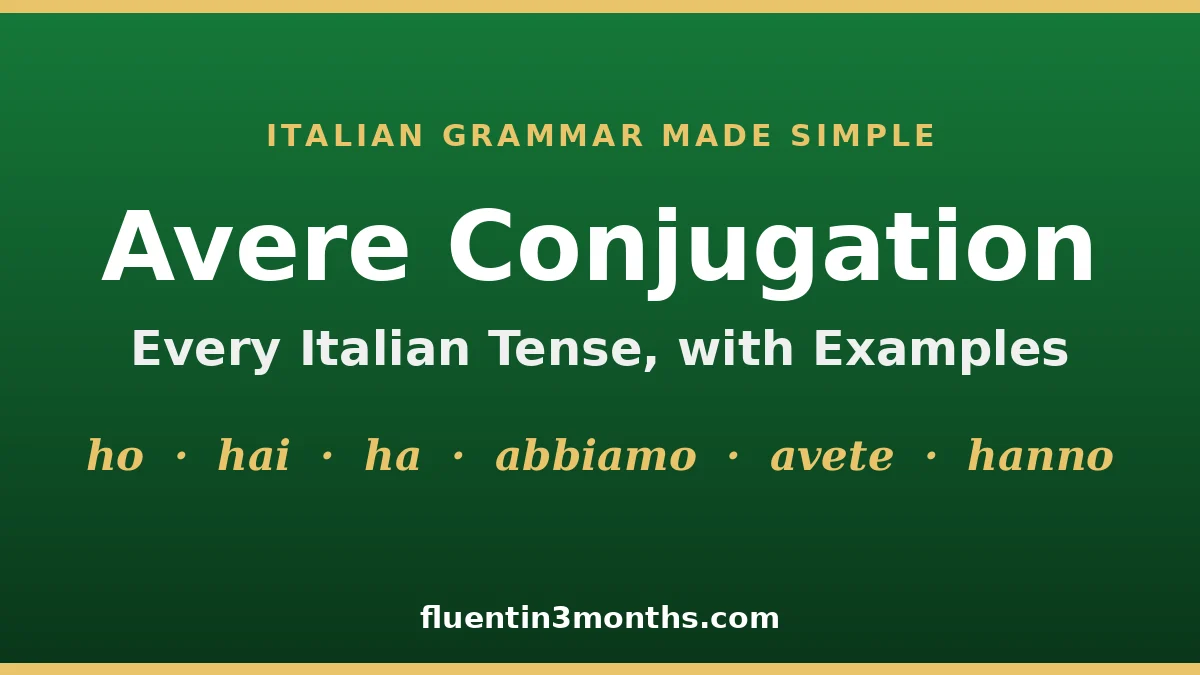
The present tense (presente) of avere is the primary tool for discussing immediate reality. Because Italian is a pro-drop language—meaning subject pronouns like io (I) or noi (we) are often omitted—the verb ending itself must clearly indicate the subject. The conjugation is as follows:
- Io ho (I have)
- Tu hai (you have, informal)
- Lui/Lei/Lei ha (he/she has, or you have, formal)
- Noi abbiamo (we have)
- Voi avete (you have, plural)
- Loro hanno (they have)
These six forms enable speakers to communicate essential information regarding possessions, family relationships, and age. For example, the phrase "Ho vent’anni" (literally "I have twenty years") is the standard method for stating one’s age, contrasting with the English "I am twenty." This highlights a fundamental divergence in how the two languages conceptualize states of being versus states of possession.
Chronology of Acquisition and Narrative Tenses
In the progression of Italian language acquisition, learners typically move from the present indicative to the past and future forms. The verb avere employs different stems and endings to navigate the timeline of events.
The Imperfetto and Passato Remoto
The imperfetto (avevo, avevi, aveva, avevamo, avevate, avevano) is utilized to describe ongoing or habitual actions in the past. It provides the background "scenery" for a story, such as describing what someone had or felt over an indefinite period.
In contrast, the passato remoto (ebbi, avesti, ebbe, avemmo, aveste, ebbero) is used for completed actions in the distant past. While the passato remoto is a staple of Italian literature and historical texts, its usage in spoken conversation varies significantly by geography. Data from linguistic surveys indicate that speakers in Central and Southern Italy, particularly in regions like Tuscany, Campania, and Sicily, utilize the passato remoto in daily speech far more frequently than their counterparts in the North. Northern speakers tend to favor the passato prossimo for almost all past-tense references, viewing the passato remoto as an archaic or overly formal construction.
Future and Conditional Moods
The future tense (futuro semplice) of avere is irregular, utilizing the contracted stem avr-. The forms—avrò, avrai, avrà, avremo, avrete, avranno—indicate future possession or probability. Similarly, the present conditional (condizionale presente)—avrei, avresti, avrebbe, avremmo, avreste, avrebbero—is used to express hypothetical situations or to make polite requests. For instance, "Avrebbe un momento?" (Would you have a moment?) is a standard formal inquiry in professional settings.
Avere as an Auxiliary Verb: The Mechanics of Compound Tenses
The secondary, yet equally vital, role of avere is its function as an auxiliary (helping) verb. In Italian, compound tenses are formed by combining a conjugated auxiliary verb with the past participle of the main verb. Avere is the auxiliary used for all transitive verbs (verbs that take a direct object) and many intransitive verbs.
The most common compound tense is the passato prossimo, which expresses an action that happened in the recent past or has a connection to the present. To form it, one uses the present tense of avere plus avuto (the past participle of avere itself) or the past participle of another verb.
Examples of Auxiliary Usage:
- Ho mangiato (I have eaten / I ate)
- Abbiamo visto il film (We have seen the film / We saw the film)
- Hai capito? (Have you understood? / Did you understand?)
A critical rule in Italian grammar involves the agreement of the past participle. While verbs conjugated with avere generally do not change their ending to match the subject, they must agree in gender and number with a preceding third-person direct object pronoun (lo, la, li, le). For example, "Le ho viste" (I saw them, feminine) shows the participle vista changing to viste to match the feminine plural pronoun le.
The Subjunctive and Imperative Moods: Nuance and Authority
For advanced communication, the congiuntivo (subjunctive) and imperativo (imperative) moods are necessary. The subjunctive is used to express doubt, emotion, desire, or subjective opinions. It often follows specific conjunctions or introductory phrases like "Spero che…" (I hope that…) or "Credo che…" (I believe that…).
The present subjunctive forms (abbia, abbia, abbia, abbiamo, abbiate, abbiano) are unique because the first three singular persons are identical (abbia). This necessitates the use of context or explicit subject pronouns to avoid confusion. In more complex sentence structures, such as contrary-to-fact conditionals, the imperfect subjunctive (avessi, avessi, avesse, avessimo, aveste, avessero) is paired with the conditional to describe what "would have been" if circumstances were different.
The imperative mood, used for commands and exhortations, employs the forms abbi (informal singular) and abbia (formal singular). Common expressions include "Abbi pazienza" (Have patience) and "Abbi cura di te" (Take care of yourself). These forms are essential for social interaction, ranging from giving advice to issuing professional directives.
Idiomatic Divergence: When "To Have" Replaces "To Be"
A significant challenge for English speakers learning Italian is the category of idiomatic expressions where avere is used to describe physical or mental states that English describes with the verb "to be." This is not a mere stylistic choice but a fundamental grammatical requirement. Using essere (to be) in these contexts is considered a major error.
Common Avere Idioms:
- Avere fame (To be hungry; literally "To have hunger")
- Avere sete (To be thirsty; literally "To have thirst")
- Avere caldo/freddo (To be hot/cold; referring to personal sensation)
- Avere sonno (To be sleepy)
- Avere ragione/torto (To be right/wrong)
- Avere paura (To be afraid)
- Avere bisogno di (To need; literally "To have need of")
Linguists analyze these structures as a way of expressing a state that a person "possesses" or is "afflicted by" temporarily, rather than a defining characteristic of their being. For example, "Io sono caldo" would imply that the person is physically warm to the touch or potentially has a fever, whereas "Io ho caldo" means the person feels hot due to the ambient temperature.
Statistical Analysis and Pedagogical Implications
Data from the Frequency Dictionary of Italian suggests that avere is consistently ranked within the top five most frequently used verbs in both written and spoken corpora. Its dual role as a lexical verb and a functional auxiliary means that a speaker cannot construct a paragraph of text without encountering it.
Educational experts and polyglots, including Benny Lewis, founder of "Fluent in 3 Months," emphasize that "speaking from day one" requires an immediate grasp of high-frequency verbs like avere. Pedagogical strategies often involve prioritizing the present tense and the passato prossimo, as these cover approximately 80% of daily conversational needs. The more complex moods, such as the subjunctive and the trapassato remoto, are introduced later as the learner moves from basic communication to nuanced expression.
The irregularity of avere is often described by grammarians as "mild" compared to the verb essere. The primary irregularities—the silent "h" and the contracted future stem—are predictable once the pattern is identified. However, the sheer volume of "avere-based" idioms means that learners must move beyond literal translation to achieve true fluency.
Broader Impact on Romance Language Studies
The study of avere provides a window into the broader family of Romance languages. Similar patterns exist in French (avoir) and Spanish (haber/tener), although Italian is unique in its specific distribution of auxiliary duties between avere and essere. While Spanish has largely moved toward using tener for possession and haber exclusively as an auxiliary, Italian retains avere for both functions, much like the French avoir.
In conclusion, the verb avere is more than a mere vocabulary word; it is the engine of Italian syntax. Its mastery allows a speaker to navigate time, express physical needs, and build the complex sentences required for intellectual and emotional depth. For the global community of Italian learners, focusing on the multifaceted nature of avere is the most efficient path to unlocking the beauty and logic of the Italian language. Whether through the formal study of conjugation tables or the practical application of idiomatic phrases, the journey to fluency invariably passes through the gates of this essential "workhorse" verb.
