


The burgeoning integration of artificial intelligence (AI) into content creation workflows has sparked a vigorous debate within the professional landscape, particularly among influencers and thought leaders. This discussion was recently reignited by a candid LinkedIn post that opened with a declarative statement: "I don’t use AI to write my content." While initially perceived by some as a statement of principle, the author clarified that the assertion was not intended as a badge of honor, but rather to underscore a crucial point: the efficacy of content hinges on its inherent value, not solely on its origin. This perspective resonates with a growing sentiment that while AI offers powerful tools for enhancement, its unchecked application risks eroding authenticity and genuine expertise.
The discourse centers on a critical distinction: the difference between leveraging AI as a tool to augment human intellect and relying on it as a substitute for critical thinking and original ideation. This nuanced approach is paramount in fields where personal voice, lived experience, and genuine authority are foundational to influence. The potential consequences of blurring this line are significant, impacting trust, credibility, and the very definition of expertise in the digital age.
The Rise of AI in Content Creation
The past decade has witnessed an exponential rise in AI’s capabilities, moving from rudimentary chatbots to sophisticated language models capable of generating human-like text, images, and even code. Tools like OpenAI’s GPT-3 and its successors, along with platforms from Google, Anthropic, and others, have made advanced AI accessible to a broad audience. These technologies are employed across various industries for tasks ranging from drafting marketing copy and generating social media posts to summarizing research papers and coding software.
For content creators, the allure of AI lies in its potential to:
- Enhance Efficiency: Automate repetitive writing tasks, generate drafts quickly, and overcome writer’s block.
- Improve Clarity and Flow: Refine sentence structure, enhance vocabulary, and ensure grammatical accuracy.
- Organize Thoughts: Assist in brainstorming, outlining complex ideas, and structuring arguments.
- Personalize Content: Tailor messages to specific audience segments based on data analysis.
Industry reports highlight the rapid adoption of AI in marketing and content creation. A 2023 survey by Statista indicated that over 50% of marketing professionals were already using AI tools in their work, with projections suggesting this number would climb significantly in the coming years. This widespread adoption underscores the perceived benefits of AI in streamlining operations and boosting productivity.
The Authenticity Dilemma: Beyond Value
While the argument that "content is king" and its value supersedes its origin holds a degree of truth, it overlooks a fundamental aspect of influence: the human connection. The LinkedIn post’s author illustrates this point with a hypothetical scenario: imagine consuming the extensive works of an author – books, courses, articles – only to discover upon meeting them that their presented persona and communicated knowledge are entirely detached from their actual capabilities. This disconnect, the author posits, would inevitably lead to disappointment.
This scenario draws a parallel to the infamous Milli Vanilli scandal of the late 1980s. The pop duo achieved immense global success, winning Grammy Awards and selling millions of records. However, their careers imploded when it was revealed that they had not sung any of the vocals on their recordings, with lip-syncing and pre-recorded tracks being used instead. The public’s disillusionment stemmed not from a sudden decline in musical quality, but from a profound breach of trust. Audiences felt they had been misled, believing they were supporting genuine artists when, in fact, they were engaging with a manufactured facade.
The Authority Principle and the Erosion of Genuine Expertise
In the realm of influence, Dr. Robert Cialdini’s principle of Authority is particularly relevant. This principle suggests that individuals are more inclined to be persuaded by those they perceive as credible experts. Genuine expertise, however, is built upon a foundation of lived experience, deep knowledge, and developed critical thinking skills. When AI becomes the primary engine for generating ideas, examples, narratives, and conclusions, the demonstrated expertise shifts from the individual to their proficiency in crafting prompts.
This distinction is critical. Prompt engineering, while a valuable skill, is not synonymous with the development of original thought or the cultivation of profound understanding. If an individual’s contributions are primarily AI-generated, the authority they project is not rooted in their personal insights or journey, but in their ability to elicit desired outputs from an algorithm. This can lead to a superficial display of knowledge, lacking the depth and nuance that comes from genuine intellectual labor and personal conviction.
The Dangers of Replacing Thinking with AI
The core concern articulated is the potential for AI to foster intellectual complacency. When AI is used to "replace thinking" rather than to "improve thinking," it can lead to a situation where individuals outsource their cognitive processes. This can manifest in several ways:
- Stifled Creativity: Over-reliance on AI-generated content may discourage original ideation and the exploration of unique perspectives.
- Reduced Critical Thinking: The ease of generating content without deep personal engagement can diminish the development of analytical and evaluative skills.
- Loss of Unique Voice: AI, by its nature, draws from existing data, potentially leading to a homogenization of content and a dilution of individual stylistic nuances.
- Ethical Concerns: The undetected use of AI in professional contexts can be seen as a form of intellectual dishonesty, undermining the principles of transparency and merit.
The Path Forward: AI as a Collaborator, Not a Creator
The author of the original piece emphasizes that their perspective is not anti-AI. They acknowledge the profound utility of AI as a daily tool for processing thoughts, editing, improving flow, and identifying blind spots. In this capacity, AI functions as an "outstanding collaborator," a sophisticated assistant that can enhance human capabilities.
However, AI cannot replicate the essence of human experience:
- Lived Experiences: The stories individuals have lived, the mistakes they have made, and the lessons they have learned are unique and cannot be generated by AI.
- Personal Convictions: Deeply held beliefs and developed perspectives are products of individual journeys and are integral to a unique voice.
- Emotional Intelligence: The ability to connect with audiences on an emotional level, often through relatable narratives and authentic expression, is a distinctly human trait.
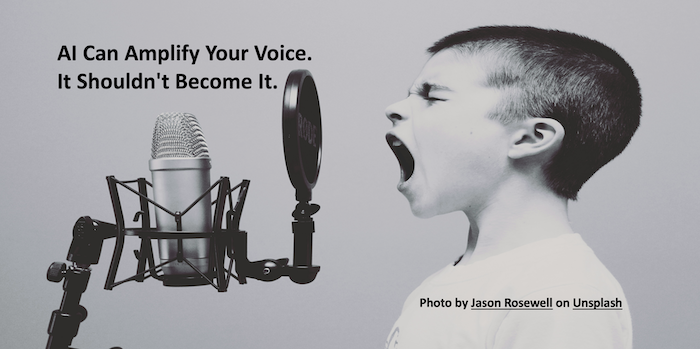
The argument is made that the individuals who will derive the most benefit from AI in the coming decade will not be those who delegate the most to it, but rather those who have already cultivated significant expertise and then utilize AI to amplify their existing knowledge and communicate it more effectively. AI, in this context, serves as a powerful amplifier, not a replacement for the source of the message.
Broader Implications for the Influence Economy
The implications of this debate extend beyond individual content creators to the broader "influence economy." As AI becomes more sophisticated, distinguishing between human-generated and AI-generated content will become increasingly challenging for the public. This could lead to a crisis of trust, where audiences become skeptical of all online content, regardless of its origin.
The concept of "authenticity" in digital communication will likely undergo a re-evaluation. For influencers, thought leaders, and brands, maintaining genuine connection and demonstrable expertise will be paramount. This may necessitate:
- Increased Transparency: Clear disclosure of AI usage in content creation processes could become a standard practice.
- Emphasis on Human Storytelling: Prioritizing personal narratives and lived experiences that AI cannot replicate.
- Focus on Verifiable Expertise: Demonstrating knowledge and skills through tangible achievements and recognized credentials.
- Cultivation of Unique Brand Voice: Investing in developing and maintaining a distinctive brand personality that goes beyond algorithmic generation.
The ongoing evolution of AI presents both opportunities and challenges. Navigating this landscape requires a conscious effort to harness AI’s power responsibly, ensuring it serves to augment human intellect and creativity rather than diminish it. The ultimate measure of influence will likely remain rooted in genuine connection, demonstrable expertise, and the authentic voice of the individual behind the message.
A Question for Reflection
As professionals increasingly integrate AI into their workflows, a critical question emerges: Where do individuals draw the line between utilizing AI as a powerful tool to enhance their output and allowing it to become the primary author of their expertise and intellectual contributions? This introspection is crucial for preserving the integrity of influence and ensuring that technological advancements serve to elevate, rather than replace, the human element in communication.
