

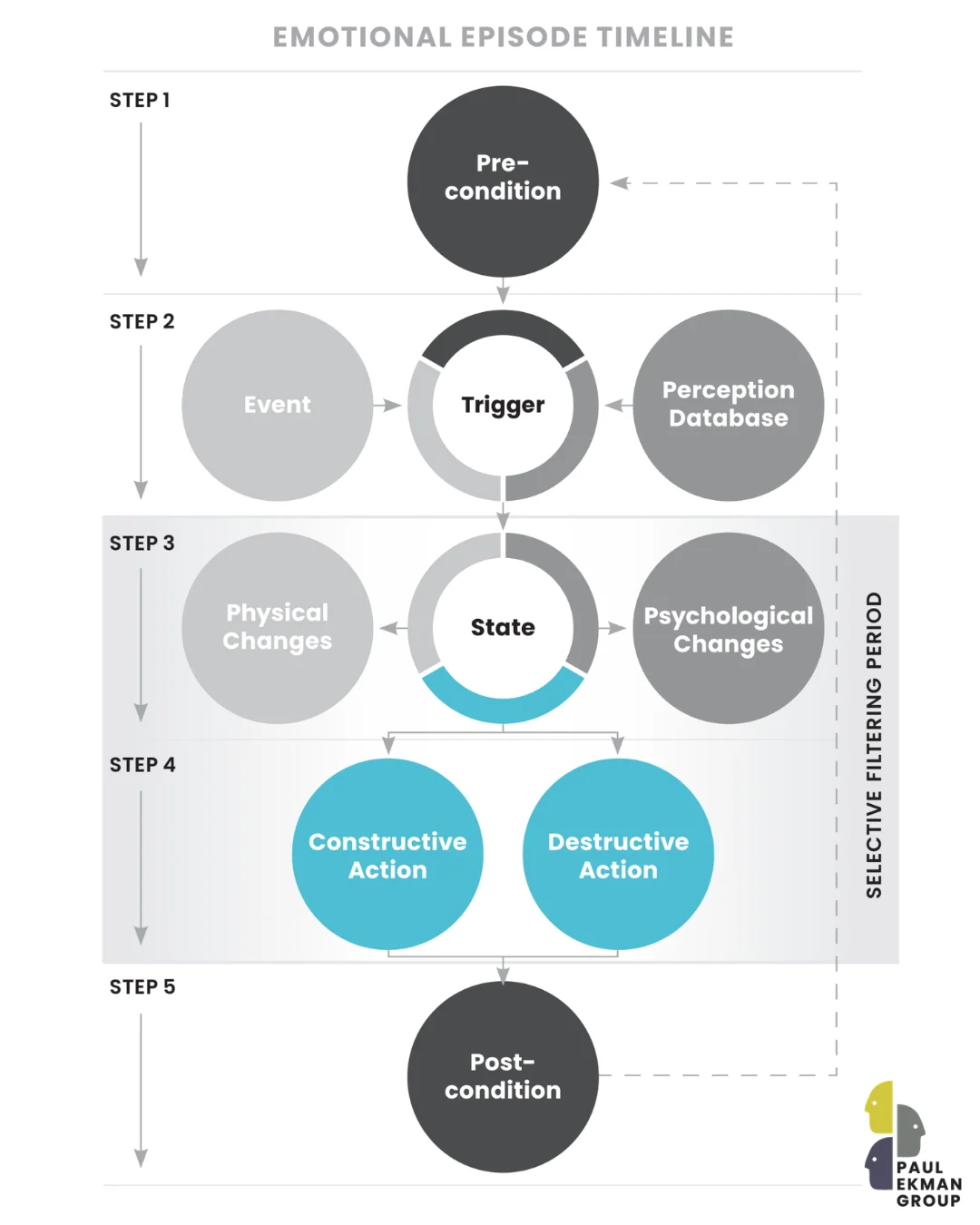
The human experience is often characterized by a rapid and seemingly spontaneous ebb and flow of emotions. Many individuals find themselves reacting to situations with a strong emotional response before they can even consciously process what has occurred. While these emotional surges can feel sudden and unpredictable, scientific research suggests that they follow a structured, albeit rapid, three-step process. This framework, known as the Emotional Episode Timeline, offers a valuable lens through which to understand how our emotions are triggered, experienced, and expressed. By dissecting this process into five distinct stages, we gain the ability to recognize our emotional responses earlier, cultivate more skillful reactions, and ultimately, work towards softening patterns of behavior that may no longer serve our well-being.
The fundamental sequence of an emotional experience can be simplified into a three-part cycle: Trigger, Experience, and Response. This basic progression unfolds countless times throughout a typical day, often unnoticed in its minutiae. Even seemingly minor episodes, such as becoming momentarily frustrated by misplacing keys or a phone, offer profound insights into our underlying habits and patterns. These small instances can reveal tendencies towards self-blame or the inclination to externalize responsibility, highlighting the subtle yet significant ways our emotional architecture operates. To further illuminate these intricate dynamics, the Emotional Episode Timeline expands upon this core sequence, breaking down the emotional journey into five detailed stages.
The Five Stages of an Emotional Episode
The Emotional Episode Timeline, as elucidated by emotion science researchers, provides a more granular understanding of how emotions manifest. This model offers a systematic approach to deconstructing the complex interplay of internal states and external stimuli that constitute our emotional lives.
Stage 1: Pre-condition – The Emotional Starting Point
Every emotional experience is influenced by the internal landscape an individual brings to a given moment. This initial phase, termed the "pre-condition," represents our physical and emotional context – essentially, our emotional starting point. Factors such as fatigue from insufficient sleep, hunger, stress accumulated from work or personal life, or conversely, a state of calm and well-restedness, all contribute to this pre-condition. A positive pre-condition, such as feeling excited after receiving good news, can prime us to experience emotions differently than if we are feeling depleted or overwhelmed. Conversely, a state of neutrality or ease can mean there is little pre-condition, making an emotional response less likely to arise spontaneously. This baseline state significantly influences the threshold at which an emotional trigger can initiate a full-blown emotional episode. For instance, research in psychophysiology has consistently demonstrated that individuals experiencing higher levels of baseline stress exhibit heightened physiological reactivity to perceived threats, suggesting a direct link between pre-condition and emotional vulnerability.
Stage 2: Trigger – The Spark of Emotion
The trigger is the catalyst that initiates an emotional episode. It is not a singular event but rather a dynamic interplay between external or internal events, our interpretation of those events, and our accumulated internal "database" of past experiences and learned responses, all filtered through our current pre-condition.
The Event: External and Internal Stimuli
An "event" can encompass a vast range of occurrences, both external and internal. Externally, it could be an interaction with another person, encountering a specific place, or navigating a particular situation. Internally, an event might be a spontaneous thought, a vivid memory resurfacing, or even a fleeting fantasy. Our sensory portals – sight, sound, smell, taste, and touch – are also conduits for events that can trigger emotions.
Crucially, the mind is in a perpetual state of monitoring and unconsciously evaluating incoming information. This process, known as "automatic appraisal," is designed to rapidly assess situations for potential opportunities or threats, preparing the individual for an appropriate response. For example, the sudden swerving of a car to avoid an animal in the road is a visceral reaction triggered by an automatic appraisal of danger. Similarly, the perceived rejection that follows not receiving a timely text response from a new acquaintance can also be a product of this rapid, often unconscious, evaluation process. Studies in cognitive neuroscience have mapped the neural pathways involved in automatic appraisal, highlighting the amygdala’s central role in detecting salient stimuli and initiating rapid emotional responses, often before conscious processing occurs in the prefrontal cortex.
The Perception Database: Our Emotional Compass
Each individual possesses a unique "perception database," an internal repository of emotional memories, learned associations, and ingrained response patterns. This database acts as an emotional alert system, allowing the mind to quickly ascertain the significance of incoming stimuli. It is shaped by two primary sources:
- Genetics and Biology: Innate predispositions and biological wiring provide a foundational layer for emotional processing. Certain individuals may be genetically predisposed to experience specific emotions more intensely or to be more sensitive to certain types of stimuli.
- Past Experiences and Learning: Our cumulative life experiences, from early childhood development to present-day interactions, profoundly shape how we interpret the world. Traumatic events, positive reinforcement, cultural norms, and social conditioning all contribute to the unique configuration of our perception database, influencing our emotional responses to similar situations in the future. For example, an individual who experienced abandonment in childhood may exhibit a heightened sensitivity to perceived signs of rejection in adult relationships, a direct consequence of their learned emotional associations.
Stage 3: State – The Embodiment of Emotion
This stage represents the actual "Experience" of the emotion – a comprehensive mind-body phenomenon characterized by both physiological and psychological shifts. It is the subjective feeling that arises once the trigger has been processed.
Physical Changes: The Body’s Emotional Language
The body’s reaction to emotion is a complex symphony of physiological changes. Depending on the specific emotion, individuals may notice their heart rate accelerating, a flush of heat rising in their face, tension in their jaw, a fluttering sensation in their stomach, the onset of tears, muscle clenching, or altered breathing patterns. Research has established that each universal emotion is associated with a distinct pattern of physiological changes designed to prepare the body for action. For instance, fear often triggers a "fight or flight" response, characterized by increased heart rate, respiration, and blood flow to the muscles, facilitating escape or confrontation. Conversely, sadness can manifest as a slowing of heart rate and a feeling of physical heaviness. Sometimes, individuals become aware of these bodily sensations before they consciously identify the emotion itself, a phenomenon known as interoception.
Psychological Changes: The Subjective Feeling
This aspect of the "State" refers to the internal, subjective "felt sense" of the emotion. It is the unique quality or "flavor" that each emotion imparts to our conscious awareness. Sadness, for example, might be experienced as a pervasive sense of heaviness and slowness, while anger can feel hot, sharp, and expansive. Each emotion colors our psychological experience in a distinct way, influencing our thoughts, perceptions, and overall mental state. This subjective experience is a critical component of emotional awareness, as it allows us to differentiate between various emotional states.
Stage 4: Action – The Behavioral Manifestation
Emotions are inherently motivating forces that propel us towards action. These actions can be overt and external, such as expressing anger through yelling or reaching out in joy, or they can be internal, like suppressing anger or softening into compassion. Rather than categorizing emotions as inherently "positive" or "negative," a more constructive approach is to assess the nature of the resulting actions:
- Constructive Actions: These are behaviors that are beneficial to oneself and/or others, fostering well-being and positive outcomes. For example, expressing anger assertively to address an injustice, or offering comfort to someone in distress, are constructive actions.
- Destructive Actions: These are behaviors that are harmful to oneself and/or others, leading to negative consequences and damaging relationships. Examples include lashing out in anger, withdrawing emotionally, or engaging in self-sabotaging behaviors.
The distinction between constructive and destructive actions is crucial. Anger, often perceived as a "negative" emotion due to its association with aggression, can, in fact, be a powerful driver of positive change when channeled constructively. For instance, righteous indignation can fuel social activism and advocate for necessary reforms. Conversely, even emotions typically viewed as "positive," such as excessive joy or enthusiasm, could lead to impulsive and destructive decisions if unchecked.
Stage 5: Post-Condition – The Lingering Impact
Every emotional episode leaves a residue, influencing subsequent states and interactions. This "post-condition" is the state of affairs that follows the action taken. If an argument resulted in yelling, the other party might respond with reciprocal anger, or conversely, with withdrawal, creating a new emotional landscape. If anger was suppressed, lingering irritation might persist, potentially affecting future interactions.
These post-conditions are not merely endpoints but often serve as seeds for new emotional episodes, initiating a cyclical process. For example, the lingering irritation from a suppressed emotion could lower one’s threshold for anger in a subsequent situation. However, post-conditions also present a vital opportunity for reflection and learning. By pausing to analyze the sequence of events, the emotional experience, and the resultant actions, individuals can gain valuable insights into their emotional patterns and identify areas for growth and adjustment. This meta-cognitive process is fundamental to emotional regulation and the development of resilience.
The Selective Filtering Period: A Critical Overlay
It is important to note that a phenomenon known as the "selective filtering period" occurs concurrently with Stages 3 (State) and 4 (Action). This is not a distinct step but rather an influential process that shapes our perception during an active emotional episode. When an emotion takes hold, our perceptual field tends to narrow, causing us to filter information in a manner that aligns with the prevailing emotional state. In a state of fear, for instance, individuals become hyper-vigilant, focusing intently on perceived threats, both real and imagined, while downplaying or ignoring reassuring information. Similarly, during anger, the focus often narrows to the frustrating aspects of a situation, with positive elements being disregarded. While this selective filtering can be adaptive in survival situations by sharpening focus on potential dangers, it can also lead to a distorted perception of reality if individuals are unaware of its influence. Understanding this filtering mechanism is crucial for maintaining objectivity and making balanced decisions, particularly in emotionally charged circumstances.
Implications and Further Exploration
The Emotional Episode Timeline provides a powerful framework for understanding the intricate mechanisms of human emotion. By recognizing the distinct stages of pre-condition, trigger, state, action, and post-condition, individuals can develop greater self-awareness and cultivate more adaptive emotional responses. This understanding has far-reaching implications for mental health, interpersonal relationships, and overall well-being.
For those seeking to delve deeper into the science of emotion, resources such as "The Feelings Field Guide" offer comprehensive explorations of the Emotional Episode Timeline and other fundamental concepts in emotion science, complete with practical exercises and guidance for enhancing emotional intelligence. Furthermore, the Atlas of Emotions, an interactive online tool developed by Drs. Paul and Eve Ekman, provides a free platform for individuals to explore how emotions arise, unfold, and influence behavior. The forthcoming Atlas of Emotions book promises to expand upon these concepts, offering further insights and practical applications.
The frequently asked questions surrounding emotional experiences often find their answers within this structured framework. The speed at which we react is attributed to automatic appraisal during the trigger stage. Variability in emotional reactivity day-to-day can be explained by fluctuations in our pre-condition. The difficulty in thinking clearly when upset is a direct consequence of the selective filtering period. Crucially, while the trigger and state stages are largely automatic, the action stage offers a critical window for conscious choice and the cultivation of constructive responses, empowering individuals to navigate their emotional landscapes with greater skill and intention.
