

The German verb haben, translating primarily to the English "to have," represents one of the most critical structural components of the German language, functioning as both a principal verb of possession and a primary auxiliary for the construction of compound tenses. Linguistic experts and educators categorize haben alongside sein (to be) and werden (to become) as the foundational trio of German verbs, without which basic communication and temporal articulation remain impossible. In contemporary linguistic studies, haben is identified as a high-frequency lexeme, appearing in nearly every register of speech and writing, from informal dialogue to formal legal statutes. Its role extends beyond simple ownership; it is the essential mechanism for the Perfekt tense, the most commonly used past tense in spoken German. Consequently, the mastery of haben is considered a non-negotiable milestone for students adhering to the Common European Framework of Reference for Languages (CEFR) standards, particularly at the A1 and A2 levels.
Historical Evolution and Morphological Irregularity
The irregular nature of haben in modern German is the result of centuries of phonetic erosion and linguistic evolution. Tracing its roots to the Old High German habēn, the verb has undergone significant simplification to facilitate ease of speech. This is most evident in the present tense (Präsens) forms for the second and third person singular. While a regular verb would retain its stem—resulting in hypothetical forms such as "habst" and "habt"—the modern German language has dropped the "-b-" to produce hast and hat.
Linguists point to this "contraction" as a hallmark of high-frequency verbs; the more a word is used, the more likely its sounds are to be smoothed over generations. Interestingly, a parallel development occurred in the English language, where the cognate "have" transitioned to "has" rather than "haves" in the third person singular. Furthermore, haben is frequently classified as a "mixed verb." This classification arises because it exhibits traits of both "weak" verbs (using a dental suffix -te in the past tense) and "strong" verbs (undergoing a stem change). Specifically, in the Präteritum (simple past), the stem hab- shifts to hatt-, a transformation that also influences the Konjunktiv II (subjunctive) form, hätte.
Structural Framework of Conjugation in the Present and Simple Past
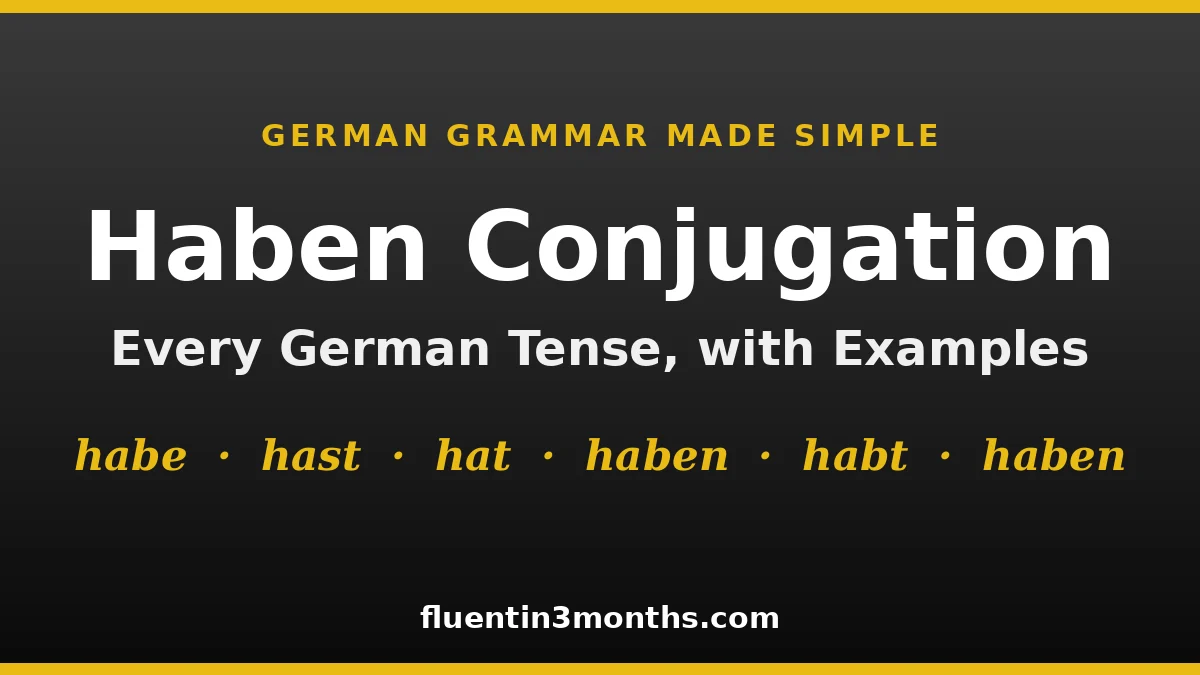
For the learner, the present tense paradigm of haben serves as the entry point into German sentence structure. The conjugation is as follows: ich habe (I have), du hast (you have, informal), er/sie/es hat (he/she/it has), wir haben (we have), ihr habt (you all have, informal), and sie/Sie haben (they/you formal have). Analysts note that the synchronization of the wir and sie/Sie forms with the infinitive is a regularizing feature that aids in memorization.
In the Präteritum, or simple past, the verb takes on a more uniform but altered stem. The forms—hatte, hattest, hatte, hatten, hattet, and hatten—are vital for written narratives and formal reporting. While many German verbs utilize the Perfekt (compound past) in spoken conversation, haben and sein are notable exceptions. Native speakers predominantly favor the Präteritum forms of these two verbs even in casual dialogue, as the compound alternative (e.g., "ich habe gehabt") is often viewed as unnecessarily cumbersome. Data from linguistic corpora suggest that the use of "ich hatte" outpaces "ich habe gehabt" in spoken German by a significant margin, making the simple past of haben a priority for those seeking oral fluency.
The Role of Haben as a Tense Auxiliary
The functionality of haben as an auxiliary verb is perhaps its most significant contribution to German syntax. It is the primary engine for the Perfekt, Plusquamperfekt (past perfect), and Futur II (future perfect) tenses. In the Perfekt tense, haben is paired with the Partizip II (past participle) of the main verb. For example, "ich habe gegessen" (I have eaten) or "ich habe gesehen" (I have seen).
Statistical analysis of the German lexicon reveals that approximately 80% of all German verbs utilize haben as their auxiliary. The remaining 20%—primarily verbs of motion (such as gehen or fahren) or verbs indicating a change of state (such as aufwachen or sterben)—utilize sein. This dominance makes haben the "default" choice for learners. The Plusquamperfekt further utilizes the Präteritum of haben (hatte) plus a participle to describe actions completed prior to another past action, such as "ich hatte das Buch bereits gelesen" (I had already read the book).
Subjunctive Mood and the Konjunktiv II
In the realm of hypothetical reasoning, polite requests, and counterfactual statements, the Konjunktiv II form of haben is indispensable. The form hätte (would have) is derived from the Präteritum stem with the addition of an umlaut and the appropriate endings: hätte, hättest, hätte, hätten, hättet, and hätten.
One of the most frequent applications of this mood in the German-speaking world is the expression "ich hätte gern," which translates to "I would like" or "I would gladly have." In a retail or hospitality context, this is the standard of politeness, replacing the more blunt "ich will" (I want). Educational data indicates that "ich hätte gern" is one of the first five functional phrases taught to expatriates and students to facilitate integration into German society. Additionally, the Konjunktiv I, while rarer and largely confined to journalistic reported speech, utilizes the forms habe, habest, habe, haben, habet, and haben to distance the speaker from the veracity of a cited statement.
Idiomatic Discrepancies and Comparative Linguistics
A significant challenge for English, French, and Spanish speakers learning German lies in the idiomatic use of haben. Many physiological and psychological states that are expressed with "to be" in English require "to have" in German. This category includes:
- Hunger haben (to be hungry / to have hunger)
- Durst haben (to be thirsty / to have thirst)
- Angst haben (to be afraid / to have fear)
- Recht haben (to be right / to have rightness)
- Zeit haben (to have time)
- Glück haben (to be lucky / to have luck)
Conversely, a common pitfall for Romance language speakers (French "avoir… ans" or Spanish "tener… años") is the expression of age. German aligns with English in this instance, utilizing sein rather than haben: "Ich bin 25 Jahre alt" (I am 25 years old). This cross-linguistic interference is a frequent subject of study in error analysis within German as a Foreign Language (DaF) pedagogy.
Pedagogical Strategies and Professional Implications
Modern language acquisition experts, including prominent polyglots and instructors at institutions such as the Goethe-Institut, emphasize a "functional first" approach to haben. Rather than rote memorization of exhaustive conjugation tables, educators recommend focusing on high-utility clusters: the present tense, the Präteritum for past-tense narration, and the "ich hätte gern" construction for social navigation.
The impact of mastering haben extends into the professional sphere. In the DACH region (Germany, Austria, and Switzerland), which boasts some of the world’s most robust economies, precision in language is often correlated with professional competence. Incorrect auxiliary selection or the misuse of the subjunctive can lead to misunderstandings in contractual negotiations or formal correspondence. Consequently, specialized "German for the Workplace" programs devote substantial resources to the nuances of haben, particularly in its role in the Futur I and Futur II tenses, which are used to discuss project timelines and completed objectives.
Conclusion and Future Outlook
The verb haben remains the cornerstone of German grammar, serving as a versatile tool for expressing possession, time, and modality. Its historical development from a regular Germanic verb to its current "mixed" status reflects the broader evolution of the German language toward phonetic efficiency. For the global community of nearly 100 million native German speakers and the millions more currently studying the language, haben is not merely a word but a structural necessity.
As digital language learning tools and AI-driven platforms continue to evolve, the data-driven analysis of verb frequency reinforces the priority of haben in curricula worldwide. Whether through the lens of historical linguistics, comparative syntax, or practical communication, the verb’s complexity and utility ensure its position as a primary subject of study. By understanding its irregular present tense, its dominance as an auxiliary, and its critical role in idiomatic expression, learners can effectively unlock the ability to communicate across all temporal planes of the German language. Mastering haben is, in essence, the first major step toward achieving true linguistic proficiency and cultural integration in the German-speaking world.
