

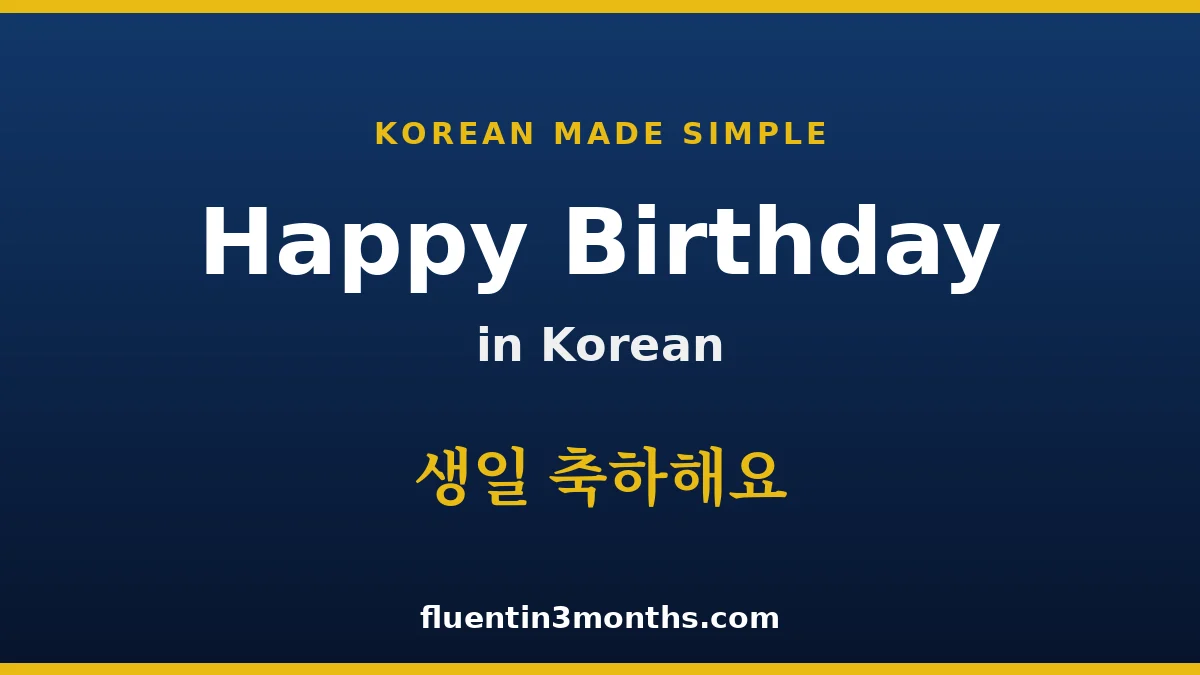
South Korea’s linguistic landscape is a complex tapestry of social hierarchy, honorifics, and deeply rooted traditions that define how individuals interact based on age, status, and intimacy. At the heart of these social interactions is the celebration of birthdays, an event that serves as a primary marker for age-related transitions in a society that has historically calculated age differently from the rest of the world. While the fundamental phrase for "happy birthday" is widely recognized as saengil chukhahaeyo, the application of this greeting requires a nuanced understanding of Korean etiquette, particularly following the landmark legislative changes of 2023 that standardized age calculations across the peninsula.
The Linguistic Architecture of Korean Birthday Greetings
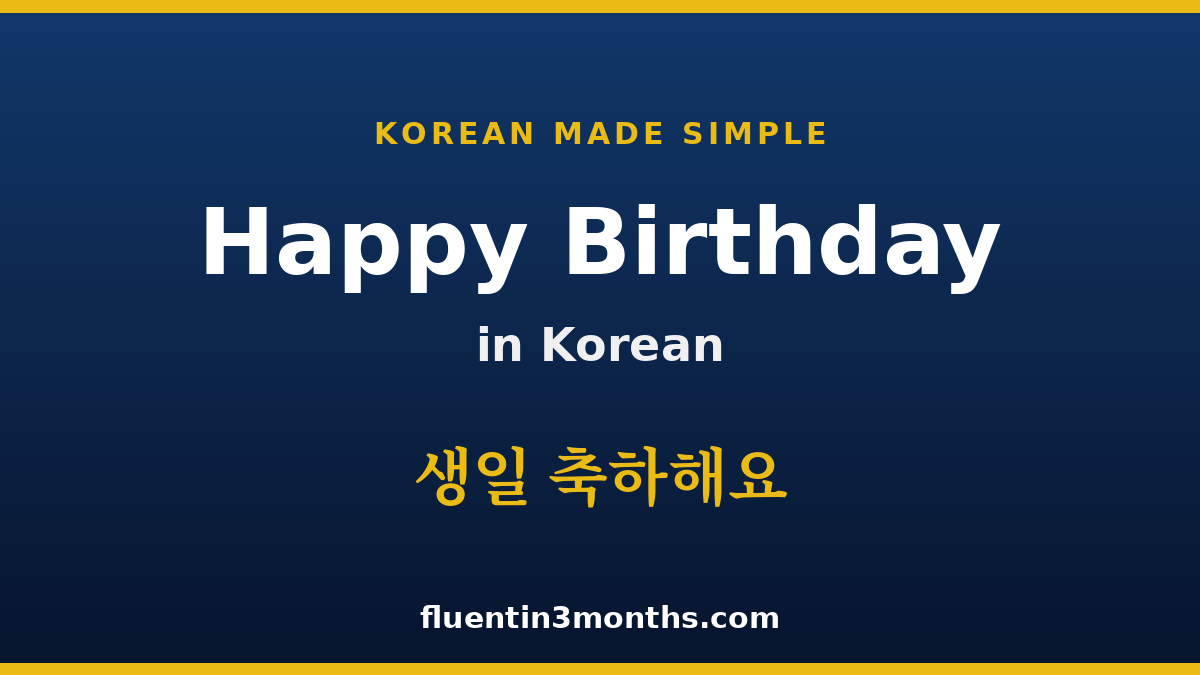
In the Korean language, a greeting is rarely just a well-wish; it is a reflection of the speaker’s relationship with the listener. The standard polite form, saengil chukhahaeyo (생일 축하해요), serves as the most versatile expression. It is composed of saengil (생일), meaning birthday, and chukhahada (축하하다), meaning to congratulate, modified by the polite ending -haeyo. This version is the "gold standard" for workplace environments, interactions with acquaintances, and social settings where a balance of friendliness and respect is required.
However, Korean society operates on a multi-tiered honorific system known as jondae-mal (formal speech) and banmal (casual speech). For close friends, younger siblings, or those with whom a mutual agreement to speak casually has been established, the phrase is shortened to saengil chukhae (생일 축하해). Conversely, when addressing elders, such as grandparents, parents, or high-ranking mentors, a significantly more deferential form is required: saengsin chukha-deurimnida (생신 축하드립니다). This version replaces the standard word for birthday with saengsin (생신), an honorific noun, and employs the humble verb deurida (드리다), which implies the offering of a gift or tribute to a superior.
The 2023 Age Standardization Law: A Chronological Shift
The most significant recent development in Korean birthday culture occurred on June 28, 2023, when South Korea officially abolished the "Korean age" system for administrative and civil purposes. For centuries, South Koreans used three distinct methods to calculate age, leading to widespread confusion in legal, medical, and social contexts.
Under the traditional "Seneun nai" (counting age) system, a child was considered one year old at birth, accounting for the time spent in the womb. Furthermore, everyone in the nation gained a year collectively on New Year’s Day, regardless of their actual birth date. This meant that a baby born on December 31 would technically turn two years old on January 1, despite having lived for only two days.
The transition to "Man nai" (international age) was a key campaign promise of President Yoon Suk-yeol’s administration. The Ministry of Government Legislation spearheaded the change, citing the need to reduce "unnecessary social and economic costs" resulting from age-related disputes in insurance contracts, pension eligibility, and clinical trials.
Despite this legal shift, the "Yeon nai" (year age) system—calculated by subtracting the birth year from the current year—remains in effect for specific regulations, such as the legal age for purchasing tobacco and alcohol, and the age of eligibility for mandatory military service. This "triple system" has created a period of social adjustment where Koreans may be legally one age but socially another, making birthday celebrations a critical point of reference for clarifying one’s "true" age in different contexts.
Culinary Traditions: The Symbolism of Miyeokguk
In South Korea, the culinary centerpiece of a birthday is not necessarily the cake, but a bowl of miyeokguk (seaweed soup). This tradition is deeply intertwined with the theme of maternal gratitude. Historically, miyeokguk has been the primary meal for women recovering from childbirth due to its high iodine and calcium content, which is believed to aid in blood purification and milk production.
By consuming seaweed soup on their birthday, Koreans engage in a symbolic act of remembering their mother’s labor and the care provided during their infancy. While modern celebrations often include Western-style cakes and parties, the morning bowl of miyeokguk remains a staple in most households. This practice underscores the Neo-Confucian values of filial piety that continue to underpin modern Korean life, transforming a personal celebration into a moment of familial reflection.
Milestones of Life: From Doljanchi to Hwangap
Korean culture places extraordinary emphasis on specific birthday milestones, most notably the first birthday, known as Doljanchi. Historically, before the advent of modern medicine, infant mortality rates in Korea were high; reaching the one-year mark was a significant victory that warranted a community-wide celebration.
A central ritual of the Doljanchi is the Doljabi. During this ceremony, the child is placed before a variety of symbolic objects, such as thread (symbolizing long life), money (wealth), a brush or book (intelligence/scholarship), or more modern additions like a stethoscope (medicine) or a computer mouse (technology). The first object the child grabs is believed to predict their future career or fortune.
Another major milestone is the Hwangap, or the 60th birthday. According to the traditional sexagenary cycle of the lunar calendar, reaching age 60 represents the completion of one full cycle and a return to the year of one’s birth. Historically, this was a massive celebration of longevity. However, as life expectancy in South Korea has surged to over 83 years, the Hwangap is often celebrated more modestly, with the 70th (Gohui) and 80th (Palsun) birthdays now taking precedence as the primary markers of elder status.
Linguistic Evolution and the Influence of Hallyu
The global rise of Korean culture, or Hallyu, has introduced Korean birthday customs to an international audience. The "Korean Birthday Song," which utilizes the melody of the Western "Happy Birthday to You" but with localized lyrics (Saengil chukha hamnida), is now recognized globally by fans of Korean media.
Interestingly, even within the song, the use of formal language—chukha hamnida (축하합니다)—is standard. This reflects a broader linguistic trend where formal endings are used in collective settings or performances, even if the individuals involved share a casual relationship.
Phonetically, learners of the language must navigate the "batchim" (final consonant) rules and the softening of certain sounds. For example, in the phrase saengil chukhahaeyo, the "h" sound in chukha is often aspirated or merged with the preceding "k" sound, creating a more fluid pronunciation that differs from a literal reading of the Romanized text.
The Scientific Legacy: Hangul and King Sejong
The ability to write and share birthday wishes in Korean is made possible by Hangul, the phonetic alphabet commissioned by King Sejong the Great in 1443. Before Hangul, the Korean language utilized Chinese characters (Hanja), which were difficult for the common populace to learn, leading to widespread illiteracy.
Hangul was designed with scientific precision; the shapes of the consonants were modeled after the physical positions of the mouth, tongue, and throat during speech. This logical structure has made Korean one of the most accessible languages to learn to read and write, facilitating the rapid exchange of digital birthday greetings in the modern era via platforms like KakaoTalk, where "birthday gift icons" (mobile vouchers) have become a standard contemporary tradition.
Societal Implications of the Age Change and Tradition
The transition to the international age system is more than a bureaucratic adjustment; it is a challenge to the deeply ingrained social hierarchy of South Korea. Since age dictates speech styles and social standing, a person who was previously considered an "older brother" (oppa/hyeong) or "older sister" (eonni/nuna) under the Korean age system might now be the same age as their peers.
Sociologists suggest that this may eventually lead to a "softening" of the hierarchy among youth, though traditionalists argue that birth year, rather than birth date, will continue to define social circles for years to come. The Ministry of Government Legislation has acknowledged that while the law has changed, social "habits" will take time to evolve.
In conclusion, celebrating a birthday in South Korea is a multi-faceted experience that requires navigating historical age systems, linguistic honorifics, and traditional rituals. Whether it is the symbolic consumption of seaweed soup, the playful predictions of the Doljabi, or the careful selection of the correct verb ending, these practices reflect a society that deeply values its past while actively restructuring its legal and social future. As South Korea continues to influence the global stage, understanding these nuances offers a window into the values of respect, family, and community that define the Korean identity.
