

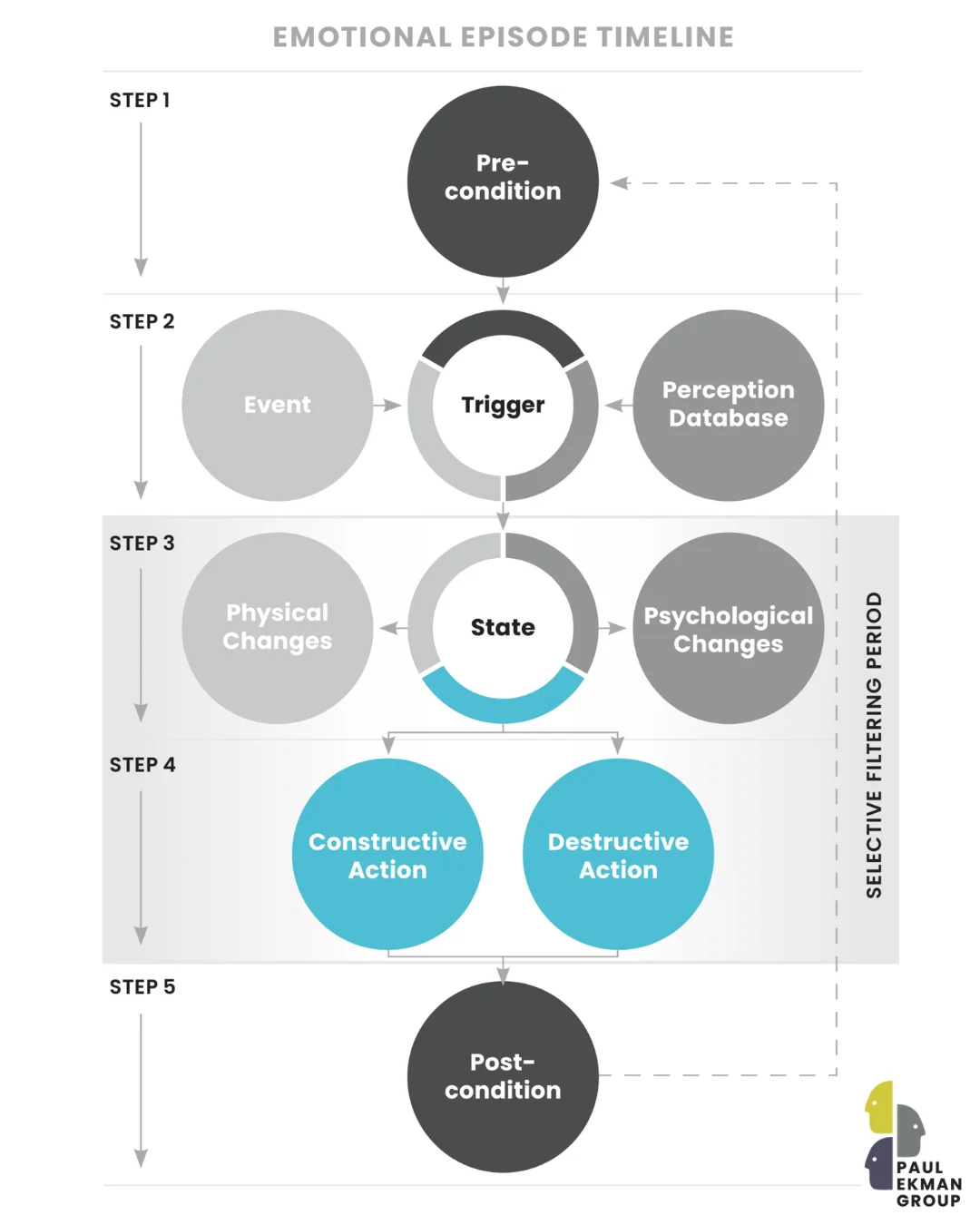
The human experience is punctuated by a constant stream of emotions, often feeling as though they arise spontaneously, catching us off guard. While the immediacy of an emotional reaction can be startling, scientific research reveals a structured, sequential process underlying every emotional episode. Understanding this "Emotional Episode Timeline" offers a powerful framework for recognizing emotions earlier, responding with greater skill, and ultimately, transforming patterns that no longer serve us. This detailed exploration delves into the science behind how emotions unfold, providing insights into the intricate interplay of our internal states and external circumstances.
The Three Pillars of Emotional Experience: Trigger, State, and Response
At its most fundamental level, an emotional experience can be distilled into a three-step sequence: Trigger, State, and Response. This basic cycle repeats countless times each day, often with minor emotional episodes passing by without conscious recall. Consider the everyday frustration of misplacing keys or a phone. While seemingly trivial, these small moments offer valuable clues about our ingrained habits and unconscious biases, such as a tendency to blame others or ourselves. By dissecting these seemingly minor events, we can begin to identify the underlying patterns that shape our emotional landscape. The more detailed Emotional Episode Timeline expands upon this foundational model, breaking down the process into five distinct stages to provide a more nuanced understanding.
Unpacking the Emotional Episode Timeline: A Five-Stage Framework
The comprehensive Emotional Episode Timeline, developed by leading researchers in the field of emotion science, provides a detailed roadmap of how our feelings manifest. This framework moves beyond the simple trigger-state-response model to incorporate the crucial preparatory and consequential phases of an emotional experience.
Stage 1: Pre-condition – The Emotional Starting Point
Every emotional journey begins with a "pre-condition," which refers to the physical and psychological context we bring to any given moment. This is our baseline emotional state, influenced by a myriad of factors. Are we feeling energized after a restful night’s sleep, or are we drained and irritable from sleep deprivation? Is our stomach growling with hunger, or are we comfortably satiated? The stresses of work, the elation of good news, or the simple peace of a calm mind all contribute to our pre-condition. This internal milieu significantly influences how susceptible we are to experiencing certain emotions. When we are feeling neutral or at ease, the pre-condition might be minimal, allowing for a more measured response to subsequent events. Conversely, a pre-existing state of fatigue or stress can lower our threshold for emotional reactivity, making us more prone to experiencing intense feelings from even minor triggers. For instance, research published in Nature Human Behaviour has indicated that sleep deprivation can significantly amplify negative emotional responses to otherwise neutral stimuli, highlighting the critical role of our physiological state in emotional processing.
Stage 2: Trigger – The Catalyst for Emotion
The trigger is the pivotal event that initiates an emotional response. It is not merely the external occurrence itself, but rather a complex interplay between the event, our interpretation of it, and our internal "perception database," all occurring within the context of our current pre-condition.
The Event: External and Internal Stimuli
An event can be anything that we encounter, whether it originates from the external world or our internal landscape. This can include the presence of another person, a specific location, a particular situation, or even a fleeting thought, memory, or fantasy. Our sensory portals – sight, sound, smell, taste, and touch – are constantly feeding information to our brains. This information is then subjected to a process known as "automatic appraisal." Our minds are wired to rapidly and often unconsciously evaluate incoming stimuli, assessing them for potential opportunities or threats, and preparing us to act accordingly. A classic example is the sudden, instinctual swerving of a car to avoid an animal darting into the road. This rapid, automatic response bypasses conscious deliberation, prioritizing immediate safety. Similarly, the absence of a quick text reply from a new acquaintance can be appraised as a sign of rejection, triggering feelings of disappointment or anxiety.
The Perception Database: Our Emotional Compass
Each individual possesses a unique "perception database," an internal repository of emotional memories and ingrained response patterns that shapes how we interpret the world. This database functions as an "emotional alert system," enabling our minds to swiftly determine the significance of an event. It is comprised of two primary sources:
- Evolutionary Predispositions: These are innate, universal emotional tendencies that have evolved to enhance survival. For example, an innate fear of heights or a predisposition to react with disgust to spoiled food are examples of such evolutionary safeguards. Research by scientists like Paul Ekman has identified several universal emotions, such as joy, sadness, anger, fear, surprise, and disgust, which are thought to have distinct physiological and facial expression correlates across cultures, suggesting a biological basis.
- Learned Experiences: This encompasses all the emotional associations and learned responses acquired throughout our lives. A negative encounter with a dog in childhood, for instance, might lead to a learned fear response whenever encountering dogs later in life. Conversely, positive associations with specific music can evoke feelings of happiness or nostalgia. The vast body of research on classical and operant conditioning demonstrates how our environments and past experiences profoundly shape our emotional reactions.
When an event occurs, our brain quickly accesses this perception database, comparing the current stimulus to stored emotional memories and learned responses. This comparison determines the emotional valence and intensity of our reaction.
Stage 3: State – The Full Mind-Body Experience
The "State" represents the emotional experience itself, aligning with the "Experience" step in the simplified model. This stage is characterized by a profound mind-body phenomenon, encompassing both physical and psychological shifts.
Physical Changes: The Body’s Emotional Symphony
The body’s response to emotion is a complex physiological cascade designed to prepare us for action. Depending on the specific emotion, individuals may notice a range of bodily sensations. These can include an accelerated heartbeat, a flush of heat rising in the face, a tightening of the jaw, a sensation of "butterflies" in the stomach, the formation of tears, muscle tension, or alterations in breathing patterns. Scientific studies, such as those investigating facial action coding systems, have demonstrated that each universal emotion is associated with a distinct pattern of physiological changes. For instance, fear is often linked to increased heart rate and respiration, preparing the body for a "fight or flight" response, while sadness may be associated with a slower heart rate and decreased energy levels. Notably, we may not always be consciously aware of the trigger that initiated the emotion, but we often become acutely aware of these bodily sensations as they manifest.
Psychological Changes: The Subjective Felt Sense
This dimension of the emotional state refers to our internal, subjective "felt sense" of the emotion. It is the unique quality or "flavor" that each emotion imparts to our conscious experience. For example, sadness might be perceived as a heavy, slow, and pervasive feeling, while anger can manifest as a hot, sharp, and constricting sensation. Each emotion colors our psychological experience in a distinct way, influencing our thoughts, perceptions, and motivations. Research in affective neuroscience suggests that these subjective experiences are correlated with specific patterns of neural activity in brain regions such as the amygdala, insula, and prefrontal cortex.
Stage 4: Action – The Behavioral Manifestation
Emotions are inherently action-oriented; they compel us to do something. These actions can be overt and external, such as yelling in anger, embracing someone in joy, or recoiling in fear. Alternatively, they can be internal and subtle, such as suppressing an angry impulse, softening one’s stance with compassion, or withdrawing into oneself. Rather than categorizing emotions as inherently "positive" or "negative," a more constructive approach involves assessing whether the resulting actions are beneficial or detrimental to ourselves and others.
- Constructive Actions: These are responses that are adaptive, problem-solving, and contribute to well-being. For example, expressing anger assertively to address an injustice or using fear to motivate proactive safety measures can be constructive. Research on emotional intelligence emphasizes the importance of harnessing emotions for beneficial outcomes.
- Destructive Actions: These are responses that are harmful, counterproductive, or lead to negative consequences. Examples include lashing out aggressively in anger, succumbing to despair in sadness, or engaging in avoidance behaviors driven by fear.
It is crucial to recognize that even emotions often labeled as "negative," such as anger, can lead to constructive actions. As highlighted by Dr. Paul Ekman’s work, constructive anger can be a powerful force for positive change, motivating individuals to stand up for their rights or advocate for others. The key lies not in the emotion itself, but in the subsequent behavior it elicits.
Stage 5: Post-condition – The Ripple Effect and Learning Opportunity
Every emotional episode leaves a residual impact, influencing subsequent states and interactions. If an individual yelled in anger, the recipient might respond with reciprocal anger, or perhaps with fear or withdrawal. If anger was suppressed, it might linger as internal irritation, potentially resurfacing later. These "post-conditions" can serve as triggers for new emotional episodes, creating a cyclical pattern. For instance, the lingering irritation from suppressed anger might make one more susceptible to an angry outburst the next time a similar situation arises.
However, these post-conditions also present a critical opportunity for reflection and learning. By pausing to examine the consequences of our emotional responses, we can gain valuable insights into our patterns of behavior. This reflective process allows us to identify areas for improvement and to cultivate more skillful and adaptive ways of navigating our emotional lives. The ability to learn from our emotional experiences is a cornerstone of personal growth and resilience.
The Selective Filtering Period: How Emotion Narrows Perception
It is important to note that a significant cognitive phenomenon occurs during the State and Action stages: the "selective filtering period." When an emotion is actively experienced, our perception tends to narrow, and we begin to filter information to align with the prevailing emotional state. In a state of fear, for example, our attention becomes hyper-focused on potential threats, both real and imagined, while less threatening stimuli are overlooked. Similarly, when experiencing anger, we may disproportionately notice the frustrating aspects of a situation, tuning out anything that is proceeding smoothly. This filtering mechanism, while evolutionarily beneficial for survival by prioritizing immediate concerns, can also distort our perception of reality if we are not consciously aware of its influence. Recognizing this selective filtering is crucial for maintaining a balanced and objective view of situations, especially during emotionally charged moments. Research on attentional bias in emotional states further supports this concept, demonstrating how our emotional focus can significantly shape what information we attend to and process.
Implications and Pathways to Emotional Mastery
Understanding the Emotional Episode Timeline offers profound implications for personal well-being and interpersonal relationships. By recognizing the sequential nature of emotional experiences, individuals can develop greater self-awareness and emotional regulation skills.
- Early Recognition: Identifying the pre-condition and trigger stages allows for earlier intervention, potentially preventing an emotion from escalating to an overwhelming state. For example, recognizing early signs of stress (pre-condition) and a minor annoyance (trigger) can prompt proactive coping strategies before frustration escalates into anger.
- Skillful Response: By understanding the link between emotion and action, individuals can consciously choose more constructive responses. This involves pausing between the emotional state and the behavioral action to make deliberate choices about how to proceed. This is the essence of emotional intelligence – the ability to understand and manage one’s own emotions, and to recognize and influence the emotions of others.
- Pattern Transformation: Repeatedly applying this framework to analyze emotional episodes can help individuals identify and deconstruct unhelpful emotional patterns. This could involve recognizing a tendency towards rumination in sadness, or an overreaction to perceived criticism, and then actively working to cultivate more adaptive responses.
Resources for Deeper Exploration
For those seeking to delve deeper into the science of emotion and enhance their emotional intelligence, several valuable resources are available. "The Feelings Field Guide," along with its companion guidebook, offers the Emotional Episode Timeline and other fundamental concepts of emotion science, complemented by practical exercises for building emotional awareness.
Furthermore, the Emotional Episode Timeline is a core concept within the Atlas of Emotions, a free interactive tool developed by Drs. Paul and Eve Ekman. This platform provides a comprehensive resource for understanding how emotions arise, unfold, and influence our actions. Dr. Eve Ekman is currently developing an accompanying book, which promises to expand upon these concepts with additional insights, illustrations, and practical guidance, offering an even more accessible and in-depth exploration of the emotional landscape.
Frequently Asked Questions About Emotional Experiences
Why do I react before I even know what’s happening?
This phenomenon is attributed to automatic appraisal, which occurs unconsciously during the trigger stage. Your brain rapidly evaluates potential help or harm, initiating a response before your conscious awareness fully catches up. This rapid, instinctual processing is a fundamental aspect of our survival mechanisms.
Why do small things set me off more on some days than others?
Your pre-condition plays a significant role. Factors such as fatigue, stress, hunger, or overall emotional equilibrium can lower your threshold for emotional reactivity. When your pre-condition is already strained, even minor triggers can feel amplified.
Why can’t I think clearly when I’m upset?
During the state and action stages of an emotional episode, you enter a selective filtering period. Your perception narrows to focus on aspects of the situation that align with your prevailing emotion, making it challenging to access a broader, more objective perspective. This narrowed focus is designed to prioritize immediate concerns but can impede rational thought.
Can I control how I react to an emotion?
While the trigger and state stages are largely automatic and automatic, the action stage offers a critical point of agency. This is the phase where conscious choices about how to respond become possible. By developing awareness and practicing techniques for emotional regulation, individuals can cultivate more skillful and constructive responses to their emotions.
