

Emotions, moods, and attitudes are fundamental aspects of human experience that profoundly shape our perception of ourselves and the world. While often used interchangeably in casual conversation, these three psychological constructs operate on distinct temporal scales and serve different, yet interconnected, functions. A deeper understanding of their nuances and interactions is crucial for fostering emotional intelligence, enhancing self-awareness, and improving interpersonal relationships. This exploration delves into the characteristics of each, their individual impacts, and the dynamic ways they influence one another, drawing upon established psychological principles.
The Fleeting Nature of Emotions
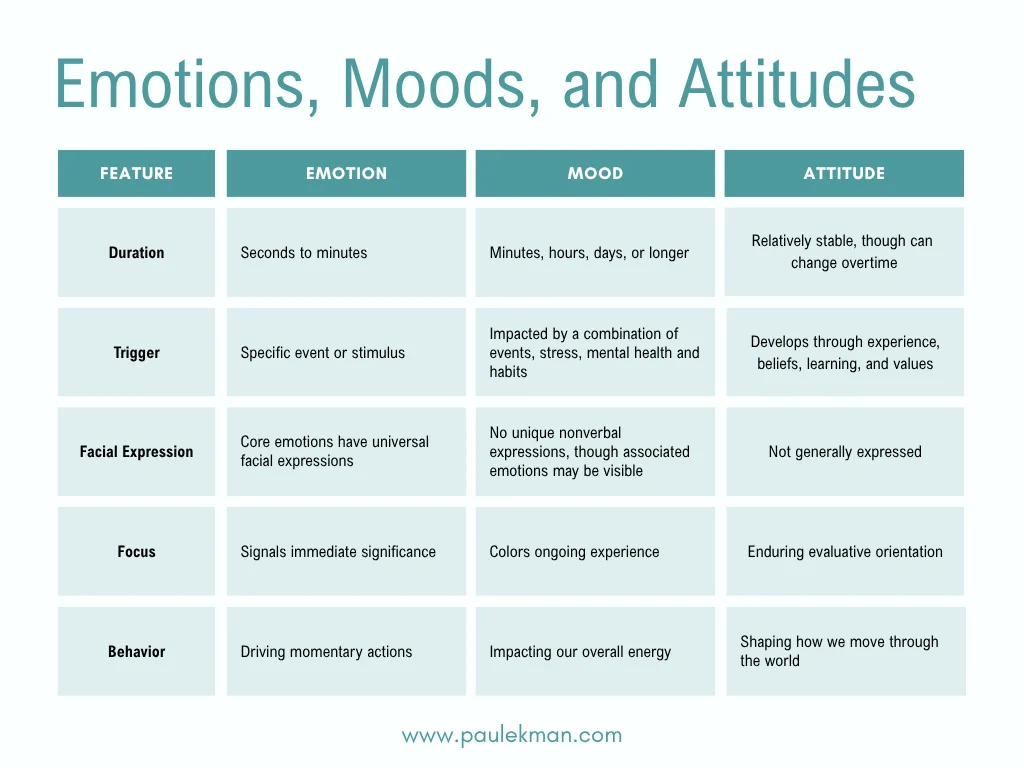
Emotions are characterized by their immediacy and intensity. They are automatic appraisal processes, deeply rooted in our evolutionary history and shaped by individual life experiences. An emotion is triggered when a significant event occurs that relates to our goals, needs, or overall well-being. This appraisal initiates a cascade of coordinated psychological and physiological responses designed to prepare us for action. For instance, encountering a perceived threat—such as a sudden loud noise or an aggressive individual—can instantaneously elicit fear. This fear response involves physiological changes like increased heart rate, dilated pupils, and the release of adrenaline, alongside psychological shifts that heighten vigilance and readiness for fight or flight.
Scientifically, emotions are understood to be relatively brief, typically lasting from fractions of a second to a few minutes. This transience is a defining feature. Think of the surge of joy upon receiving good news or the sting of disappointment after a setback; these are acute, time-limited experiences. Research, including studies on universal facial expressions of emotion pioneered by figures like Paul Ekman, has demonstrated that certain core emotions are recognized across diverse cultures, suggesting a biological basis. These emotions manifest not only internally through physiological arousal but also externally through distinct facial expressions and bodily postures. These outward signs are crucial for social signaling, allowing us to communicate our internal states to others and facilitating social coordination. The speed and universality of emotional responses underscore their adaptive role in navigating immediate environmental challenges and opportunities.
The Enduring Influence of Moods
In contrast to the sharp, acute nature of emotions, moods are more diffuse and persistent affective states. They can linger for hours, days, or even longer, creating a pervasive backdrop to our daily lives. A key distinction is that moods often lack a clearly identifiable trigger. While an emotion might be a direct response to a specific event—a heated argument, a satisfying accomplishment—a mood can descend upon us without a discernible cause. One might wake up feeling cheerful or inexplicably down, or find themselves gradually slipping into a state of irritation without a clear precipitating incident.
Moods do not typically produce the distinct facial expressions associated with many emotions. However, they can subtly manifest in our physical presentation, such as changes in muscle tension, posture, or overall energy levels. A person in a generally negative mood might appear more slumped or less animated than usual, even if they cannot pinpoint a specific reason for their state.
Functionally, moods act as a general emotional tone that colors our experiences. They influence the ease with which certain emotions are triggered and can significantly shape our interpretation of events. For example, someone in a good mood might perceive a minor inconvenience as a trivial matter, while the same individual in a bad mood might react with disproportionate frustration. This pervasive influence means moods can affect our judgment, our social interactions, and even our internal monologue, impacting how we process information and relate to others throughout an extended period. The prolonged nature of moods can have a significant impact on productivity, decision-making, and overall well-being, making them a critical area of study in psychology.
The Stable Foundation of Attitudes
Attitudes represent a different category of psychological phenomena, distinct from the transient nature of emotions and moods. Rather than being affective states themselves, attitudes are enduring evaluations of people, ideas, objects, behaviors, or experiences. They are relatively stable predispositions that guide our thoughts, feelings, and actions. Psychologists often conceptualize attitudes as comprising three interconnected components: beliefs, emotional associations, and behavioral tendencies. This is commonly referred to as the ABC model of attitudes:
- Affective Component: This refers to the emotional feelings or responses associated with the attitude object. For example, a positive attitude towards dogs might be accompanied by feelings of warmth and affection.
- Behavioral Component: This encompasses our tendencies to act in certain ways toward the attitude object. Someone with a positive attitude towards environmental conservation might be more inclined to recycle or support green initiatives.
- Cognitive Component: This involves the beliefs, thoughts, and knowledge we hold about the attitude object. For instance, an attitude towards vaccination might be influenced by beliefs about its efficacy and safety.
Attitudes can also be categorized as explicit or implicit. Explicit attitudes are those we are consciously aware of and can readily report. Implicit attitudes, on the other hand, are unconscious biases or preferences that can still influence our behavior without our deliberate awareness. For example, someone might consciously believe they are not prejudiced (explicit attitude), but their implicit associations might reveal unconscious biases.
The development of attitudes is a dynamic process. They are not immutable but evolve over time through repeated emotional experiences, learning (including classical and operant conditioning), social influences, cultural norms, and personal reflection. New experiences can strengthen, weaken, or gradually reshape existing attitudes. Crucially, unlike moods, attitudes are always directed toward a specific target. We hold attitudes about specific individuals, political policies, social issues, or even abstract concepts like freedom or justice. Because attitudes act as an evaluative lens, they significantly influence how we interpret new information, how we respond to situations, and ultimately, how we experience the world. This evaluative function makes attitudes powerful predictors of behavior.
The Dynamic Interplay: How They Influence Each Other
While emotions, moods, and attitudes are distinct psychological constructs, they are not isolated. Instead, they engage in a constant, dynamic interplay that shapes our internal landscape and external behavior.
Moods as Modulators of Emotion:
Our prevailing mood significantly influences the likelihood and intensity of emotional responses. An individual in an upbeat or positive mood may find it easier to bounce back from minor frustrations or setbacks, experiencing less intense negative emotions. Conversely, someone in an irritable or negative mood might react with disproportionate anger or distress to minor annoyances. This is because moods can lower or raise our emotional threshold. A series of intense, short-lived emotions, such as repeated instances of worry or frustration, can cumulatively contribute to the development of a prolonged negative mood state, such as anxiety or irritability. This highlights how the accumulation of emotional experiences can directly feed into the formation and maintenance of moods.
Attitudes as Frameworks for Emotional Experience:
Attitudes play a crucial role in both shaping and being shaped by our emotional lives. Consider the scenario of receiving constructive feedback. Two individuals might receive the exact same feedback, yet their emotional responses can differ dramatically based on their underlying attitudes. If one individual holds an attitude that views feedback as a valuable opportunity for growth and learning, they are likely to experience emotions like curiosity and perhaps even excitement. In contrast, someone with an attitude that perceives feedback as a personal threat or criticism might experience anxiety, defensiveness, and annoyance. In this instance, their pre-existing attitudes act as a filter, dictating how they interpret the feedback and, consequently, the emotions they experience. This demonstrates how attitudes provide a cognitive and evaluative framework that directs emotional processing.
The Impact of Attitudes Towards Emotions:
A particularly significant and often overlooked aspect of attitudes is our attitude towards emotions themselves. These are learned beliefs and judgments about specific emotions. For example, one might develop an attitude that anger is inherently dangerous or socially unacceptable, leading them to suppress or deny this emotion. Similarly, sadness might be viewed as a sign of weakness, or joy as something that should always be overtly expressed. These attitudes are often deeply ingrained, formed through years of familial experiences, cultural conditioning, educational influences, and personal history.
Our attitudes toward emotions directly influence our willingness to acknowledge, accept, express, or learn from them. If we believe an emotion is "bad" or "unacceptable," we are less likely to engage with it constructively, potentially leading to emotional suppression or maladaptive coping mechanisms. These attitudes also intersect with the concept of "display rules," which are culturally learned norms dictating how, when, and to whom emotional expressions are appropriate. While the fundamental facial expressions of certain emotions are considered universal, the rules governing their display vary significantly across cultures and even within different social contexts. For example, while the expression of happiness might be universally understood, cultural display rules might dictate whether it is appropriate to express overt joy in a somber professional setting. Understanding these display rules is crucial for navigating cross-cultural interactions and for appreciating the diversity in emotional expression worldwide.
Building Enhanced Emotional Awareness
At the Paul Ekman Group, the foundational principle for developing greater emotional intelligence is the cultivation of clear and curious observation of our internal experiences. This involves a multi-faceted approach:
- Recognizing Emotions: The ability to accurately identify discrete emotions as they arise is the first step. This requires paying attention to both internal physiological cues and external behavioral manifestations.
- Understanding Moods: Developing an awareness of the prevailing mood and its potential influence on our emotional reactivity and cognitive biases is crucial. This involves noticing shifts in our general affective state and recognizing when it might be coloring our perceptions.
- Becoming Aware of Attitudes: Critically examining the beliefs and evaluations we hold about ourselves, others, and specific emotions allows us to understand the underlying framework through which we interpret experiences. This self-reflection can reveal deeply held assumptions that may be limiting or causing unnecessary distress.
By consciously engaging with these three elements—emotions, moods, and attitudes—individuals can move beyond automatic reactions and cultivate more considered, compassionate, and effective responses to themselves and others. The development of these skills is not instantaneous; it is an ongoing process that requires consistent practice and dedication. Through sustained effort, individuals can strengthen their capacity for emotional awareness, leading to improved decision-making, more resilient relationships, and a greater sense of well-being. The scientific study of emotion and emotional intelligence offers valuable insights and tools for this journey of self-discovery and growth.
