

The Italian language, a descendant of Vulgar Latin, is built upon a foundation of highly versatile verbs that serve dual purposes as both lexical drivers and grammatical anchors. Among these, the verb avere (to have) stands as a paramount "workhorse," essential for expressing possession, physical states, and the construction of complex past tenses. For the global community of nearly 68 million Italian speakers and the millions of students currently enrolled in Italian language programs worldwide, mastering avere is not merely an academic exercise but a functional necessity for daily communication. This report provides an exhaustive analysis of avere, its historical evolution, its diverse conjugation patterns, and its critical role in the Italian linguistic landscape.
The Etymological Evolution and Orthographic Significance of Avere
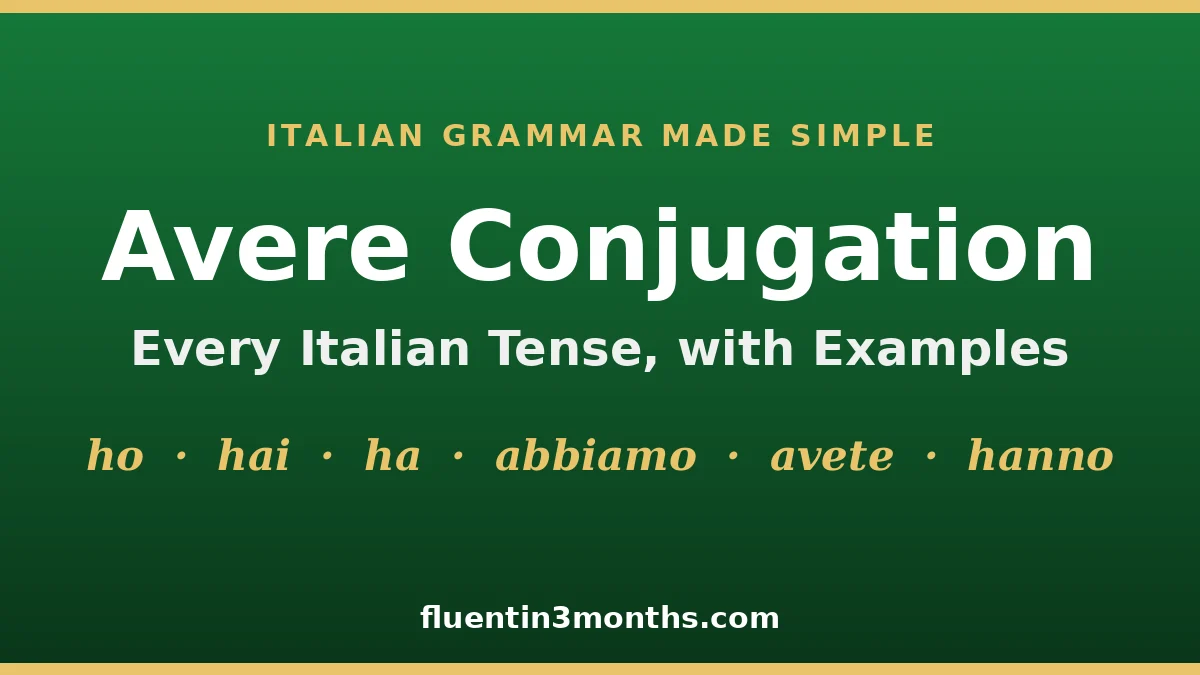
The verb avere traces its lineage directly to the Latin habēre, which carried meanings ranging from "to hold" to "to possess." Over centuries of phonetic evolution, the initial aspirated "h" sound prevalent in classical Latin vanished in the transition to the Romance languages. However, in Italian, the "h" was retained in specific present-tense forms—ho (I have), hai (you have), ha (he/she has), and hanno (they have)—as a vital orthographic marker.
Linguistic historians note that the retention of the silent "h" serves a purely functional purpose: distinguishing homophones. Without the "h," ho would be indistinguishable from the conjunction o (or); hai would be confused with the prepositional contraction ai (to the); ha would mirror the preposition a (to/at); and hanno would be identical to the noun anno (year). Data from pedagogical institutions suggest that orthographic errors involving the omission of the "h" are among the most frequent mistakes made by both primary students in Italy and foreign learners, underscoring the need for rigorous attention to spelling from the outset of study.
The Present Indicative: A Quantitative Foundation for Fluency
The present indicative (presente) of avere is the most frequently utilized paradigm in the Italian language. It serves as the primary tool for discussing age, family, and personal belongings. According to frequency dictionaries of the Italian language, avere consistently ranks within the top five most used verbs across all media, including literature, news, and spoken dialogue.
The conjugation follows an irregular pattern:
- Io ho (I have)
- Tu hai (You have, informal singular)
- Lui/Lei/Lei (He/She/You, formal singular) ha
- Noi abbiamo (We have)
- Voi avete (You have, plural)
- Loro hanno (They have)
Beyond literal possession, these forms are the building blocks for the passato prossimo, the most common past tense in spoken Italian. In this context, avere functions as an auxiliary verb, paired with a past participle (e.g., ho mangiato – I have eaten). Statistical analysis of Italian syntax indicates that approximately 70% of Italian verbs utilize avere as their auxiliary, while the remaining 30%—primarily reflexive and many intransitive verbs—utilize essere (to be).
Chronology of Tense Development: From Simple to Compound
The mastery of avere requires an understanding of its performance across different moods and tenses. The transition from simple tenses (one word) to compound tenses (two words) represents a significant hurdle in the learner’s timeline.
Simple Indicative Tenses
- Imperfetto (Imperfect): Used for habitual actions or descriptions in the past (avevo, avevi, aveva…).
- Passato Remoto (Remote Past): Historically significant for literature and southern Italian dialects (ebbi, avesti, ebbe…). While its usage has declined in northern conversational Italian, it remains a staple of narrative journalism and historical texts.
- Futuro Semplice (Simple Future): Characterized by the contracted stem avr- (avrò, avrai, avrà…).
Compound Tenses and the Role of the Past Participle
The compound tenses are formed using the conjugated auxiliary plus the past participle avuto.
- Passato Prossimo: Ho avuto (I had/have had).
- Trapassato Prossimo: Avevo avuto (I had had).
- Futuro Anteriore: Avrò avuto (I will have had).
A critical rule in Italian grammar involves the agreement of the past participle. While avere usually does not require the participle to change its ending to match the subject, it must agree in gender and number with a preceding third-person direct object pronoun (e.g., Le ho avute – I had them, feminine plural).
The Subjunctive and Conditional Moods: Expressing Subjectivity
In professional and formal Italian, the use of the congiuntivo (subjunctive) and condizionale (conditional) is a hallmark of linguistic sophistication. The subjunctive is employed in clauses expressing doubt, emotion, or necessity, often following "che" (that).
The Subjunctive Paradigm
- Presente Congiuntivo: abbia, abbia, abbia, abbiamo, abbiate, abbiano.
- Imperfetto Congiuntivo: avessi, avessi, avesse, avessimo, aveste, avessero.
Linguistic experts from the Accademia della Crusca, the leading authority on the Italian language, emphasize that the subjunctive is not "dying," as some critics suggest, but is evolving in its application. It remains essential for conveying nuance. For instance, "Credo che lui abbia ragione" (I believe he is right) uses the subjunctive to signal a subjective opinion rather than an objective fact.
The Conditional Mood
The conditional mood, particularly the condizionale presente (avrei, avresti…), is used for hypothetical scenarios or to soften requests (e.g., "Avrei una domanda" – I would have a question).
Semantic Divergence: Where Italian "Has" and English "Is"
One of the most significant challenges for English speakers is the category of idiomatic expressions where Italian employs avere to describe states of being that English describes with the verb "to be." This linguistic divergence is a frequent source of "interference" errors in language acquisition.
Key Idiomatic Expressions
- Avere fame/sete: To be hungry/thirsty (literally: "to have hunger/thirst").
- Avere caldo/freddo: To be hot/cold (referring to the person’s sensation).
- Avere … anni: To be … years old (literally: "to have … years").
- Avere ragione/torto: To be right/wrong.
- Avere paura: To be afraid.
- Avere sonno: To be sleepy.
Linguistic researchers suggest that these constructions reflect a different conceptualization of the self in Romance languages, where physical and mental states are viewed as attributes "possessed" by the individual rather than inherent states of "being."
Regional Variations and Contemporary Usage Trends
The application of avere is not uniform across the Italian peninsula. Regional dialects and the "Italiano popolare" (popular Italian) often influence how the verb is used in the past tense. In Northern Italy, there is a strong preference for the passato prossimo (ho avuto) even for events that occurred decades ago. Conversely, in regions such as Sicily and Calabria, the passato remoto (ebbi) is frequently used for recent events, reflecting the historical influence of local dialects on standard Italian.
Furthermore, in contemporary digital communication, the silent "h" is increasingly omitted in informal text messaging—a trend that has sparked debate among educators and purists. However, official stances from the Ministry of Education remain firm: the correct orthography of avere is a non-negotiable standard for literacy.
Pedagogical Implications and Best Practices
For educators and learners, the complexity of avere necessitates a structured approach. Language acquisition experts, including Benny Lewis of "Fluent in 3 Months," advocate for a "speak from day one" philosophy, which prioritizes the high-frequency present tense forms before moving to the intricacies of the subjunctive.
Recommended Learning Chronology:
- Phase 1: Present indicative and basic possession.
- Phase 2: Idiomatic "to be" expressions (hunger, age, etc.).
- Phase 3: Using avere as an auxiliary for the passato prossimo.
- Phase 4: Future and conditional stems.
- Phase 5: Subjunctive moods for formal and nuanced expression.
Data suggests that students who master the auxiliary role of avere early in their studies show a 40% faster progression in their ability to narrate past events compared to those who focus solely on vocabulary.
Conclusion: The Indispensable Nature of Avere
In conclusion, the verb avere is far more than a simple translation of "to have." It is a multi-faceted linguistic tool that serves as the engine for Italian syntax. From its Latin roots and the strategic use of the silent "h" to its role in the complex web of compound tenses and idiomatic expressions, avere is central to the Italian identity.
As global interest in Italian culture, opera, and gastronomy continues to grow, the demand for effective Italian language instruction remains high. Understanding the nuances of avere—its irregularities, its regional variations, and its semantic breadth—is the first and most critical step for any individual seeking to navigate the Italian-speaking world with accuracy and confidence. Whether used to declare one’s age, express a desire for food, or recount a historical event, avere remains the undisputed workhorse of the Italian language.
