

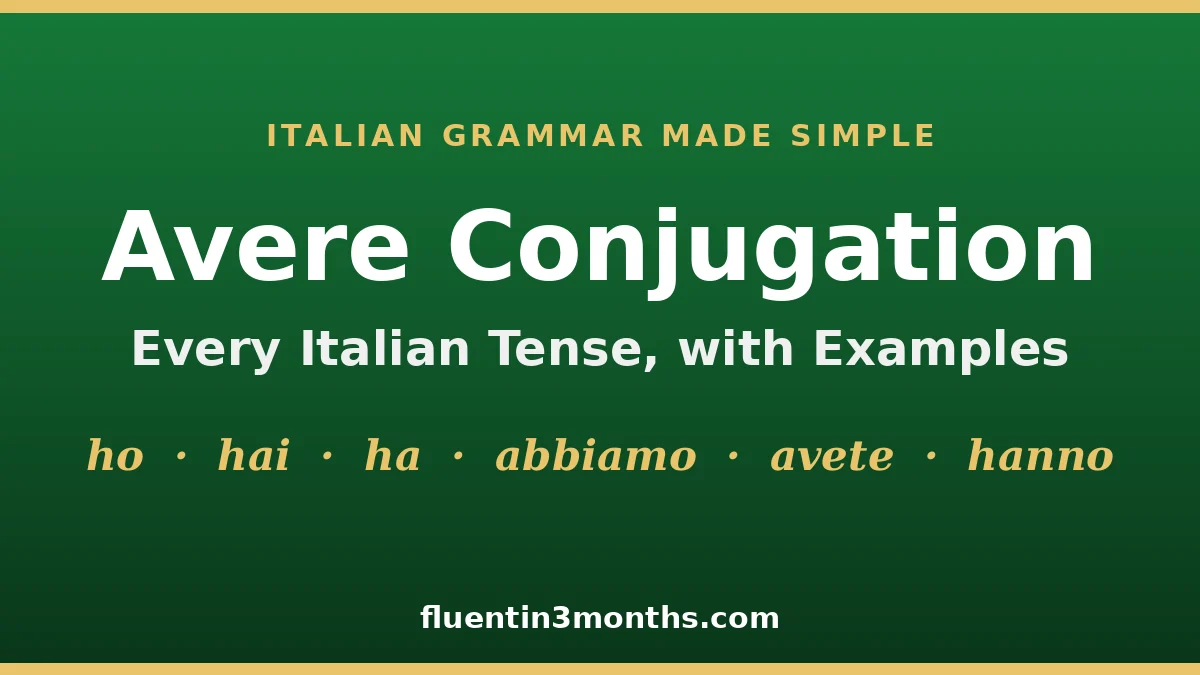
The Italian verb avere, translated primarily as to have, serves as a fundamental pillar of the Italian language, functioning both as a primary indicator of possession and a critical auxiliary for constructing complex tenses. Beyond its literal meaning, avere is essential for expressing physical states, age, and various idiomatic conditions that, in English, are typically conveyed using the verb to be. Understanding the nuances of this irregular verb is considered a mandatory milestone for any student of Romance languages, as it appears in nearly every facet of daily communication, from casual dialogue to formal literature.
The Historical and Linguistic Evolution of Avere
The etymological roots of avere trace back to the Latin verb habēre, which carried a broad range of meanings including to hold, to keep, or to possess. As Latin evolved into the various Romance languages, habēre underwent significant phonetic and morphological shifts. In the transition to Italian, the initial "h" sound was lost in pronunciation, though it was retained in specific written forms of the present tense to serve as an orthographic marker.
Linguistically, avere is classified as an irregular verb of the second conjugation (-ere). However, its irregularity is relatively contained compared to its counterpart essere (to be). The most notable irregularities occur in the present indicative and the future/conditional stems. The preservation of the silent "h" in forms like ho (I have) and hanno (they have) is a deliberate feature of Italian spelling, designed to distinguish these high-frequency verbs from common homophones.
The Mechanics of the Present Indicative: A Study in Orthography
The present indicative of avere is the first hurdle for learners, requiring a firm grasp of Italian spelling conventions. The four forms containing the letter "h"—ho, hai, ha, and hanno—are pronounced exactly as if the "h" were absent. Despite being silent, the "h" serves a vital functional purpose in written Italian: it acts as a visual differentiator.
- Ho (I have) is distinguished from o (or).
- Hai (you have, singular) is distinguished from ai (to the, masculine plural).
- Ha (he/she/it has) is distinguished from a (to/at).
- Hanno (they have) is distinguished from anno (year).
Failure to include the "h" in these instances results in a different word entirely, often leading to significant grammatical errors or semantic confusion. The remaining forms, abbiamo (we have) and avete (you plural have), do not require the "h" as they are not homophonous with other common particles.
Auxiliary Functions and the Passato Prossimo
Avere serves as the primary auxiliary verb for the majority of Italian verbs when forming compound tenses, most notably the passato prossimo (present perfect). This tense is used to describe completed actions in the past. When used as an auxiliary, avere is paired with the past participle of the main verb.
Statistically, transitive verbs—those that take a direct object—almost exclusively utilize avere as their auxiliary. For example, "Ho mangiato la mela" (I have eaten the apple). In these constructions, the past participle (mangiato) generally remains invariable, regardless of the gender or number of the subject. However, a significant rule in Italian grammar dictates that the past participle must agree in gender and number with a preceding third-person direct object pronoun (lo, la, li, le). For instance, "Le ho viste" (I saw them, feminine) demonstrates this agreement.
A Comparative Analysis: Avere vs. To Be
One of the most complex aspects of mastering avere for English speakers is its use in expressions where English employs the verb to be. This cross-linguistic divergence is a common source of error for beginners. In Italian, many internal physical sensations and states of being are "possessed" rather than "inhabited."
Common Idiomatic Expressions
- Avere fame: Literally "to have hunger" (To be hungry).
- Avere sete: Literally "to have thirst" (To be thirsty).
- Avere freddo/caldo: To feel cold or hot.
- Avere ragione/torto: To be right or wrong.
- Avere paura: To be afraid.
- Avere sonno: To be sleepy.
- Avere bisogno di: To need.
Furthermore, Italian uses avere to express age. While an English speaker says "I am twenty years old," an Italian speaker says "Ho vent’anni" (I have twenty years). This conceptual difference highlights the importance of learning avere not just as a translation of "to have," but as a tool for expressing existence and experience within the Italian cultural and linguistic framework.
Chronological Roadmap for Mastering Conjugations
The mastery of avere follows a logical progression in language acquisition. Experts suggest a tiered approach to learning its various moods and tenses to ensure long-term retention and accuracy.
Phase 1: The Foundations (Weeks 1-4)
The initial focus is placed on the Presente Indicativo and the Passato Prossimo. These allow the speaker to communicate immediate needs and describe recent events. During this phase, learners must memorize the past participle of avere, which is avuto.
Phase 2: Narrative and Future (Months 2-4)
Once the present is mastered, students move to the Imperfetto (avevo, avevi…), used for habitual past actions or descriptions, and the Futuro Semplice (avrò, avrai…). The future tense introduces the contracted stem "avr-", which is also utilized in the conditional mood.
Phase 3: Hypotheses and Formality (Months 6+)
The final stages of mastery involve the Condizionale (avrei, avresti…) for polite requests or hypothetical scenarios, and the Congiuntivo (subjunctive). The subjunctive is particularly challenging as it is used in dependent clauses to express doubt, emotion, or necessity. Forms like "abbia" (present subjunctive) and "avessi" (imperfect subjunctive) are hallmarks of advanced proficiency.
Regional Variations and Narrative Tenses
The use of avere in the Passato Remoto (ebbi, avesti, ebbe…) provides a fascinating glimpse into regional linguistic trends in Italy. While the passato remoto is technically the standard tense for distant past events in literature, its use in spoken language varies geographically.
In Northern Italy, the passato prossimo is frequently used even for distant events. Conversely, in Central and Southern Italy, the passato remoto remains a vibrant part of daily speech. A journalist or novelist will utilize the full range of avere’s past tenses to provide texture and temporal clarity to a story, whereas a casual speaker in Milan might rely almost entirely on the compound forms.
Statistical Data and Common Errors
Data from language learning platforms and linguistic studies indicate that errors involving avere are among the top ten most frequent mistakes made by non-native Italian speakers.
- Orthographic Omission: Forgetting the silent "h" in ho, hai, ha, and hanno.
- Auxiliary Confusion: Using essere instead of avere for transitive verbs (e.g., saying "sono mangiato" instead of "ho mangiato").
- Literal Translation: Using essere for age or hunger (e.g., "sono venti anni" instead of "ho venti anni").
- Subject-Verb Agreement: Mis-conjugating the "noi" and "voi" forms in complex tenses.
Linguists emphasize that because avere is an auxiliary, an error in its conjugation results in a "double error," as it invalidates the entire compound tense structure being attempted.
Broader Implications for Italian Fluency
The verb avere is more than a grammatical necessity; it is a gateway to the Italian mindset. Its versatility reflects the language’s preference for concrete expressions of state and possession. For the global community of Italian learners—estimated at over 2 million people worldwide—avere represents the bridge between basic survival Italian and true conversational fluency.
From a pedagogical perspective, the study of avere serves as a microcosm of Italian grammar as a whole. It introduces the concepts of irregularity, silent letters, auxiliary selection, and idiomatic divergence. Mastery of this single verb provides a template for understanding hundreds of other verbs that follow its auxiliary pattern.
In conclusion, avere remains the indispensable workhorse of the Italian language. Its historical evolution from Latin, its critical role in tense construction, and its presence in the most common idiomatic expressions make it the most vital verb for any student to master. By navigating the complexities of its silent letters and irregular stems, learners gain the tools necessary to express not only what they have, but who they are and how they experience the world in the Italian tongue. As the saying goes in language circles: "Abbi pazienza e comincia"—have patience and begin. The journey to fluency starts with a single, silent "h."
