


The dramatic conclusion to the BMW Championship this past Sunday, where Wyndham Clark, holding a commanding five-stroke lead at the start of the final round, navigated a nerve-wracking back nine to ultimately secure a three-shot victory, has not only captivated golf enthusiasts but also illuminated a fascinating aspect of human psychology: loss aversion. This phenomenon, deeply rooted in behavioral economics, plays a more significant role in high-stakes decision-making than often acknowledged, even among the world’s most seasoned and skilled professionals. The implications extend far beyond the greens of professional golf, offering valuable insights into how individuals across various fields approach opportunities and potential setbacks.
The BMW Championship: A Test of Nerve and Strategy
The BMW Championship, one of the premier events on the PGA Tour and a crucial leg of the FedEx Cup Playoffs, draws the season’s top performers. This year’s tournament, held at Olympia Fields Country Club in Illinois, presented a formidable challenge with its demanding course conditions and the immense pressure of advancing to the FedEx Cup Championship finale. Wyndham Clark, a rising star in professional golf, had positioned himself brilliantly entering Sunday’s final round. His five-stroke advantage provided a buffer, yet the inherent nature of professional golf, where fortunes can change rapidly, meant that the outcome was far from decided.
As the final round unfolded, the narrative took a compelling turn. Clark, who had demonstrated remarkable composure throughout the tournament, faced mounting pressure as his challengers began to close the gap. The psychological weight of maintaining such a significant lead, especially on the back nine where crucial putts can define a tournament, became palpable. While the initial lead suggested a comfortable victory, the reality of the sport’s inherent unpredictability and the psychological dynamics at play soon became evident. Clark’s ability to ultimately reclaim control of the narrative, punctuated by a spectacular three-birdie finish, underscores not only his skill but also his mental fortitude in the face of escalating pressure.
Unpacking the Psychology of the Putt: Loss Aversion in Golf
The drama witnessed on Sunday served as a potent reminder of groundbreaking research conducted by Devin Pope and Maurice Schweitzer. Their 2011 study, "Is Tiger Woods Loss Averse? Persistent Bias in the Face of Experience, Competition, and High Stakes," published in the prestigious American Economic Review, delved into the subtle yet significant ways psychological biases influence performance.
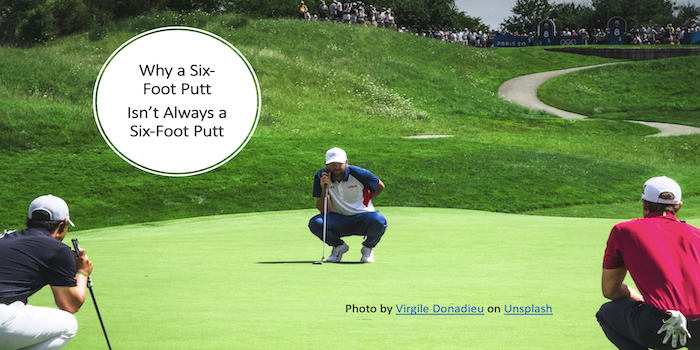
Utilizing the precise data captured by the PGA Tour’s ShotLink system, Pope and Schweitzer analyzed over 2.5 million putts taken by 421 golfers across a five-year period (2004-2009). Their findings were striking: professional golfers were demonstrably more likely to make a par putt than a comparable birdie putt. The difference, ranging from 2 to 4 percentage points, might seem minor in isolation, but when applied across millions of putts at the highest level of the sport, it reveals a consistent pattern of behavior. This means that a six-foot putt, objectively the same distance and requiring the same stroke, yielded a different success rate depending on what was at stake – a par or a birdie.
The Science Behind the Stumble: Understanding Loss Aversion
This phenomenon is attributed to "loss aversion," a core concept in behavioral economics pioneered by Daniel Kahneman and Amos Tversky. Loss aversion posits that the psychological impact of a loss is significantly greater than the pleasure derived from an equivalent gain. In simpler terms, humans are wired to dislike losing more than they enjoy winning.
In the context of golf, this translates to distinct psychological experiences when standing over a putt. A birdie putt represents an opportunity for gain – an extra stroke under par. While making it is desirable, missing it still leaves the golfer with par, which is not a negative outcome in itself. However, a par putt carries a different emotional weight. Missing a par putt results in a loss – a stroke over par. This perceived loss can trigger a more intense emotional response, leading to increased anxiety and, consequently, a higher probability of error. Even for elite athletes who have honed their skills through years of practice and competition, this ingrained psychological bias can subtly influence their performance under pressure.
The Evolving Dynamics of the Game: Tournament Progression and Shifting Focus
Interestingly, Pope and Schweitzer’s research also identified a temporal dimension to this bias. They observed that the discrepancy between par and birdie putting success decreased as tournaments progressed. In the first round, the difference was approximately 3.8 percentage points, shrinking to 2.1 percentage points by the final round. This reduction is not indicative of the bias disappearing entirely but rather of a shift in the golfers’ primary focus.
As a tournament advances, particularly into the final round, professional golfers tend to shift their psychological orientation from competing against the course’s par to competing against the scores of their fellow competitors. This change in perspective can mitigate the intense focus on avoiding a personal "loss" against par, as the primary concern becomes outpacing the field. When the stakes are highest and the competition is most direct, the relative positioning against other players becomes a more salient factor than the absolute score against par. This doesn’t negate loss aversion but suggests that the object of the potential loss can change, influencing decision-making.
Beyond the Fairway: Broader Implications of Loss Aversion
The implications of loss aversion, as highlighted by the golfing research, extend far beyond the realm of professional sports. This psychological principle is a fundamental driver of human behavior in countless everyday situations, particularly in commercial and personal decision-making.
Traditional notions of scarcity often revolve around external factors, such as a salesperson emphasizing limited stock ("Only two left!") or a deadline approaching ("Sale ends at midnight!"). These are clear examples of the scarcity principle, which is closely linked to loss aversion. However, the golfing research reveals a more nuanced form of scarcity: the potential loss of something one already possesses or has earned.
For example, in a sales context, a customer might be persuaded not by the prospect of gaining a new product, but by the fear of losing the opportunity to acquire it, or worse, losing the money they’ve already invested in the process if they don’t complete the transaction. In personal finance, individuals might hold onto underperforming investments longer than they should, not because they believe in their future growth, but because selling would mean realizing a loss. Similarly, in relationships, people might stay in unsatisfying situations to avoid the perceived loss of stability or companionship.
Ethical Influence and Conscious Decision-Making
The understanding of loss aversion offers a powerful tool for ethical influence. The goal, as emphasized by Brian Ahearn, Chief Influence Officer at Influence PEOPLE and a faculty member at the Cialdini Institute, is not to manipulate individuals by exploiting their fear of loss. Instead, it is about recognizing how people naturally make decisions and then communicating relevant information truthfully and transparently.
Ethical influence, rooted in the principles of renowned social psychologist Robert Cialdini, involves being aware of these psychological tendencies. When individuals understand that the possibility of loss can often weigh more heavily than an equivalent opportunity for gain, they can approach decisions with greater awareness. This self-awareness is crucial. The next time an important decision arises, it is beneficial to ask: "Am I pursuing this because I genuinely desire it, or am I reacting more strongly due to a fear of losing something?" The distinction can be profound and lead to more informed and ultimately more beneficial choices.
For golfers, the question becomes even more direct. Do they feel a heightened sense of pressure or a different mental state when standing over a crucial putt that could save par compared to one that could secure a birdie? Anecdotal evidence and the quantitative data from studies like Pope and Schweitzer’s suggest that the psychological landscape is indeed altered.
The Enduring Human Element
The performance of elite athletes like Wyndham Clark, despite their extraordinary training, dedication, and experience, serves as a poignant reminder of our shared humanity. Even when millions of dollars are on the line and the world is watching, the fundamental psychological drivers that shape human decision-making remain at play. The ability to win, as Clark demonstrated, often involves not just executing skills flawlessly but also mastering the internal psychological battles. His victory at the BMW Championship is a testament to his talent and his capacity to navigate the complex interplay of pressure, expectation, and the deeply ingrained human tendency to avoid loss, ultimately turning a potential psychological pitfall into a career-defining triumph. The insights gleaned from his performance and the research it evokes offer a valuable lens through which to understand decision-making in all aspects of life.
