

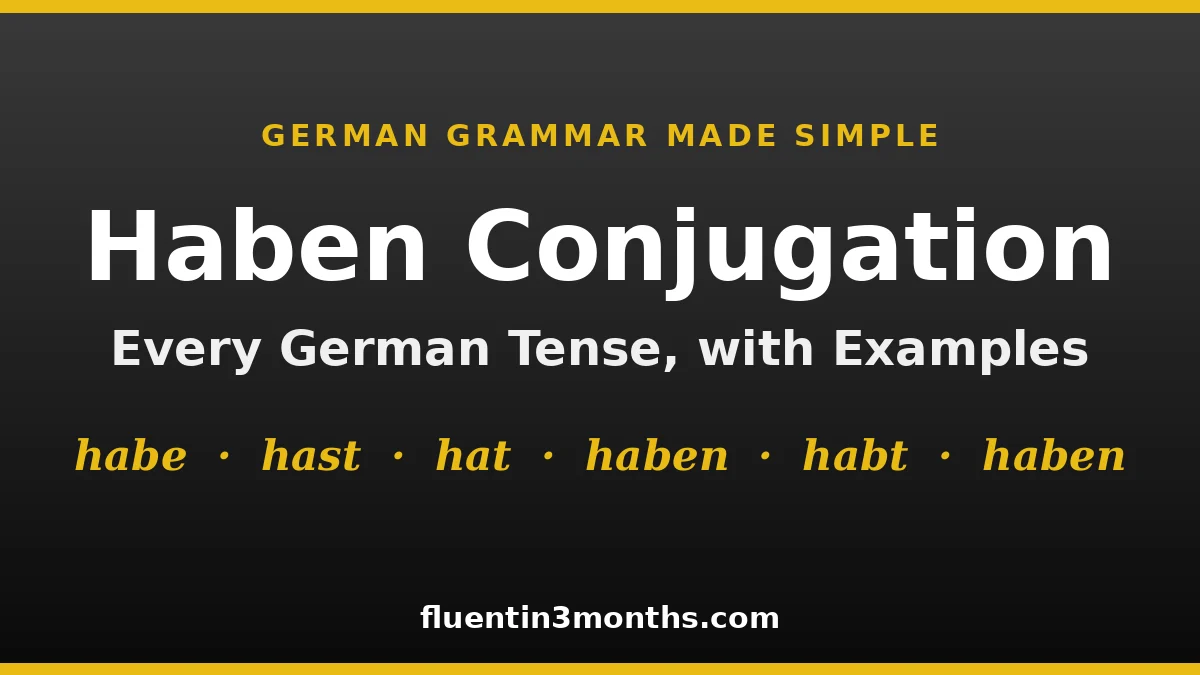
The verb haben serves as one of the most critical structural components of the German language, functioning both as a primary indicator of possession and as the dominant auxiliary verb for the formation of the past tense. In the hierarchy of Germanic linguistics, haben is categorized alongside sein (to be) and werden (to become) as a "Hilfsverb" or auxiliary verb, meaning it provides the necessary grammatical framework for nearly every complex sentence structure. For the approximately 130 million people who speak German as a native or second language, the correct application of haben is not merely a matter of vocabulary but a prerequisite for navigating the temporal dimensions of the language. Mastery of this verb allows a speaker to transition from basic present-tense observations to sophisticated narrations of the past, hypothetical scenarios, and formal requests.
The Linguistic Evolution and Irregularity of Haben
Linguists categorize haben as an irregular or "mixed" verb, a classification resulting from centuries of phonetic erosion and structural shifts within the Germanic language family. While regular German verbs follow a predictable pattern of stem-and-ending, haben exhibits unique contractions that often confuse novice learners. The most notable irregularity occurs in the present tense (Präsens), specifically within the second-person singular (du) and third-person singular (er/sie/es) forms. In these instances, the "b" from the infinitive stem "hab-" is dropped, resulting in "hast" and "hat" rather than the logically expected "habst" or "habt."
Historical linguistics suggests that this contraction is a byproduct of high-frequency usage. In many Indo-European languages, the most commonly used verbs undergo the greatest degree of simplification over time to facilitate faster communication. This phenomenon is mirrored in the English cognate "have," where the third-person singular is "has" rather than "haves." Furthermore, in the simple past (Präteritum), haben transitions its stem to "hatt-," adopting a dental suffix (-te) common to weak verbs but maintaining a stem change characteristic of strong verbs. This hybrid nature makes it a "mixed verb," a group that also includes essential terms such as wissen (to know) and bringen (to bring).
Present Tense Conjugation and Initial Acquisition
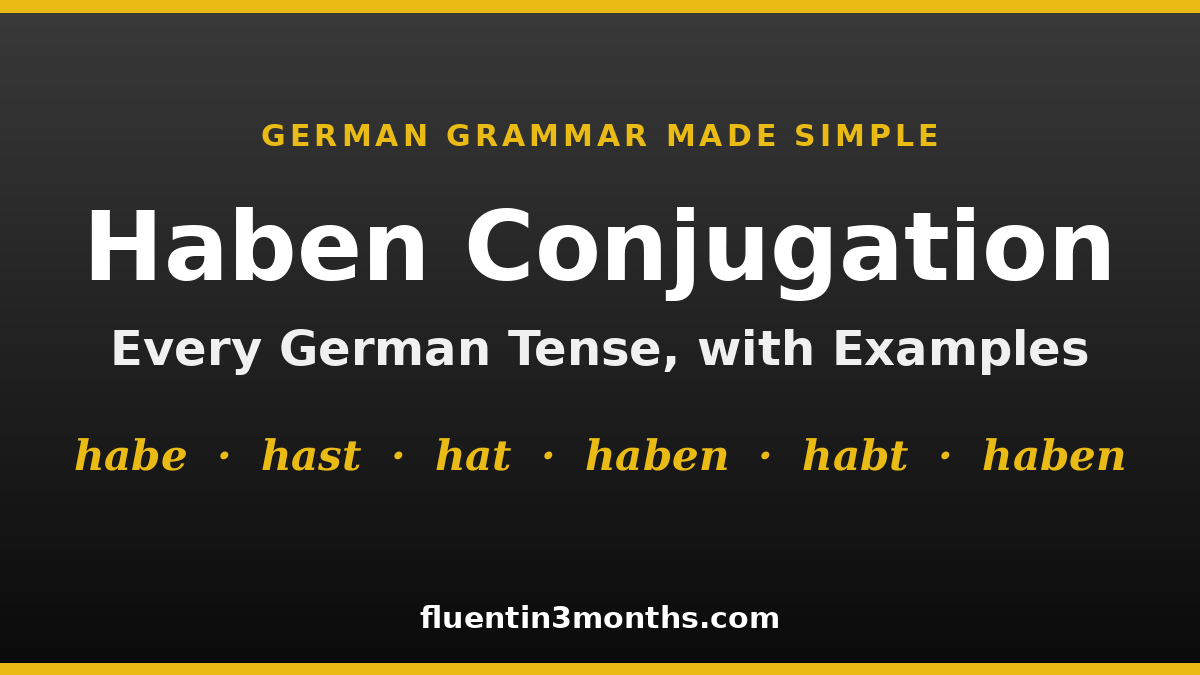
For the student of German, the present tense of haben represents the first major hurdle in verb conjugation. Because it is used in approximately 80% of past-tense constructions, any error at this stage cascades through more advanced grammatical structures. The standard conjugation for the present tense is as follows:
- ich habe (I have)
- du hast (you have – informal)
- er/sie/es hat (he/she/it has)
- wir haben (we have)
- ihr habt (you all have – informal)
- sie/Sie haben (they have / you have – formal)
Data from language acquisition centers indicates that the omission of the "b" in "hast" and "hat" is one of the most frequent errors among A1-level learners. Correcting this habit early is essential for achieving a native-like cadence. Beyond literal possession, these six forms facilitate the majority of daily German idioms and the entirety of the Perfekt tense when combined with a past participle.
The Temporal Gateway: Haben as an Auxiliary Verb
The primary functional significance of haben lies in its role as the auxiliary for the Perfekt (Present Perfect) tense. Unlike English, which utilizes various past tenses in spoken conversation, German relies almost exclusively on the Perfekt for everyday speech. To construct this, a conjugated form of haben is paired with the Partizip II (past participle) of another verb, which is typically placed at the end of the sentence.
For example, to say "I have eaten," one uses "Ich habe gegessen." In this construction, "habe" provides the person and tense, while "gegessen" provides the action. Statistical analysis of German prose and speech indicates that haben serves as the auxiliary for the vast majority of verbs. The only exceptions are verbs of motion (such as gehen/to go) or verbs indicating a change of state (such as aufwachen/to wake up), which utilize sein as their auxiliary.
Chronology of Past and Future Tenses
To provide a full narrative of events, speakers must utilize the simple past (Präteritum) and the past perfect (Plusquamperfekt). While most verbs in German use the Perfekt in speech, haben and sein are notable exceptions; native speakers prefer the Präteritum forms even in casual conversation due to their brevity.
The Simple Past (Präteritum)
- ich hatte (I had)
- du hattest (you had)
- er/sie/es hatte (he/she/it had)
- wir hatten (we had)
- ihr hattet (you all had)
- sie/Sie hatten (they/you formal had)
Compound Tenses
The compound tenses illustrate the mathematical nature of German grammar. The Plusquamperfekt is used to describe an action that occurred before another past action, while the Futur I and Futur II tenses project actions into the future.
- Perfekt: habe gehabt (have had)
- Plusquamperfekt: hatte gehabt (had had)
- Futur I: werde haben (will have)
- Futur II: werde gehabt haben (will have had)
The use of "habe gehabt" is technically correct but is frequently replaced by "hatte" in both spoken and written registers to avoid redundancy, highlighting a rare instance where German prioritizes efficiency over strict tense adherence.
The Konjunktiv: Hypotheticals and Social Etiquette
The Konjunktiv II (Subjunctive II) is a critical mood in German used for expressing wishes, hypotheticals, and polite requests. For the verb haben, the Konjunktiv II form is "hätte." This form is indispensable in the German service industry and social interactions.
The phrase "Ich hätte gern…" (I would like…) is the standard polite formula for ordering food, purchasing goods, or requesting assistance. Linguists note that using the indicative "Ich will" (I want) is often perceived as blunt or aggressive in German culture. By utilizing the subjunctive "hätte," the speaker softens the request, making it a staple of diplomatic and social communication.
The Konjunktiv I, by contrast, is primarily found in journalism and legal documents to report speech without vouching for its veracity. For example, a news report might state "Er habe kein Geld" (He [allegedly] has no money) to distance the publication from the statement’s truth.
Idiomatic Deviations and Cross-Linguistic Comparisons
One of the most significant challenges for English, French, and Spanish speakers learning German is the idiomatic use of haben. In many instances where English uses "to be" (am/is/are), German requires haben.
- Physical States: In German, one "has" hunger (Ich habe Hunger) and "has" thirst (Ich habe Durst), whereas in English, one "is" hungry or thirsty.
- Mental States: Fear is possessed rather than being a state of being (Ich habe Angst).
- Correctness: To be right or wrong is expressed as having rightness or having wrongness (Du hast recht).
However, a critical point of divergence occurs with age. While Romance languages like French (avoir 25 ans) and Spanish (tener 25 años) use "to have" for age, German aligns with English in using sein (to be). A common error for learners coming from Spanish or French is saying "Ich habe 20 Jahre," which is grammatically incorrect in German; the correct form is "Ich bin 20 Jahre alt."
Analysis of Pedagogical Implications
The mastery of haben is often cited by educators as a "tipping point" in German language proficiency. Once a student internalizes the conjugation and the auxiliary function of haben, their ability to generate complex sentences increases exponentially. This is because haben acts as the engine for the "Perfekt" tense, which is the primary vehicle for communication in the German-speaking world.
According to data from language proficiency exams (such as the Goethe-Zertifikat), students who master the nuances of haben—particularly the distinction between "hätte" for politeness and "hatte" for narration—score significantly higher in the "Sprachbausteine" (language components) and oral expression sections. The verb is not just a vocabulary item; it is a structural necessity that defines the speaker’s level of sophistication.
Summary of Impact and Broader Implications
The verb haben is more than a translation of "to have." It is a multifaceted tool that governs the past, shapes the future, and facilitates social harmony through polite discourse. Its irregularities—the dropped "b" in the present and the stem change in the past—are markers of its ancient roots and its status as a high-frequency pillar of the language.
For the international community, understanding the mechanics of haben is essential for effective communication with German-speaking partners in business, science, and diplomacy. As the German economy remains a central force in the European Union, the precision afforded by correct verb usage ensures clarity in contracts, reports, and negotiations. Ultimately, whether used to express a simple need, narrate a complex history, or make a polite request in a Berlin café, haben remains the indispensable heartbeat of German syntax. Aspiring speakers are encouraged to move beyond memorization and toward an integrated understanding of how this single verb opens the door to the entirety of the German linguistic landscape. Through consistent practice and an appreciation for its irregular history, learners can achieve the fluency required to navigate the German-speaking world with confidence. Hab keine Angst—have no fear—the path to mastery begins with these fundamental tables and the willingness to speak from day one.
