

The Spanish verb poder represents one of the most significant linguistic hurdles for students of the Romance languages, serving as the primary modal vehicle for expressing ability, possibility, and permission. As a foundational element of Spanish syntax, poder—translated generally as "to be able to" or "can"—functions as a high-frequency tool that appears in nearly every facet of daily communication. However, its utility is matched by its morphological complexity, characterized by a dual-layered irregularity that includes a stem-changing present tense and a "strong" preterite form. For educators and linguists, the mastery of poder is often cited as a turning point in a student’s journey toward intermediate proficiency, marking the transition from simple declarative statements to nuanced expressions of intent and capacity.
The Linguistic Framework of Poder
In the hierarchy of Spanish verbs, poder occupies a unique space as a modal verb, meaning it is almost always followed by an infinitive to complete its meaning. Linguistically, it operates as a gatekeeper of action. Without a firm grasp of its various forms, a speaker is unable to navigate basic social interactions, such as requesting assistance, discussing potential outcomes, or describing past successes.
Data from the Corpus de Referencia del Español Actual (CREA) indicates that poder consistently ranks within the top 20 most frequently used verbs in the Spanish language. This high frequency is attributed to its versatility. Unlike English, which utilizes several different modal verbs—can, could, may, might—to distinguish between permission and physical ability, Spanish relies heavily on the conjugation and context of poder to convey these distinct meanings.
Chronology of Acquisition: The Path to Mastery
The pedagogical approach to teaching poder typically follows a structured timeline designed to manage its irregularities. This progression ensures that students internalize the most common forms before tackling the more archaic or complex moods.
Phase I: The Present Tense and the Stem-Change Phenomenon
The first encounter with poder occurs at the novice level (A1 in the Common European Framework of Reference for Languages). Here, students must grapple with the $o to ue$ stem change. Poder is classified as a "boot verb" or "shoe verb," a mnemonic used by educators to describe verbs where the stem changes in all forms except for nosotros (we) and vosotros (you all, informal Spain).
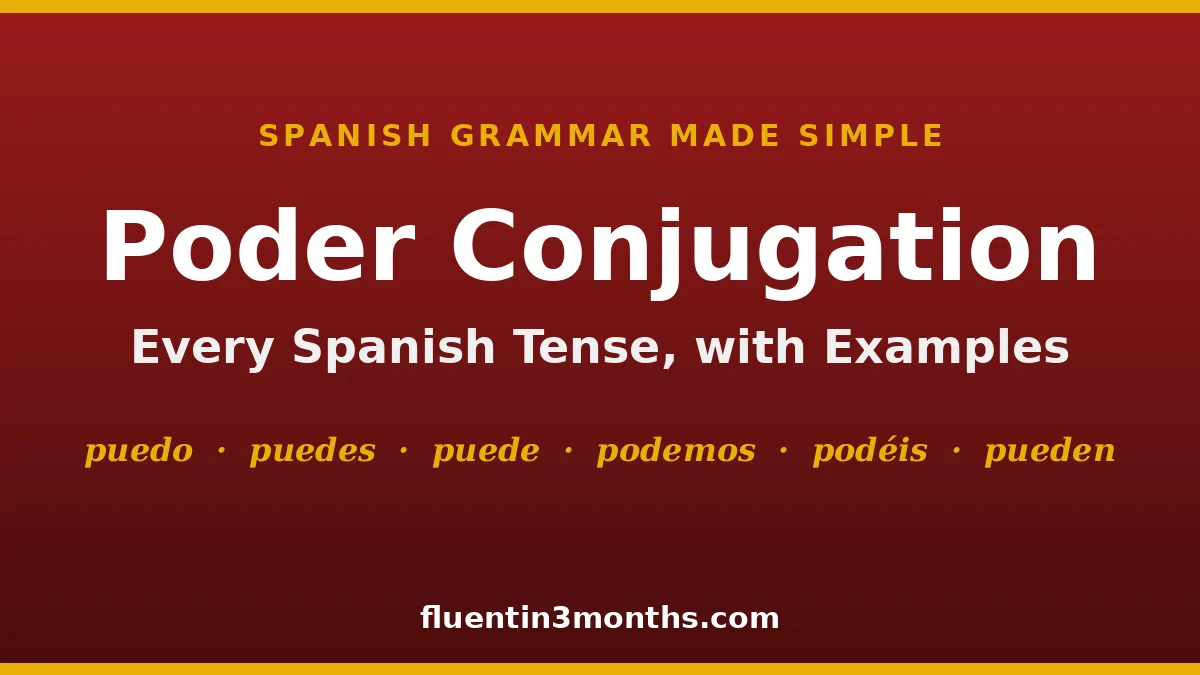
In the present indicative, the stress falls on the stem in the singular forms and the third-person plural, causing the "o" to fracture into the diphthong "ue." This results in puedo (I can), puedes (you can), puede (he/she/it can), and pueden (they can). Conversely, in the nosotros and vosotros forms (podemos and podéis), the stress shifts to the ending, preserving the original "o" stem.
Phase II: The Conditional and Polite Discourse
Once the present tense is stabilized, curriculum standards move toward the conditional mood. The form podría is essential for the "Language of Politeness." Linguists note that while ¿Puedes ayudarme? (Can you help me?) is grammatically correct, the conditional ¿Podrías ayudarme? (Could you help me?) is the preferred standard for formal and respectful interaction. This stage marks the student’s entry into pragmatic competence, where language is used not just for meaning, but for social navigation.
Phase III: The Preterite and the "Strong" Stem
The most significant hurdle arrives at the intermediate level (A2/B1) with the introduction of the preterite tense. Poder belongs to a closed group of irregular verbs known as "strong preterites." These verbs undergo a radical stem change—in this case, from pod- to pud-—and adopt a unique set of endings that lack the standard accent marks found in regular verbs.
The resulting forms (pude, pudiste, pudo, pudimos, pudisteis, pudieron) are notorious for causing spelling errors among learners who attempt to apply regular conjugation rules. This phase is critical because, in the preterite, the meaning of poder shifts slightly to imply "managed to" or "succeeded in," whereas the negative no pude implies a failed attempt.
Comparative Analysis: The Poder vs. Saber Conflict
A recurring challenge for English-speaking learners is the distinction between poder and saber, both of which can be translated as "can." Statistical analysis of learner errors shows that this is one of the most persistent interference mistakes.
Situational Ability (Poder)
Poder is used for circumstantial or physical ability. If a person says No puedo nadar, it implies that while they might know the skill of swimming, they are currently unable to do so—perhaps because the pool is closed, they are injured, or they lack a swimsuit.
Inherent Skill (Saber)
Saber is reserved for learned skills or "knowing how." To say Sé nadar means "I know how to swim." Using puedo in this context would sound unnatural to a native speaker, as it suggests the speaker is seeking permission or discussing a temporary window of opportunity rather than a permanent capability.
Experts in second-language acquisition suggest a "one-line rule" for students: use saber for things you learned (languages, instruments, sports) and poder for things that depend on the moment (time, health, money, permission).
Morphological Data and Conjugation Tables
To provide a factual overview of the verb’s structure, the following data illustrates the indicative simple tenses, which form the backbone of Spanish communication.
| Pronoun | Present | Preterite | Imperfect | Future | Conditional |
|---|---|---|---|---|---|
| Yo | puedo | pude | podía | podré | podría |
| Tú | puedes | pudiste | podías | podrás | podrías |
| Él/Ella/Usted | puede | pudo | podía | podrá | podría |
| Nosotros/as | podemos | pudimos | podíamos | podremos | podríamos |
| Vosotros/as | podéis | pudisteis | podíais | podréis | podríais |
| Ellos/Ellas/Ustedes | pueden | pudieron | podían | podrán | podrían |
Supporting this data is the "Strong Preterite" rule, which dictates that the yo and él/ella/usted forms do not take an accent on the final vowel, a common point of confusion for those accustomed to regular verbs like comí or habló.
The Subjunctive Mood: Navigating Doubt and Emotion
As students progress to advanced levels (B2/C1), they must master poder in the subjunctive mood. This mood is triggered by expressions of doubt, desire, or emotion. The present subjunctive follows the same $o to ue$ stem change as the indicative (pueda, puedas, pueda, podamos, podáis, puedan).
The imperfect subjunctive, however, derives from the irregular preterite stem pud-. This yields two sets of interchangeable endings: the -ra forms (pudiera) and the -se forms (pudiese). While both are grammatically valid, data from the Real Academia Española (RAE) indicates a higher frequency of the -ra ending in spoken Latin American Spanish, whereas the -se ending maintains a presence in literary and formal Iberian Spanish.
Institutional Perspectives and Educational Impact
Leading linguistic institutions, including the Instituto Cervantes, emphasize that modal verbs like poder are essential for achieving "functional fluency." In a statement regarding curriculum development, educational consultants noted that the inability to conjugate poder correctly often serves as a "glass ceiling" for learners.
"The verb poder is not merely a vocabulary item; it is a structural pillar," says Dr. Elena Rodriguez, a specialist in Hispanic Linguistics. "When a student masters the shift from podía (general past ability) to pude (specific past success), they are no longer just translating English thoughts into Spanish; they are beginning to think within the logic of the Spanish aspectual system."
Furthermore, the compound tenses—formed using the auxiliary verb haber and the past participle podido—allow for complex temporal expressions. Phrases like he podido (I have been able to) or habría podido (I would have been able to) are vital for the "Conditional Perfect," a tense used frequently in legal and academic Spanish to discuss hypothetical past actions.
Implications for Global Communication
The broader impact of mastering poder extends beyond the classroom. In a globalized economy where Spanish is the second most spoken language by native speakers, the nuance provided by this verb is crucial for international business and diplomacy. The distinction between "we cannot do this" (no podemos) and "we might not be able to" (puede que no podamos) can be the difference between a successful negotiation and a diplomatic misunderstanding.
Moreover, the virtual absence of poder in the imperative mood (commands) highlights a fascinating cultural and linguistic reality. Because one cannot logically command someone to "be able" to do something, the imperative forms (puede, pueda) are almost never used in speech. Instead, Spanish speakers utilize the present indicative or subjunctive to grant permission, reflecting a linguistic structure that prioritizes situational reality over forceful command.
Conclusion: The Tool of Possibility
In summary, the verb poder is much more than an irregular entry in a textbook. It is a multifaceted tool that requires a deep understanding of phonetics, syntax, and pragmatics. From the $o to ue$ shift in the present tense to the "strong" stems of the preterite and the nuanced requirements of the subjunctive, poder challenges the learner at every stage of their development. By navigating these complexities, students gain the ability to express not just what is happening, but what is possible, what is permitted, and what they are truly capable of achieving in the Spanish-speaking world. Mastery of this verb is, quite literally, the power to communicate.
