

The Italian verb avere serves as one of the two fundamental pillars of the Italian language, functioning both as a principal verb signifying possession and as a critical auxiliary for the formation of compound tenses. For linguists and students alike, mastering avere is not merely an exercise in memorization but a necessary step toward achieving functional literacy in Italian. This verb, derived from the Latin habēre, carries a heavy functional load in daily communication, appearing in a vast array of idiomatic expressions where English speakers would typically employ the verb "to be." Understanding its irregular conjugation patterns, its orthographic peculiarities—such as the silent "h"—and its syntactic role in auxiliary structures is essential for navigating the complexities of Romance linguistics.
The Historical Evolution and Chronology of Avere
The trajectory of the verb avere is a testament to the transition from Classical Latin to the modern Italian vernacular. In Latin, habēre was a second-conjugation verb that expressed a broad range of meanings including holding, possessing, or considering. As Vulgar Latin evolved into the various dialects of the Italian peninsula, the phonetic structure of the verb underwent significant attrition.
By the 13th century, during the emergence of the Tuscan dialect as the literary standard, the initial "h" sound had largely disappeared from spoken Italian. However, the written "h" was retained in specific present-tense forms—ho, hai, ha, and hanno—to serve a diacritic function. This orthographic choice was formalized by early Italian grammarians to distinguish these high-frequency verb forms from their homophones: o (or), ai (to the), a (to/at), and anno (year).
In the 14th century, the works of Dante Alighieri, Petrarch, and Boccaccio solidified the use of avere as the primary auxiliary for transitive verbs. This period marked a definitive shift in the chronology of the language, where the synthetic past tenses of Latin were increasingly supplemented or replaced by compound forms using avere and the past participle. Today, the Accademia della Crusca, the leading authority on the Italian language, continues to monitor the evolution of the verb, particularly regarding its usage in regional dialects and its interaction with modern loanwords.
Statistical Prevalence and Pedagogical Data
Quantitative analysis of the Italian language consistently places avere among the most frequently utilized words in the lexicon. According to the Vocabolario di base della lingua italiana, a statistical compilation of essential vocabulary, avere ranks within the top ten most common verbs. In a standard corpus of spoken Italian, avere and essere (to be) together account for a significant percentage of all verbal occurrences due to their dual roles as lexical verbs and auxiliaries.
From a pedagogical perspective, data from language acquisition studies suggest that English-speaking learners often face a "conceptual interference" when learning avere. This occurs because Italian uses avere for physiological and psychological states—such as hunger (fame), thirst (sete), and age (età)—which English expresses through "to be." Statistics from standardized Italian proficiency exams (such as the CILS or CELI) indicate that errors involving the misuse of essere instead of avere in these idiomatic contexts are among the most common mistakes for Level A1 and A2 learners.
The Mechanics of Present Tense Conjugation
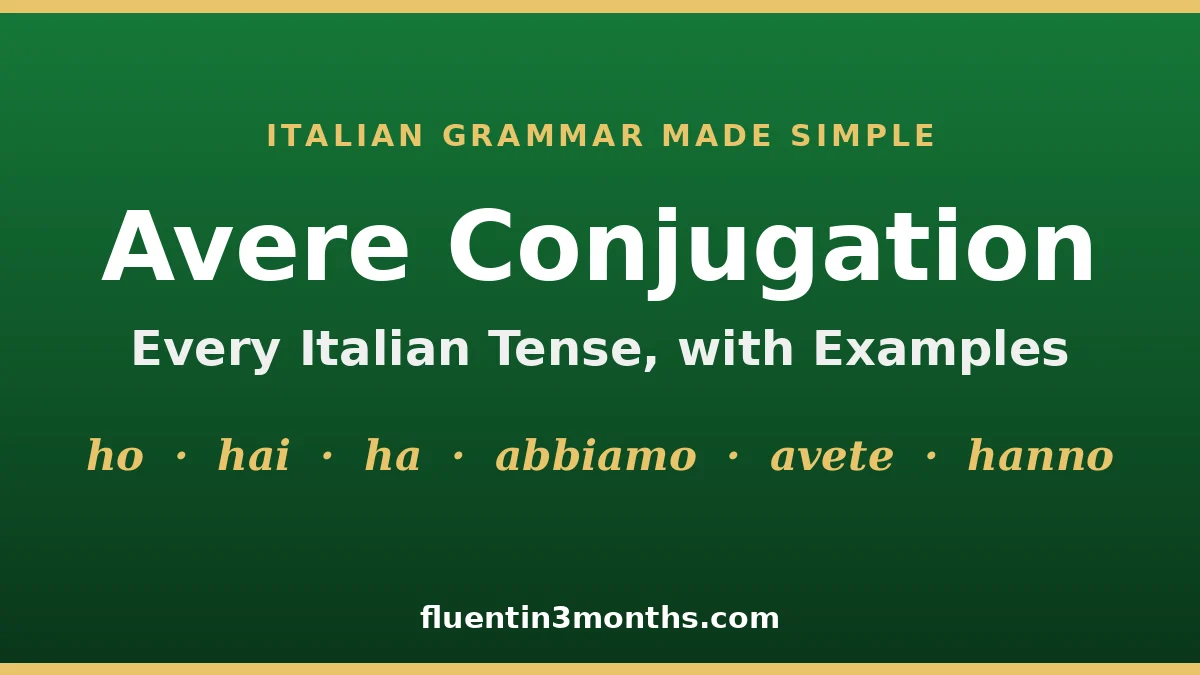
The present indicative (presente) of avere is the first hurdle for any student. Its irregularity is a direct result of its high frequency and historical phonetic shifts. The forms are as follows:
- Io ho: I have
- Tu hai: You have (informal singular)
- Lui/Lei/Lei: He/She/You (formal singular) has
- Noi abbiamo: We have
- Voi avete: You have (plural)
- Loro hanno: They have
The silent "h" is the most critical orthographic feature. Failure to include the "h" in writing results in a different word entirely, which can lead to significant confusion in formal correspondence. While the "h" provides no phonetic value in modern standard Italian, it remains a non-negotiable requirement of standard spelling.
Auxiliary Functions and Compound Tense Syntax
Beyond its meaning of "to have," avere is the engine behind the passato prossimo (present perfect), trapassato prossimo (past perfect), and other compound tenses. It is the default auxiliary for all transitive verbs—verbs that take a direct object. For example, in the sentence "Ho mangiato la mela" (I have eaten the apple), "ho" serves as the auxiliary to the past participle "mangiato."
However, the choice of auxiliary is a nuanced area of Italian grammar. While transitive verbs almost universally take avere, intransitive verbs (verbs that do not take a direct object) are split. Many verbs of motion, change of state, or reflexive verbs require essere. A brief analysis of syntactic implications reveals that when avere is used as an auxiliary, the past participle generally remains in its default masculine singular form (-o). The exception occurs when a third-person direct object pronoun precedes the verb, in which case the participle must agree in gender and number with the object (e.g., "Le ho viste," meaning "I saw them," where "them" is feminine).
Navigating the Indicative and Conditional Moods
The verb’s irregularity extends into the future and conditional tenses, where the stem undergoes a characteristic contraction. Instead of the expected "avererò," the stem contracts to "avr-":
- Futuro Semplice (Future): avrò, avrai, avrà, avremo, avrete, avranno.
- Condizionale Presente (Conditional): avrei, avresti, avrebbe, avremmo, avreste, avrebbero.
The passato remoto (remote past) remains a vital part of the Italian literary tradition and regional speech, particularly in Southern Italy. Forms such as ebbi (I had) and ebbe (he/she had) are irregular and must be learned as distinct units. While northern speakers may favor the passato prossimo in casual conversation, the passato remoto is indispensable for reading Italian history, law, and classic literature.
The Subjunctive and Imperative: Expressing Subjectivity and Command
The congiuntivo (subjunctive) is used to express doubt, emotion, necessity, or subjective thoughts. Because avere is an auxiliary, the subjunctive forms of avere are frequently used to build the past subjunctive of other verbs.
- Presente Congiuntivo: abbia, abbia, abbia, abbiamo, abbiate, abbiano.
- Imperfetto Congiuntivo: avessi, avessi, avesse, avessimo, aveste, avessero.
A common reaction among learners is frustration over the identical forms for the first, second, and third-person singular in the present subjunctive (abbia). Linguists note that this ambiguity is typically resolved through context or the explicit use of subject pronouns (io, tu, lui/lei).
The imperative mood, used for commands and exhortations, also utilizes irregular forms for avere. The informal singular "abbi" (have!) is often found in fixed phrases like "Abbi pazienza!" (Have patience!). In formal settings, the subjunctive-derived "abbia" is used to maintain a polite tone.
Idiomatic Discrepancies: The "Avere" vs. "To Be" Divide
One of the most profound implications of mastering avere is the shift in cognitive mapping required to express physical sensations. In Italian, these are viewed as things one "possesses" rather than states one "is."
- Avere fame/sete: To be hungry/thirsty (Literally: To have hunger/thirst)
- Avere caldo/freddo: To be hot/cold (Literally: To have heat/cold)
- Avere paura: To be afraid (Literally: To have fear)
- Avere ragione/torto: To be right/wrong (Literally: To have reason/wrong)
- Avere sonno: To be sleepy (Literally: To have sleepiness)
This distinction is not merely grammatical but cultural. It reflects a linguistic heritage that categorizes internal experiences as external acquisitions or conditions held by the individual.
Expert Analysis and Broader Implications
Linguistic experts, including those from the Modern Language Association (MLA), emphasize that the mastery of auxiliary verbs like avere is the "tipping point" for language fluency. Once a learner can instinctively conjugate avere, they unlock the ability to speak in the past, future, and hypothetical moods across thousands of other verbs.
The broader impact of this verb’s study extends to the understanding of other Romance languages. A student who understands the auxiliary role of avere in Italian will find immediate parallels in French (avoir), Spanish (haber), and Portuguese (haver). However, the Italian system is uniquely rigorous in its rules regarding auxiliary selection, making it a critical case study for comparative linguistics.
In conclusion, the verb avere is much more than a simple translation of "to have." It is a multi-faceted tool that serves as the connective tissue of Italian syntax. From its Latin origins and its strategic use of the silent "h" to its role in expressing the very essence of human sensation, avere remains the most essential "workhorse" of the Italian language. For any individual seeking to communicate effectively within the Italian-speaking world, a deep and technical understanding of this verb is not optional—it is the foundation upon which all further linguistic skill is built.
